Date: October 14, 2026
Place: Cologne, Germany
World News: Artificial Intelligence, Robotics and Technology
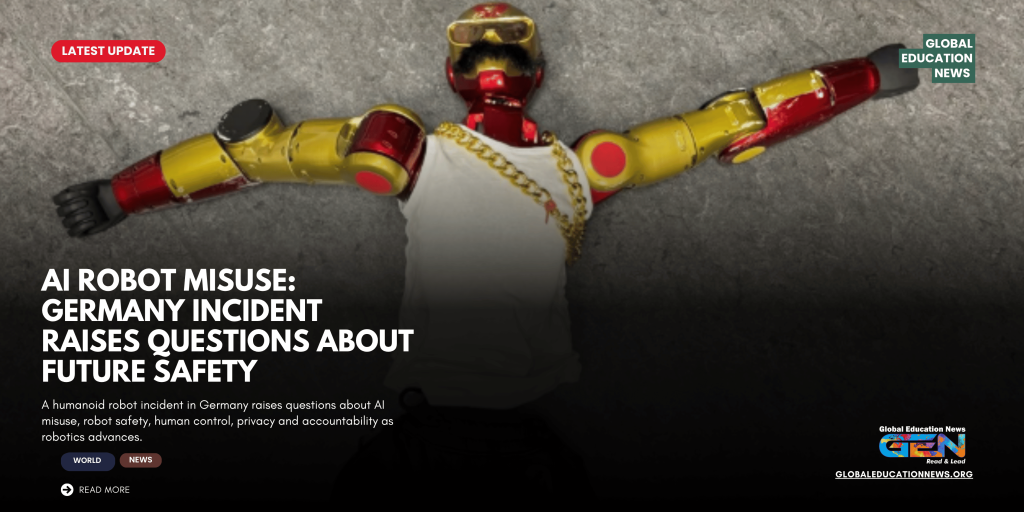
Artificial intelligence (AI) and humanoid robots are moving beyond research laboratories into workplaces, homes and public spaces. While these technologies promise to transform healthcare, education, manufacturing and everyday life, concerns about their misuse are also growing. A recent incident in Cologne, Germany, has brought this debate into focus after police seized a humanoid robot following an alleged harassment incident involving a 16-year-old girl.
German police are investigating whether the robot’s movements were preprogrammed or controlled remotely. Two young men have been identified as suspects, but reports available on October 14 say they had not been charged at the time of publication.
The incident raises a broader question for the future of AI: What happens when powerful technology is placed in human hands without adequate safeguards?
Although the investigation has not established all the circumstances, the case highlights the importance of responsible robot use, public safety, human accountability and stronger safeguards as humanoid machines become more common.
What Happened in Germany? Humanoid Robot Incident Raises Safety Concerns
According to police information reported on October 13, the incident occurred overnight on October 10–11 near a fast-food restaurant in Cologne. A humanoid robot allegedly made unwanted physical contact with a teenage girl.
Police seized the robot and mobile phones connected to the investigation. Authorities are examining whether the robot’s movements were programmed in advance or directed by a human operator.
The incident is unusual because it involves a physical machine in an alleged harassment case. It also raises questions about how robots are operated in public, whether their actions can be monitored and who should be held responsible when technology is misused.
The investigation remains ongoing. The available information does not establish that the robot independently made decisions or that artificial intelligence itself caused the alleged incident.
How Can AI Robots Be Used in Everyday Life?
Humanoid robots are designed to perform tasks that may require movement, interaction with people or the use of tools. Depending on their design, they may operate through remote control, programmed instructions, AI-assisted decision-making or a combination of these approaches.
Their potential applications include:
- Healthcare: Supporting staff with logistics, routine tasks and assistance in care settings.
- Education: Helping demonstrate scientific concepts, support practical learning and introduce students to robotics.
- Manufacturing: Handling repetitive tasks, moving materials and working in structured industrial environments.
- Homes and public services: Assisting with selected household tasks, information services and other routine activities.
- Emergency response: Helping trained teams inspect certain hazardous environments where sending people first may be unsafe.
These applications could improve productivity, support workers and make some services more accessible. However, their benefits depend on how reliably the machines operate, how people supervise them and whether appropriate safety measures are in place.
What Is the Difference Between an AI Robot, a Programmed Robot and a Remote-Controlled Robot?
Not every humanoid robot uses AI in the same way. Understanding these differences is essential when investigating an incident involving a machine.
| Type of robot | How it operates | Key consideration |
|---|---|---|
| Programmed robot | Follows instructions or predefined sequences | The instructions and operating conditions matter |
| Remote-controlled robot | Responds to commands from a human operator | Operator conduct and control systems matter |
| AI-assisted robot | Uses AI to interpret information or support decisions | Testing, monitoring and limits on its actions matter |
| Hybrid robot | Combines programmed tasks, AI functions and human control | Investigators may need to examine several systems |
A robot may also use different control methods at different times. Therefore, identifying a machine as an “AI robot” does not, by itself, explain why it behaved in a particular way.
In the Cologne case, investigators are examining whether the movements were preprogrammed or controlled in real time. The results will be important in determining what role the machine and its human operators played.
Can AI Robots Be Misused in the Future?
As robots become more capable and accessible, misuse could take different forms. Some risks arise from deliberate human actions, while others may result from software errors, poor design, inadequate supervision or security weaknesses.
1. Deliberate misuse by human operators
A person could use a robot to intimidate, harass or disturb others. In such cases, the machine may become a means of carrying out human behaviour rather than the independent source of the misconduct.
The Germany incident highlights why the identity and actions of a robot’s operator may be as important as the machine itself.
2. Unsafe or unpredictable movements
Robots operate in physical environments where people may be nearby. A software fault, sensor error or unexpected situation could cause a machine to move in an unsafe way.
Developers need to test robots under realistic conditions and provide reliable ways to stop them when necessary.
3. Privacy and unauthorised recording
Some robots use cameras, microphones and other sensors to understand their surroundings. If these systems record people without appropriate safeguards, they may raise privacy concerns.
Clear rules about recording, data storage, consent and access to collected information can help reduce these risks.
4. Cybersecurity and unauthorised control
Connected robots may depend on wireless communications, software and remote-control systems. Weak security could expose some systems to unauthorised access or interference.
Manufacturers and operators need secure access controls, software updates and ways to detect suspicious activity.
5. Overdependence on automated decisions
AI systems can make mistakes, misinterpret situations or perform poorly outside the conditions for which they were designed. Giving robots greater independence without adequate testing and supervision could increase the consequences of such failures.
These are broader risks associated with robotics, not findings that have been established in the Cologne investigation.
Who Is Responsible When an AI Robot Causes Harm?
One of the biggest questions raised by the growing use of humanoid robots is accountability. Responsibility will depend on the facts of an incident, the applicable law and the roles played by different people or organisations.
| Stakeholder | Responsibility to consider |
|---|---|
| Robot operator | Using the machine lawfully and following safety instructions |
| Owner or organisation | Providing appropriate supervision and controlling how the robot is used |
| Manufacturer | Designing and testing the machine with suitable safety protections |
| Software developer | Addressing relevant software defects and security risks |
| Authorities | Investigating incidents and applying relevant laws |
| Regulators and policymakers | Establishing suitable safety, privacy and accountability standards |
These responsibilities are not automatically equal or interchangeable. An investigation must establish what happened before responsibility can be determined.
If a person deliberately uses a robot to harass someone, the fact that a machine was involved does not automatically remove that person’s responsibility. Likewise, a manufacturer should not automatically be blamed for every incident involving its product.
The legal outcome depends on evidence, including the machine’s capabilities, how it was controlled and whether any technical failure contributed to the event.
What Safety Measures Could Make Humanoid Robots Safer?
As robots move into public environments, safety needs to be considered from the design stage through everyday operation.
Important measures include:
- Human supervision: Define when a human operator must monitor or approve a robot’s actions.
- Emergency stop systems: Provide accessible and reliable methods to halt unsafe movement.
- Restricted operating zones: Prevent machines from entering areas or approaching people in ways that could create unacceptable risks.
- Secure control systems: Protect remote access and prevent unauthorised users from operating the robot.
- Privacy protections: Set clear limits on cameras, microphones, recording and the use of personal information.
- Incident records: Where appropriate and lawful, maintain records that can help investigators establish what commands were issued and how the machine responded.
- Independent safety testing: Assess robots in realistic conditions, including situations involving unexpected human movement.
- Clear accountability rules: Establish expectations for manufacturers, owners, operators and organisations deploying robots.
Safety systems should reflect the robot’s capabilities and the environment in which it operates. A machine working inside a controlled factory may require different protections from one moving among members of the public.
Will AI Robots Become More Common in Public Spaces?
Robotics is likely to expand as businesses and institutions explore automation, assistance and physical AI. However, adoption will depend on cost, reliability, practical usefulness, public acceptance and regulatory requirements.
Humanoid robots could assist with repetitive work and selected services, but widespread use will require more than impressive demonstrations. They must be able to operate safely around people, respond appropriately to unexpected situations and remain subject to effective human oversight.
Public confidence will also matter. People are more likely to accept robots in shared environments when they understand what the machines can do, how they are controlled and what protections apply if something goes wrong.
The Cologne incident is a reminder that public discussions about robotics should cover not only technological progress but also the behaviour of people who operate these machines.
What Does the Germany Incident Mean for the Future of AI?
The incident does not prove that humanoid robots will inevitably become dangerous or that AI systems will independently engage in misconduct. It does, however, highlight a practical challenge: technology capable of interacting with people in the physical world needs safeguards that match its capabilities.
As AI systems become integrated with machines, the consequences of misuse may extend beyond digital misinformation or online abuse. Physical robots can move through shared spaces, interact with people and collect information about their surroundings.
That makes questions of human control, privacy, safety and accountability especially important.
For students, educators and future technology professionals, the case also highlights the need to understand AI ethics alongside technical skills. Responsible innovation requires developers and users to consider how systems could be misused, not only what they are designed to achieve.
The long-term goal should not be to stop useful robotics development. It should be to ensure that technological progress is accompanied by effective safety standards, responsible use and clear accountability.
Key Facts at a Glance
| Question | Key information |
|---|---|
| Where did the incident occur? | Cologne, Germany |
| When did it reportedly occur? | Overnight on October 10–11, 2026 |
| Who was involved? | A 16-year-old girl and two young men identified as suspects in reports |
| What did police do? | Seized the robot and mobile phones as part of the investigation |
| What are investigators examining? | Whether the robot’s movements were preprogrammed or remotely controlled |
| Does the case prove the robot acted independently? | No. That has not been established |
| What is the wider issue? | AI and robot safety, human misuse, privacy and accountability |
Frequently Asked Questions (FAQs)
1. Why did German police seize a humanoid robot?
Police in Cologne seized a humanoid robot following an alleged harassment incident involving a 16-year-old girl. The machine and mobile phones were taken as evidence while investigators examined the circumstances.
2. Was the robot acting independently using AI?
That has not been established. Police were investigating whether its movements were preprogrammed or controlled remotely. The available reports do not prove that AI independently directed the alleged conduct.
3. Can humanoid robots be misused by humans?
Yes. Depending on their capabilities, robots can be used inappropriately by their operators, just as other technologies can be misused. The possible consequences and applicable laws depend on the circumstances.
4. What are the biggest risks associated with AI robots?
Potential risks include unsafe movements, deliberate misuse, privacy violations, cybersecurity weaknesses and excessive reliance on automated decisions. The level of risk varies by robot design and application.
5. Can AI robots be useful in education and healthcare?
Yes. Depending on their design, robots can support demonstrations, selected educational activities, routine logistics and certain assistance tasks. Their use requires appropriate supervision, testing and protections for the people they interact with.
6. Who is legally responsible if a robot harms someone?
Responsibility depends on the evidence and applicable law. An operator, owner, manufacturer or another party may be relevant to an investigation, but liability cannot be determined without examining the specific circumstances.
7. How can humanoid robots be made safer?
Measures include reliable emergency stops, human supervision, secure control systems, privacy protections, independent testing and clear procedures for reporting and investigating incidents.
8. Does the Germany incident mean AI robots should be banned?
The incident alone does not establish that a general ban is necessary. It highlights the importance of proportionate safeguards, responsible operation and accountability as robots are introduced into more public settings.
Conclusion: The Future of AI Depends on Responsible Human Choices
The Germany incident has brought an important question into the spotlight: as robots become more capable of interacting with people, how can society ensure they are used responsibly?
Humanoid robots could support education, healthcare, industry and everyday services. But their benefits will depend on safe design, secure operation, appropriate human supervision and effective rules against misuse.
The central lesson is that technological progress must be accompanied by responsibility. Understanding who controls a robot, how it makes or follows decisions, and what happens when something goes wrong will be essential as AI moves from digital systems into the physical world.
Global Education News will continue to cover developments in artificial intelligence, robotics, technology policy and their implications for students, workers and society.