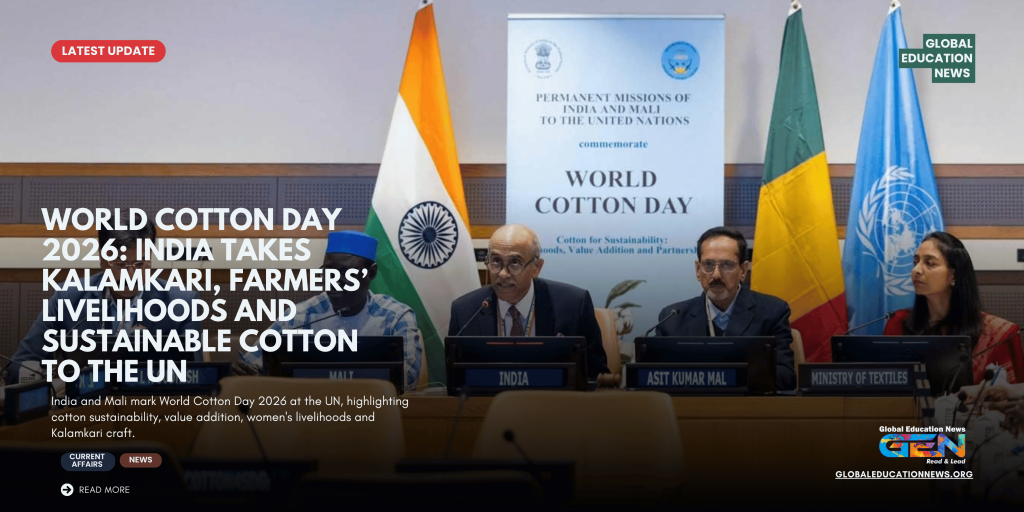
October 9, 2026 | New York, United States | Education News: India and Mali have brought the global cotton industry into focus at the United Nations, highlighting how sustainable cotton production, value addition, traditional craftsmanship and international partnerships can support livelihoods and economic development. The event, held at UN Headquarters in New York on October 7 to commemorate World Cotton Day, explored how cotton can create opportunities beyond farming and raw-material exports.
Organised jointly by the Permanent Missions of India and Mali to the United Nations, the event was titled “Cotton for Sustainability: Livelihoods, Value Addition and Partnership.” Diplomats, Indian parliamentarians and representatives of international organisations discussed ways to improve market access, strengthen cotton-processing capacity, support small producers and artisans, and expand women’s economic participation. A hands-on demonstration of India’s traditional Pen Kalamkari art on cotton added a cultural dimension to the discussion. citeturn517227search1
Why Did India and Mali Organise a Cotton Sustainability Event at the UN?
The initiative focused on a central challenge for cotton-producing countries: how to ensure that the people who grow, process and transform cotton receive greater economic benefits from the final products.
Cotton is not only an agricultural commodity. It supports employment across farming, ginning, spinning, textile manufacturing, garment production and handicrafts. However, countries and communities that primarily export raw cotton may miss opportunities to earn more through domestic processing, product development and access to higher-value markets.
At the UN event, India’s Permanent Representative, Ambassador Harish Parvathaneni, highlighted four priorities: strengthening producers’ livelihoods, expanding value addition and market access, promoting sustainability, and building technology partnerships. Mali’s Permanent Representative, Ambassador Issa Konfourou, emphasised cotton’s importance to the country’s rural economy and the need to expand domestic processing and employment. citeturn517227search1
What Is World Cotton Day, and Why Is It Important?
World Cotton Day is observed annually on October 7. The United Nations General Assembly formally recognised the observance through Resolution 75/318, drawing attention to cotton’s contribution to economic development, international trade and poverty reduction, particularly in developing and least-developed countries.
The occasion provides an opportunity to discuss the challenges facing cotton producers, including production costs, market access, processing infrastructure and the distribution of economic benefits throughout the supply chain.
For India and Mali, the observance also offered a platform to strengthen international cooperation around sustainable production, rural employment and locally created textile products. citeturn517227search1turn517227search4
How Can Value Addition Increase Farmers’ and Artisans’ Incomes?
Value addition means transforming a basic commodity into a product with greater economic value. In the cotton industry, this can involve processing raw cotton into yarn, producing fabric, manufacturing garments or creating distinctive textile products through embroidery, printing and other traditional crafts.
The discussions at the UN emphasised strengthening the entire cotton value chain rather than focusing only on raw-material production.
| Stage of the cotton value chain | Potential economic benefit |
|---|---|
| Cotton cultivation | Better productivity and improved opportunities for farmers |
| Processing and spinning | Local employment and greater domestic processing capacity |
| Textile and garment manufacturing | Higher-value products and industrial development |
| Traditional crafts and design | Opportunities for artisans, small enterprises and cultural preservation |
| Branding and market access | Greater potential to reach domestic and international buyers |
| Technology and partnerships | Improved production methods, quality, traceability and business connections |
These are potential benefits rather than guaranteed outcomes. Achieving them depends on factors such as affordable finance, infrastructure, fair remuneration, reliable markets, skills and access to suitable technology.
How Does Traditional Indian Kalamkari Art Connect Cotton With Sustainable Development?
One of the event’s practical highlights was a demonstration of Pen Kalamkari on cotton, guided by an Indian master artisan. Kalamkari is a traditional textile art associated with hand-drawn or hand-painted designs on fabric.
The demonstration illustrated how cotton can move from an agricultural product to a culturally significant, finished textile. Traditional crafts can create work for skilled artisans, preserve local knowledge and help producers differentiate their products in competitive markets.
Indian parliamentarian Asit Kumar Mal highlighted the Kantha embroidery tradition of Bolpur, West Bengal, in discussing the contribution of craftsmanship to women’s livelihoods, reuse and resource efficiency. The discussion also drew attention to the importance of fair payment, affordable credit, design support and market access for artisans. citeturn517227search1
Why Are Women’s Livelihoods Important in the Cotton Industry?
Women contribute to several stages of the cotton and textile economy, including agricultural work, processing, embroidery, weaving and garment production. Yet their economic contribution does not automatically translate into fair income or access to business opportunities.
The event highlighted the importance of improving women’s participation and economic empowerment through stronger value chains.
Measures such as access to finance, better market connections, skills development, design support and fair remuneration can help women artisans and small entrepreneurs build more sustainable livelihoods. The wider objective is to ensure that the economic benefits generated by cotton reach the people involved throughout its production and transformation.
What Role Can India and Mali Play in Global Cotton Cooperation?
India and Mali approach the cotton sector from different economic contexts, but both recognise its importance to employment and rural development.
Mali’s discussions focused on challenges including limited processing capacity, input costs and market access. India highlighted its cotton and textile industries, traditional crafts, infrastructure development and initiatives aimed at improving productivity and quality.
Representatives also discussed opportunities to strengthen cooperation among cotton-producing countries, including the sharing of technical knowledge, processing expertise and market experience. Such partnerships can help countries retain more economic value locally instead of relying mainly on raw-cotton exports. citeturn517227search1
India’s cotton and textile priorities
The Ministry of Textiles highlighted initiatives including the Mission for Cotton Productivity and the Kasturi Cotton Bharat initiative, which aim to improve cotton productivity, quality and traceability. Discussions also covered textile infrastructure, support for artisans and small enterprises, and the importance of predictable trade and market access.
These initiatives form part of a broader effort to strengthen India’s cotton-to-textile value chain, although their long-term benefits will depend on implementation and market outcomes. citeturn517227search1
What Were the Key Takeaways From the UN Event?
The discussions produced several important themes for the future of the global cotton economy:
- Sustainable production: Cotton production needs to be supported by practices and systems that improve long-term economic and environmental outcomes.
- Stronger value chains: Processing, textile manufacturing and finished-product development can create additional employment and economic opportunities.
- Better market access: Farmers and artisans need reliable routes to buyers and fair opportunities to benefit from the products they create.
- Women’s economic participation: Finance, skills, design support and fair remuneration can strengthen women’s livelihoods.
- International partnerships: Countries can share technology, expertise and experience to improve the competitiveness of their cotton industries.
- Traditional craftsmanship: Textile arts such as Kalamkari demonstrate how cultural heritage can support livelihoods and distinctive products.
The event connected agricultural development with trade, manufacturing, cultural heritage and sustainable livelihoods. It also underlined the need to measure success through tangible improvements in producers’ incomes, market opportunities and processing capacity.
Frequently Asked Questions (FAQs)
1. When is World Cotton Day observed?
World Cotton Day is observed every year on October 7. The United Nations formally recognised the observance through General Assembly Resolution 75/318.
2. What was the India-Mali cotton event at the United Nations about?
The event, titled “Cotton for Sustainability: Livelihoods, Value Addition and Partnership,” examined sustainable cotton production, farmers’ livelihoods, value addition, women’s economic empowerment and international cooperation.
3. Where was the World Cotton Day 2026 event held?
The event took place at United Nations Headquarters in New York on October 7, 2026.
4. What does value addition mean in the cotton industry?
Value addition refers to transforming raw cotton into higher-value products, including yarn, fabrics, garments and handcrafted textiles. It can create additional employment and income opportunities when producers and workers can access markets and receive fair compensation.
5. How can traditional Indian crafts support cotton-based livelihoods?
Crafts such as Kalamkari and Kantha embroidery can create work for artisans, preserve traditional skills and help textile products stand out in domestic and international markets.
6. What were India’s key priorities at the event?
The priorities included supporting producers’ livelihoods, expanding value addition and market access, promoting sustainability, and strengthening technology and international partnerships.
7. Why is international cooperation important for cotton-producing countries?
Cooperation can help countries share technology, improve processing capacity, strengthen market access and develop more competitive cotton and textile industries.
Conclusion
The India-Mali event at the United Nations placed cotton within a broader conversation about sustainable development, employment, trade and cultural heritage. Its central message was that cotton’s economic potential extends far beyond cultivation: processing, manufacturing, traditional craftsmanship and stronger market connections can create opportunities for farmers, artisans and small enterprises.
Turning these priorities into lasting benefits will require effective implementation, investment, fair compensation and collaboration across the value chain. For more updates on international development, sustainability, education and skills, follow Global Education News.