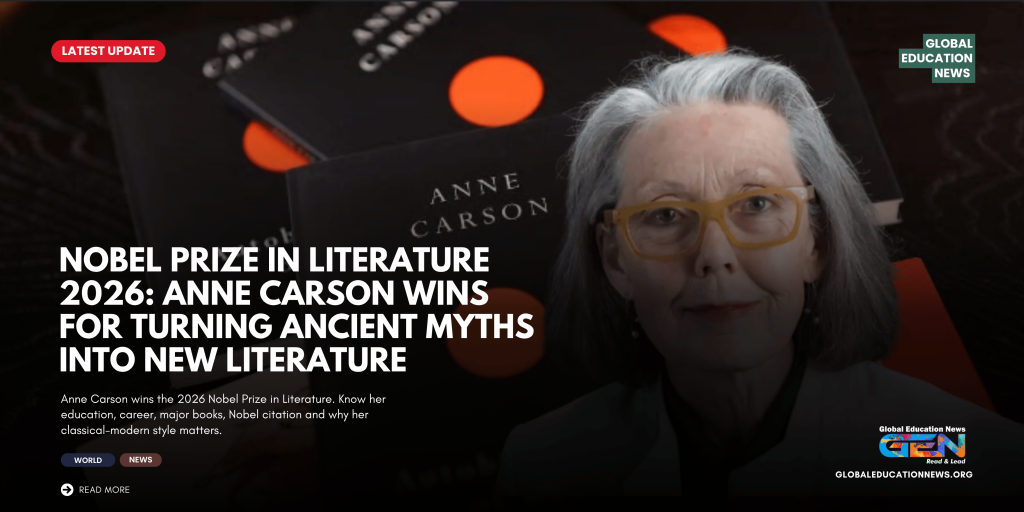
October 9, 2026 | Stockholm | Education & Literature News: Canadian poet, essayist, translator and classical scholar Anne Carson has won the 2026 Nobel Prize in Literature, becoming the latest writer to receive one of the world’s most prestigious literary honours.
The Swedish Academy awarded Carson the Nobel Prize “for her bold and inventive oeuvre that, in playful dialogue with the classical tradition, has created new forms for contemporary literature.” The award recognises a career in which Carson has repeatedly crossed the boundaries between poetry, prose, translation, classical scholarship, fiction and visual art.
Carson, 76, was in Iceland when she learned about the award. Her recognition is particularly notable because her writing does not fit easily into a single literary category. She frequently takes material from ancient Greek literature and places it in conversation with modern questions about love, identity, grief, memory and human relationships.
Her Nobel win also puts the spotlight on an unusual connection between academic scholarship and creative writing: Carson’s deep study of classical literature became the foundation for some of the most experimental works of contemporary literature.
Who Is Anne Carson, the 2026 Nobel Prize Winner in Literature?
Anne Carson was born in Toronto, Canada, in 1950 and developed an early interest in ancient Greek literature.
Her academic journey began with the study of classics. She later earned a doctorate in classics from the University of Toronto in 1981 and went on to teach at universities in Canada and the United States, including McGill University and the University of Michigan.
Carson’s career is unusual because she has operated simultaneously as:
- A poet
- A classicist
- A translator
- An essayist
- A literary scholar
- A teacher
- A writer of experimental fiction
- A collaborator in theatre and visual arts
Her academic background in ancient Greek texts has remained closely connected to her creative work.
Rather than treating classical literature as something belonging only to the past, Carson has repeatedly asked how ancient stories, characters and ideas can be transformed for modern readers.
Why Did Anne Carson Win the Nobel Prize in Literature 2026?
The central reason lies in literary innovation.
The Swedish Academy highlighted Carson’s ability to engage with classical traditions while creating new literary forms for contemporary audiences. Her work frequently mixes different genres instead of following conventional boundaries between poetry, fiction, essays and translation.
This means that Carson does not simply reproduce ancient stories.
She reinterprets them.
Her writing can take an ancient Greek myth, a classical poem or a historical literary figure and place it alongside modern experiences.
The result is a form of literature where the ancient and contemporary exist together.
What Is Unique About Anne Carson’s Writing?
Carson’s work is often described as genre-defying because it can move between several literary forms within the same project.
She may combine:
- Poetry and prose
- Scholarship and personal reflection
- Translation and original writing
- Classical mythology and modern culture
- Fiction and literary criticism
- Text and visual art
The Nobel Committee has emphasised the relationship between Carson’s scholarly attention to words and her search for new poetic meaning.
That approach has allowed her to treat language itself as something that can be examined, rearranged and reinvented.
Anne Carson Education: How Classics Shaped Her Literary Career
Carson’s education is particularly relevant to understanding her Nobel-winning work.
She studied classics at the University of Toronto, eventually completing her PhD in 1981. Her academic training gave her an extensive understanding of ancient Greek language, literature and culture.
Her relationship with Greek literature reportedly began while she was still at school, when a Latin teacher introduced her to Greek.
That early curiosity developed into a lifelong engagement with classical texts.
Instead of separating academic research from creative writing, Carson brought the two together.
Her career therefore offers an important lesson for students interested in literature:
Deep academic study can become a source of creative innovation rather than a limitation on creativity.
Anne Carson’s Major Works: Which Books Made Her Famous?
Carson has produced an unusually diverse body of work over several decades.
Some of the books most closely associated with her literary reputation include Eros the Bittersweet, The Glass Essay, Autobiography of Red, The Beauty of the Husband, Nox, Antigonick, Red Doc> and Float.
| Work | Year | Why It Matters |
|---|---|---|
| Eros the Bittersweet | 1986 | Explores desire through classical literature and scholarship |
| The Glass Essay | 1995 | Blends poetry, personal experience and literary criticism |
| Autobiography of Red | 1998 | Reimagines a figure from Greek mythology in a modern verse narrative |
| The Beauty of the Husband | 2001 | Experimental work combining poetry, fiction and reflections on marriage |
| Nox | 2010 | Uses poetry, photographs, drawings and archival material to explore grief |
| Antigonick | 2012 | An illustrated reworking of Sophocles’ Antigone |
| Red Doc> | 2013 | Continues and transforms characters from Autobiography of Red |
| Float | 2016 | A collection of 22 independent chapbooks designed to be read in different orders |
| Norma Jeane Baker of Troy | 2019 | Connects Helen of Troy with Marilyn Monroe |
| Wrong Norma | 2024 | Collection of poetic prose and artwork |
The variety of these works helps explain why the Swedish Academy described Carson as a writer who creates new possibilities rather than simply working within established literary categories.
Autobiography of Red: The Work That Shows Carson’s Literary Genius
Among Carson’s best-known books is Autobiography of Red, first published in 1998.
The work draws inspiration from the ancient Greek poet Stesichorus and his story of Geryon, a red-winged monster associated with the myth of Herakles.
Carson transforms this relatively brief classical reference into a contemporary coming-of-age story.
The mythological character becomes a young person dealing with relationships, identity and emotional discovery.
This transformation demonstrates Carson’s distinctive method:
Take a fragment from antiquity → question it → expand it → place it in a modern emotional world.
The Nobel Committee specifically highlighted Carson’s ability to give classical literary traditions an intensely contemporary character.
The Glass Essay: Where Poetry Meets Literary Criticism
Another important work is The Glass Essay, published in 1995.
The poem connects the narrator’s personal experiences with the work of English novelist Emily Brontë.
Carson combines personal reflection, storytelling and literary analysis rather than treating them as separate forms.
The Nobel Committee pointed to this work as an example of how Carson allows poetry and narrative to strengthen one another.
This approach is significant for contemporary literature because it challenges the assumption that a poem must remain purely poetic or that literary criticism must remain strictly academic.
Nox: How Carson Turned Grief Into a Literary Object
Carson’s Nox, published in 2010, is another striking example of her experimentation.
The work was created in response to the death of her brother Michael.
Rather than presenting the material simply as a conventional book of poems, Carson created a physical, accordion-style work incorporating photographs, letters, drawings and text.
The structure draws inspiration from an elegy by the ancient Roman poet Catullus, who also wrote about the death of his brother.
The result sits somewhere between poetry, memoir, visual art and archival document.
It demonstrates another characteristic of Carson’s work:
The form of the book itself can become part of the meaning.
How Anne Carson Connects Ancient Greece With Modern Life
Carson’s literary career has been built around a simple but powerful question:
What happens when ancient stories are allowed to speak to modern experiences?
Her answer has appeared in many forms.
She has reworked:
- Greek myths
- Ancient poetry
- Classical tragedies
- Historical characters
- Literary figures
- Ancient ideas about desire and beauty
But she places them beside modern subjects such as:
- Love
- Marriage
- Grief
- Identity
- Adolescence
- Memory
- Loss
- Art
- Desire
This is why Carson’s work is not simply classical scholarship.
It is classical scholarship transformed into contemporary literature.
Norma Jeane Baker of Troy: Helen of Troy Meets Marilyn Monroe
Carson’s Norma Jeane Baker of Troy, published in 2019, provides another example of her approach.
The work brings together Helen of Troy, one of Greek mythology’s most famous figures, and Marilyn Monroe, one of modern culture’s most recognisable figures.
The connection allows Carson to explore questions around beauty, fame, desire and the way women can become objects of public fascination.
The work draws from Euripides’ Helen while placing the ancient character in dialogue with a modern cultural icon.
This type of literary collision—ancient myth meeting contemporary culture—is central to Carson’s creative identity.
What Is the Educational Significance of Anne Carson’s Nobel?
For students and educators, Carson’s Nobel Prize offers a lesson that extends beyond literature.
Her career demonstrates how different disciplines can strengthen one another.
She combined:
Classics + language + history + poetry + philosophy + translation + visual art.
That interdisciplinary approach is increasingly relevant in modern education.
Students are often encouraged to specialise early, but Carson’s career shows how knowledge from one field can transform creative work in another.
A student studying ancient languages, for example, can use that knowledge not only for academic research but also for storytelling, translation, theatre, creative writing or cultural studies.
Anne Carson’s Awards Before the Nobel Prize
The Nobel Prize is the most prestigious recognition of Carson’s career, but it is not her first major international honour.
Her earlier recognitions include:
- MacArthur Fellowship — 2000
- T. S. Eliot Prize — 2001
- Griffin Poetry Prize — 2001
- Griffin Poetry Prize — 2014
- Princess of Asturias Award for Literature — 2020
She therefore entered the Nobel conversation with an established international reputation.
Her 2001 T. S. Eliot Prize was particularly notable because she became the first woman to receive that award.
What Does Anne Carson’s Nobel Mean for Contemporary Literature?
Carson’s victory is significant because it recognises experimentation as a major literary achievement.
The award suggests that literature does not have to remain inside traditional categories.
A poem can contain scholarship.
A translation can become a creative work in its own right.
A myth can become a modern story.
A physical book can become part of the artwork.
A literary essay can become poetry.
That freedom is at the heart of Carson’s work.
The Nobel recognition therefore sends a broader message about the possibilities of contemporary literature.
Anne Carson Becomes Canada’s Latest Nobel Literature Laureate
Carson’s Nobel also adds another chapter to Canada’s literary history.
She follows Alice Munro, who won the Nobel Prize in Literature in 2013.
Carson is the second Canadian recipient of the Literature Nobel since Munro.
Her victory also reinforces Canada’s growing international literary profile while highlighting a very different kind of writing from Munro’s celebrated short fiction.
How Much Money Does the 2026 Nobel Prize in Literature Carry?
The 2026 Nobel Prize in Literature carries an award of 12 million Swedish kronor, approximately US$1.2 million based on current reporting.
The Nobel Prize ceremony is scheduled for December 10, 2026, in Stockholm.
Nobel Prize in Literature 2026: Key Facts
| Detail | Information |
|---|---|
| Winner | Anne Carson |
| Country | Canada |
| Born | Toronto, 1950 |
| Age in 2026 | 76 |
| Profession | Poet, essayist, translator, classicist |
| Nobel | Literature 2026 |
| Nobel citation | For her bold and inventive oeuvre creating new forms through dialogue with classical tradition |
| Academic field | Classics / Classical literature |
| PhD | University of Toronto, 1981 |
| Major work | Autobiography of Red |
| Other notable works | The Glass Essay, The Beauty of the Husband, Nox, Float, Wrong Norma |
| Major earlier honour | Princess of Asturias Award for Literature, 2020 |
| Nobel prize amount | 12 million Swedish kronor |
| Award ceremony | December 10, 2026 |