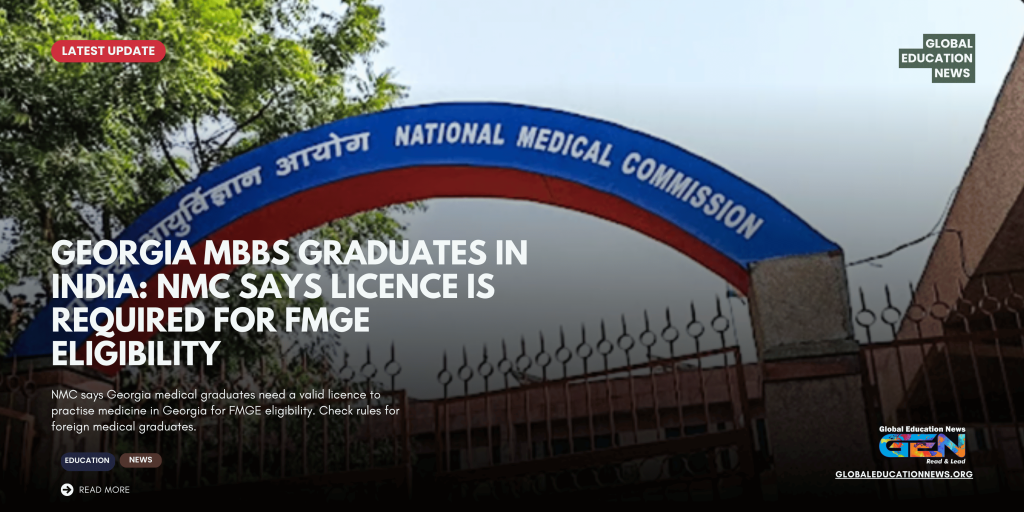
October 8, 2026 | New Delhi | Education News: The National Medical Commission (NMC) has clarified that Indian students who complete a medical degree in Georgia cannot automatically become eligible to practise medicine in India simply because they hold a Georgian medical qualification.
For graduates seeking to return to India, the applicable foreign medical graduate regulations and licensing requirements must be satisfied. In particular, the NMC has clarified that a medical graduate from Georgia must possess a valid licence to practise medicine in Georgia to be eligible for the Foreign Medical Graduate Examination (FMGE) in India. Merely holding a “junior doctor” status or completing a foundation programme is not enough.
The clarification is important for Indian students considering MBBS or equivalent medical programmes abroad, particularly those evaluating Georgia as a destination for medical education.
What Did NMC Say About Georgia Medical Graduates?
The clarification came after a candidate sought information through the PM Grievance Portal regarding the validity of pursuing a six-year MBBS programme in Georgia and subsequently appearing for the FMGE in India.
The NMC’s position is that the foreign medical graduate must meet the regulatory requirements governing recognition and eligibility. A graduate’s status within the Georgian medical system therefore matters—not merely the possession of a degree certificate.
Under the applicable framework, the foreign medical qualification must be one that is recognised for enrolment as a medical practitioner in the country where it was awarded.
Is a Georgia MBBS Degree Alone Enough to Practise in India?
No.
An Indian citizen or Overseas Citizen of India who obtains a primary medical qualification outside India must fulfil the prescribed requirements for registration in India.
The NMC’s existing guidance states that foreign medical graduates seeking registration must qualify the prescribed screening examination, subject to the applicable regulatory framework and exemptions.
For Georgia graduates specifically, the latest clarification adds an important requirement: the graduate needs the requisite licence to practise medicine in Georgia for FMGE eligibility.
Therefore, the pathway is not:
Georgia MBBS degree → automatic medical licence in India
Instead, graduates must satisfy the applicable foreign medical graduate requirements before they can proceed toward registration and practice in India.
What Is the FMGE and Why Does It Matter?
The Foreign Medical Graduate Examination (FMGE) is the screening examination used for eligible Indian citizens and OCI holders who obtain primary medical qualifications from foreign medical institutions and seek registration to practise medicine in India.
The NMC states that an Indian citizen or OCI holder with a primary medical qualification from a foreign medical institution who wants provisional or permanent registration in India must qualify the prescribed screening test, subject to the applicable rules.
The FMGE is therefore a critical step for many Indian students who study medicine overseas and later want to return to India.
The National Board of Examinations in Medical Sciences (NBEMS) conducts the examination. The 2026 schedule has also been expanded to include a third FMGE examination during the year, with an additional examination scheduled for October 31, 2026.
Why Is a Georgian Medical Licence Important?
The issue is connected to the recognition of a foreign medical qualification in the country where it was obtained.
The NMC’s regulatory guidance requires a foreign medical graduate to be registered with the relevant professional regulatory body—or otherwise be competent to obtain a licence to practise medicine—in the jurisdiction where the medical degree was awarded.
This means students need to examine more than the name or duration of an MBBS-equivalent programme.
They should also establish whether their eventual qualification meets the conditions necessary for legal medical practice in the country of education.
Is ‘Junior Doctor’ Status Enough for FMGE Eligibility?
No.
The latest NMC clarification specifically distinguishes between having the required professional licence and being designated or employed as a “junior doctor.”
A junior-doctor designation or completion of a foundation programme by itself does not establish the licensing requirement for FMGE eligibility.
This distinction could be particularly relevant for students who are told that an employment or training status after graduation is equivalent to a medical practice licence.
What Should Indian Students Check Before Studying Medicine in Georgia?
The NMC has repeatedly advised students planning to study medicine abroad to carefully verify whether their proposed programme meets Indian regulatory requirements.
Before taking admission, students should check:
- Whether the foreign institution and qualification satisfy applicable NMC requirements.
- Whether the course structure meets the prescribed standards.
- Whether the programme includes the required duration and practical training.
- Whether the medical qualification is recognised in the country where it is awarded.
- Whether the graduate can obtain the required professional licence in that country.
- Whether the programme meets the applicable FMGL requirements for eventual registration in India.
The NMC specifically cautions that students should not rely solely on advertisements or claims made by foreign medical institutions when assessing eligibility.
What Are the NMC Rules for Foreign Medical Graduates?
The Foreign Medical Graduate Licentiate Regulations, 2021 (FMGL Regulations) form a central part of the current regulatory framework.
The NMC’s regulations and guidance cover requirements relating to the foreign medical qualification, training, internship and registration pathway. The Commission also states that foreign medical graduates must complete the applicable supervised internship requirements in India before permanent registration, subject to the regulations.
The Commission’s current rules and FAQs should therefore be checked alongside any institution-specific information before students make admission decisions.
Does Studying Medicine in Georgia Guarantee Registration in India?
No.
Studying at a foreign medical institution does not by itself guarantee the right to practise medicine in India.
The NMC explicitly states that foreign medical graduates must meet the applicable regulatory conditions and qualify the prescribed screening examination where required.
The latest Georgia-specific clarification reinforces the importance of meeting the licensing requirement in the country where the medical qualification was obtained.
Georgia MBBS to India: What Is the Broad Pathway?
For an eligible Indian student who completes medical education in Georgia, the return-to-India pathway broadly involves several regulatory stages.
| Stage | Requirement / consideration |
|---|---|
| Medical education in Georgia | Programme must satisfy applicable requirements |
| Foreign qualification | Must meet the relevant recognition conditions |
| Georgian professional status | Required licence to practise in Georgia for FMGE eligibility |
| FMGE | Qualifying examination for eligible foreign medical graduates |
| Indian internship/registration | Applicable NMC and State Medical Council requirements must be fulfilled |
| Medical practice in India | Requires the prescribed registration/licence |
The exact requirements can vary according to the student’s admission date, qualification, applicable regulations and individual circumstances. Students should therefore verify their situation with the relevant authorities rather than relying on a generic admission claim.
Why Is This Clarification Important for Indian Students?
Georgia has attracted Indian students looking for medical education outside India. The latest NMC clarification highlights a broader issue that applies to anyone considering an overseas medical degree: the degree itself is only one part of the pathway to medical practice in India.
Students need to understand the regulations governing both the foreign qualification and the eventual Indian registration process before committing substantial time and money to an overseas medical programme.
A programme that appears attractive on the basis of tuition fees, admission requirements or course duration may still create problems later if the qualification does not satisfy the conditions required for FMGE eligibility or registration.
What Does NMC’s Clarification Mean for Current Georgia Medical Students?
Current students and graduates should determine whether they satisfy the applicable requirements for their particular qualification and graduation pathway.
The latest clarification does not mean that every Georgia medical graduate is automatically barred from pursuing medical registration in India. Rather, it establishes that the required professional licensing status in Georgia is relevant to FMGE eligibility.
Students who are uncertain about their individual status should rely on written clarification from the competent regulatory authorities and retain documentation relating to their medical education, licensing and professional registration.
Georgia MBBS Graduates and India Practice: Key Facts
| Question | Current position |
|---|---|
| Does a Georgia medical degree automatically permit practice in India? | No |
| Is FMGE relevant? | Yes, where applicable under the regulations |
| Is a Georgian medical licence important? | Yes |
| Is “junior doctor” status alone sufficient? | No |
| Is a foundation programme alone sufficient? | No |
| Does passing FMGE alone complete the entire registration pathway? | No; other applicable requirements remain |
| Who regulates medical education and registration standards? | National Medical Commission and relevant State Medical Councils |
| Main regulation for foreign medical graduates | FMGL Regulations, 2021 |
Georgia MBBS and NMC Rules FAQ
Can Georgia MBBS graduates practise medicine in India?
Not automatically. They must satisfy the applicable NMC and registration requirements, including the prescribed qualifying examination where applicable.
Do Georgia medical graduates need a licence in Georgia for FMGE?
The latest NMC clarification says that a Georgia medical graduate must possess the required licence to practise medicine in Georgia to be eligible for FMGE.
Is junior doctor status enough for FMGE eligibility?
No. The NMC has clarified that merely being classified as a junior doctor does not satisfy the licensing requirement.
Is completing a foundation programme enough?
No. Completion of a foundation programme alone does not substitute for the required professional licence for FMGE eligibility.
Do all foreign medical graduates have to clear FMGE?
Indian citizens and OCI holders with primary medical qualifications from foreign medical institutions generally have to qualify the prescribed screening examination to obtain registration in India, subject to the applicable rules and exemptions.
Does passing FMGE automatically give permanent medical registration?
No. Foreign medical graduates must also meet the other applicable NMC and State Medical Council requirements for provisional or permanent registration.
What should students check before joining a medical college in Georgia?
Students should verify the institution, qualification, course structure, practical training, recognition in Georgia, professional licensing pathway and compliance with Indian foreign-medical-graduate regulations before taking admission.
The Takeaway for Students Planning MBBS Abroad
The NMC’s latest clarification sends a clear message to Indian students considering medical education in Georgia: a foreign medical degree should not be evaluated only on the basis of admission, tuition fees or course duration.
The graduate’s ability to satisfy professional licensing requirements in the country where the degree was awarded—and the subsequent Indian regulatory pathway—must also be considered.
For students planning to return to India, checking the latest NMC rules before admission can help avoid a situation in which a completed foreign medical qualification does not lead to the expected route toward medical registration.
Global Education News will continue tracking NMC, FMGE and foreign medical education rules that affect Indian students studying medicine abroad.