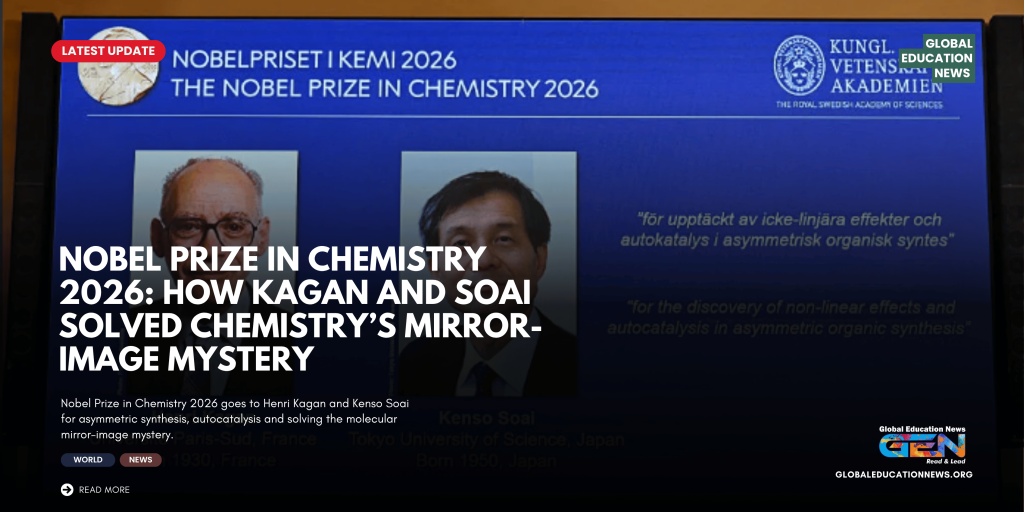
October 8, 2026 | Stockholm | Education News: The Nobel Prize in Chemistry 2026 has been awarded to Henri B. Kagan and Kenso Soai for discoveries that transformed scientists’ understanding of how chemical reactions can favour one molecular mirror image over another.
The Royal Swedish Academy of Sciences recognised the two scientists “for the discovery of non-linear effects and autocatalysis in asymmetric organic synthesis.” Their work helped address a scientific mystery that had challenged chemists for more than a century: why living systems overwhelmingly use only one of two possible mirror-image forms of many molecules.
The breakthrough has major importance for organic chemistry, asymmetric synthesis, molecular chirality and pharmaceutical research, where controlling which mirror-image form of a molecule is produced can be crucial.
Nobel Prize Chemistry 2026: Who are the laureates?
The 2026 Nobel Prize in Chemistry has been awarded jointly to Henri B. Kagan of France and Kenso Soai of Japan.
Kagan’s research established important principles for controlling asymmetric chemical reactions, while Soai later demonstrated a remarkable form of self-amplifying asymmetric autocatalysis.
Together, their discoveries helped show how a small initial imbalance between two molecular mirror images can be amplified through chemical reactions.
| Nobel Chemistry 2026 fact | Details |
|---|---|
| Laureates | Henri B. Kagan and Kenso Soai |
| Prize | Nobel Prize in Chemistry 2026 |
| Awarded for | Discovery of non-linear effects and autocatalysis in asymmetric organic synthesis |
| Major scientific theme | Molecular chirality and homochirality |
| Key application area | Asymmetric organic synthesis and pharmaceutical chemistry |
| Kagan’s breakthrough | Demonstrated ways to strongly favour one molecular mirror image |
| Soai’s breakthrough | Developed self-amplifying asymmetric autocatalysis |
| Announcement | October 7, 2026 |
What is the Nobel Prize in Chemistry 2026 discovery?
At the heart of this year’s Nobel Prize is a phenomenon called chirality.
Some molecules exist in two forms that are mirror images of each other. Like a person’s left and right hands, the two forms can look almost identical while remaining fundamentally different in three-dimensional arrangement.
These molecular forms are known as enantiomers.
The problem is that chemical reactions can often produce both forms. For many applications, however, chemists need to produce predominantly one particular form.
Kagan and Soai developed and demonstrated chemical processes that can make one molecular “hand” dominate over the other. Their research showed how chemical asymmetry can be created, amplified and maintained.
Why are mirror-image molecules important in chemistry?
Molecular handedness matters because two enantiomers can interact differently with other molecules.
This is particularly important in biological systems because proteins, enzymes and other biological structures themselves have highly specific three-dimensional shapes.
As a result, the two mirror-image versions of a compound can sometimes have very different biological effects.
For pharmaceutical chemistry, this means researchers often need precise control over which molecular form is produced.
The Nobel-recognised discoveries therefore provided important tools for chemists designing reactions for the manufacture of medicines and other biologically active compounds.
How did Henri Kagan change asymmetric organic synthesis?
Henri B. Kagan’s work in the 1980s demonstrated a powerful way of controlling asymmetric chemical reactions.
Instead of producing equal amounts of two mirror-image molecules, his research showed that chemical reactions could be designed to generate a much larger proportion of the desired form.
This became an important foundation for modern asymmetric synthesis, a field devoted to selectively producing molecules with a particular three-dimensional arrangement.
Kagan’s work helped establish that even a relatively small preference for one molecular form could have significant consequences.
How did Kenso Soai take the discovery further?
Kenso Soai’s research provided an extraordinary demonstration of asymmetric autocatalysis.
In autocatalysis, a chemical product helps promote the reaction that produces more of that same product.
Soai’s work showed that such a process could amplify molecular asymmetry. A small initial imbalance could therefore become increasingly pronounced through repeated chemical reactions.
His research eventually produced a reaction in which one molecular mirror image could emerge overwhelmingly rather than simply appearing alongside an equal amount of its counterpart.
This was a major step toward understanding how chemical systems could develop strong molecular asymmetry without requiring a perfectly balanced starting point.
What is homochirality and why has it puzzled scientists?
Homochirality describes the predominance of one handedness of molecules in living systems.
For example, amino acids used by living organisms overwhelmingly occur in one particular molecular orientation, while biological molecules such as DNA also display characteristic handedness.
The existence of this strong molecular preference has been a long-standing scientific puzzle.
If chemistry can theoretically produce two mirror-image forms, why does life overwhelmingly favour one?
The work recognised by the Nobel Prize in Chemistry 2026 provided important insight into how a small molecular imbalance can be amplified through chemical reactions.
Why does the 2026 Chemistry Nobel matter for medicines?
The discovery is especially significant for pharmaceutical chemistry.
When scientists develop medicines, controlling molecular structure can affect how a compound interacts with biological targets. Producing the desired enantiomer can therefore be an important part of drug research and manufacturing.
The Nobel-recognised chemistry does not mean that every modern medicine was directly developed using a single reaction discovered by Kagan or Soai. Rather, their work supplied fundamental concepts and tools for controlling molecular asymmetry and understanding how asymmetric catalysts and reactions operate.
That distinction is important: the Nobel Prize recognises fundamental chemistry with broad consequences, rather than one particular drug.
How did Kagan and Soai solve a century-old chemistry mystery?
The scientific story stretches back much further than the two laureates.
In the 19th century, Louis Pasteur studied tartaric acid and recognised that some substances could exist in two mirror-image forms with different properties.
For decades, scientists continued to investigate how molecular handedness could arise and why biological systems overwhelmingly favour one form.
Kagan’s work demonstrated how asymmetric reactions could strongly favour one molecular form. Soai then showed how autocatalysis could amplify molecular asymmetry, creating a powerful mechanism through which a small initial preference could become dominant.
Together, these discoveries helped provide a chemical explanation for a phenomenon that had remained mysterious for generations.
What does the Nobel Chemistry 2026 breakthrough mean for students?
For chemistry students, the 2026 Nobel Prize offers an important example of how seemingly abstract concepts can have major scientific consequences.
Key concepts connected with the research include:
- Chirality — the property that makes a molecule distinguishable from its mirror image.
- Enantiomers — two mirror-image forms of the same molecular structure.
- Asymmetric synthesis — methods designed to produce one molecular form preferentially.
- Autocatalysis — a reaction in which a product helps promote its own formation.
- Non-linear effects — situations where a small change can produce a disproportionately large chemical outcome.
- Homochirality — the predominance of one molecular handedness in biological systems.
The Nobel announcement therefore connects textbook chemistry with major questions in medicine, biology, molecular science and the origins of life’s chemical asymmetry.
What are the wider scientific implications of the 2026 Chemistry Nobel?
The work of Kagan and Soai extends beyond a single chemical reaction.
Their discoveries help scientists understand how molecular asymmetry can be generated and amplified. This has implications for research into catalysis, organic synthesis, pharmaceuticals and the chemical origins of biological handedness.
The research also demonstrates a broader principle in science: a tiny initial difference does not necessarily remain tiny. Under the right conditions, chemical feedback can amplify that difference dramatically.
That insight is one reason the 2026 Chemistry Nobel is significant for both fundamental chemistry and applied molecular science.
Nobel Prize in Chemistry 2026: Key points at a glance
| Question | Answer |
|---|---|
| Who won the Chemistry Nobel 2026? | Henri B. Kagan and Kenso Soai |
| What did they discover? | Non-linear effects and autocatalysis in asymmetric organic synthesis |
| What problem did their work address? | How molecular asymmetry and homochirality can emerge |
| What is chirality? | The property of having a non-superimposable mirror-image form |
| Why is it important? | Molecular handedness can affect how compounds interact with biological systems |
| What is autocatalysis? | A process where a reaction product helps promote formation of more product |
| Major application area | Pharmaceutical and organic chemistry |
| Why is it historically important? | It helped address a chemical mystery that had persisted for more than a century |
FAQ: Nobel Prize in Chemistry 2026
Who won the Nobel Prize in Chemistry 2026?
Henri B. Kagan and Kenso Soai won the 2026 Nobel Prize in Chemistry.
Why did Kagan and Soai win the Chemistry Nobel?
They were awarded the prize for the discovery of non-linear effects and autocatalysis in asymmetric organic synthesis, which helped explain how molecular asymmetry can emerge and become amplified.
What is the main discovery behind the 2026 Chemistry Nobel?
The research showed how chemical reactions can favour one mirror-image form of a molecule and how asymmetric preferences can be amplified through autocatalysis.
What is chirality in chemistry?
Chirality is a property of molecules that have mirror-image forms that cannot be perfectly superimposed on each other, similar to the relationship between a left hand and a right hand.
What is homochirality?
Homochirality refers to the dominance of one molecular handedness in biological systems. It is one of the long-standing questions connected with the chemistry of life.
Why is asymmetric synthesis important for medicines?
Different molecular mirror images can interact differently with biological systems. Asymmetric synthesis allows chemists to preferentially produce the molecular form they need.
What is asymmetric autocatalysis?
Asymmetric autocatalysis is a chemical process in which a product helps promote further production of the same molecular form, allowing an initial asymmetry to become strongly amplified.
Did the Nobel Prize discovery create a specific new medicine?
The award recognises fundamental chemical discoveries and methods, rather than the invention of one particular medicine. Their work has provided important principles and tools for asymmetric organic synthesis and pharmaceutical chemistry.
What students should learn from Nobel Chemistry 2026
The Nobel Prize in Chemistry 2026 is more than a story about two molecular mirror images. It demonstrates how fundamental research can solve scientific problems that remain unanswered for decades.
Kagan’s work showed how chemical reactions could be pushed toward one preferred molecular form. Soai’s research demonstrated how autocatalysis could amplify such asymmetry. Together, the discoveries have reshaped scientists’ understanding of chirality, asymmetric synthesis and molecular self-amplification.
For students studying chemistry, the award also offers a powerful reminder that concepts such as molecular structure, catalysts and reaction mechanisms can eventually influence fields as important as drug discovery and biotechnology.
Global Education News will continue tracking major Nobel Prize developments, breakthrough science, research discoveries and their implications for students and the wider education community.