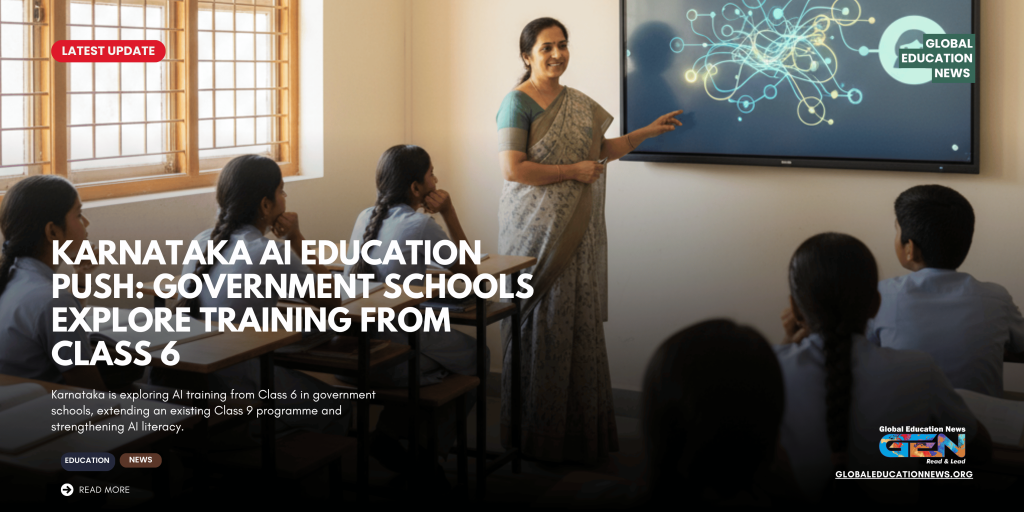
October 7, 2026 | Bengaluru | Education News: Karnataka is exploring an expansion of Artificial Intelligence (AI) education in government schools, with officials asked to examine the possibility of introducing AI training from Class 6. The move would extend an existing government-school AI programme that has already begun for Class 9 students and could bring foundational AI literacy to younger learners.
Chief Minister D.K. Shivakumar has directed officials to work with the Information Technology Department and explore support from private-sector partners for the proposed expansion. Google has expressed interest in providing AI training, and officials have been asked to examine relevant programmes implemented in Telangana.
The proposal is part of Karnataka’s wider effort to connect school education with future skills, digital learning and emerging technology. But the Class 6 expansion remains at the planning and exploration stage; it should not yet be described as a completed statewide rollout.
What Is Karnataka Planning for AI Education From Class 6?
Karnataka is considering extending AI training to students beginning in Class 6.
According to the latest government-linked announcement, AI training has already started for Class 9 students in government schools. Officials have now been instructed to explore how the programme could be introduced at an earlier stage.
The proposal reflects a broader shift in how AI is being viewed within school education. Instead of treating artificial intelligence only as a specialised subject for engineering students or professionals, governments are increasingly considering foundational AI literacy as part of school-level future skills.
Karnataka AI Education: What Is Confirmed?
| Key development | Current status |
|---|---|
| AI training in government schools | Already started for Class 9 |
| Extension to Class 6 | Under exploration |
| IT Department support | Proposed as part of implementation |
| Private-sector partnerships | Being explored |
| Google involvement | Company has expressed interest in providing training |
| Telangana model | Officials asked to examine existing initiatives |
| AI university | Karnataka is also exploring a state AI university |
| Wider objective | Future skills and technology readiness |
Why Is Karnataka Bringing AI Into School Education?
The central argument behind the initiative is that students will increasingly enter an economy shaped by artificial intelligence, automation and digital technologies.
Introducing AI concepts during school years could help students understand not only how technology works but also how it affects education, employment and everyday life.
Karnataka has previously announced a broader AI education programme, including AI Akshara Abhiyana and Coding Gurukula, with the stated aim of developing AI and coding skills among students.
The latest Class 6 proposal therefore builds on an existing policy direction rather than appearing as an isolated announcement.
How Will AI Literacy Help Government-School Students?
AI literacy at school level does not necessarily mean teaching students advanced machine-learning techniques.
For younger learners, the emphasis can instead be on understanding basic concepts such as:
- What artificial intelligence is
- How AI systems use data
- How algorithms influence digital platforms
- Responsible and ethical use of AI
- Basic computational thinking
- Problem-solving and logical reasoning
- Understanding AI-generated information
- The opportunities and limitations of AI
Such foundational skills can help students become informed users of technology before they encounter increasingly sophisticated AI tools in higher education and employment.
What Role Could Google and Private Partners Play?
Karnataka is examining partnerships with private organisations to support the proposed expansion.
The Chief Minister’s office said Google has expressed interest in providing AI training for government-school students. Officials have been asked to examine Google’s initiatives in Telangana while considering an appropriate model for Karnataka.
At this stage, the available information does not establish a final statewide partnership structure, curriculum or implementation timetable. Those details would need to be worked out before a Class 6 programme could be described as fully operational.
Is AI Already a Subject in Karnataka Government Schools?
Yes, Karnataka has already moved AI education into government schools at the secondary level.
In July 2026, the state introduced AI as a vocational subject for Classes 9 and 10 in 1,642 government high schools under the National Skills Qualifications Framework. The programme included 1,180 newly approved high schools, 381 NSQF schools and 81 existing single-sector schools.
The programme was designed to develop skills including problem-solving, critical thinking, technical knowledge and employability.
The latest Class 6 proposal would therefore represent an effort to begin AI exposure earlier in the school journey.
How Could AI Education Change From Class 6 to Class 10?
If the proposed expansion goes ahead, Karnataka could eventually develop a progression in which students encounter AI concepts at increasingly advanced levels.
Classes 6–8: Foundational AI literacy
Students could be introduced to basic AI concepts, digital awareness, computational thinking and responsible technology use.
Classes 9–10: Applied and vocational skills
Students could build on those foundations through the existing AI vocational programme, with greater emphasis on technical skills and employability.
Higher education: Advanced AI and specialised study
Students interested in AI could then move toward computer science, data science, engineering, mathematics, research and specialised AI programmes.
This kind of progression would make AI education less about learning a single technology and more about developing a long-term digital-skills pathway.
What Are the Challenges of Teaching AI to Younger Students?
Starting AI education earlier also creates practical challenges.
The quality of the programme will depend on teacher preparation, curriculum design, infrastructure and access to appropriate digital resources.
A Class 6 AI programme would need to be age-appropriate and should not simply transfer university-level technical concepts into school classrooms.
Teacher capacity will be particularly important. Karnataka’s existing AI programme for Classes 9 and 10 has already involved plans for AI guest teachers, with eligible candidates required to have qualifications in areas such as computer applications, computer science or information technology.
For a younger cohort, teacher training would also need to cover how to explain AI concepts in ways that are understandable and educationally meaningful.
Could AI Education Help Bridge the Digital Divide?
The government-school focus gives the initiative a potentially important equity dimension.
If AI literacy is introduced only through private schools, coaching centres or specialised technology programmes, students from different socioeconomic backgrounds may have unequal exposure to emerging technologies.
Introducing foundational AI education through government schools could broaden access.
However, simply announcing AI education does not guarantee equal access. Schools would need appropriate devices, connectivity, trained teachers and learning materials for the programme to have consistent impact across urban and rural areas.
Karnataka’s AI School Push Is Part of a Bigger Technology Strategy
The school-level proposal is occurring alongside Karnataka’s plans for a broader AI ecosystem.
The state is also exploring the establishment of an AI university, while earlier announcements included plans for AI-focused programmes and AI hubs.
The combination of school-level AI literacy, vocational education and higher-education infrastructure indicates an attempt to create a longer technology-skills pipeline.
For education policy, the more significant question will be whether these initiatives can connect effectively — from foundational learning in schools to advanced study, research and employment.
What Does Karnataka’s Class 6 AI Proposal Mean for Students?
For students, the proposed change could eventually mean that AI becomes part of normal school learning rather than something encountered only after Class 12 or in professional courses.
The focus should be broader than learning to operate AI tools. Students will need to understand how AI works, where it can be useful, where it can make mistakes and how it should be used responsibly.
That distinction will become increasingly important as AI-generated information and automated tools become more common in education.
The Bigger Education Story
Karnataka’s latest move signals a significant change in the way AI literacy in India could develop: from a specialised skill associated with engineering and professional education toward a foundational competency introduced during school years.
The immediate development is still a proposal. AI training is already underway at the Class 9 level, while officials are now examining how it could be extended to Class 6 with support from the IT Department and private partners.
If implemented with age-appropriate curricula, trained teachers and equitable access to technology, the initiative could give government-school students earlier exposure to one of the technologies expected to reshape higher education and the future workplace.
For Global Education News, the bigger question is no longer whether AI will enter classrooms, but how early students should learn about it — and whether schools can teach AI literacy without reducing education to simply learning how to use AI tools.