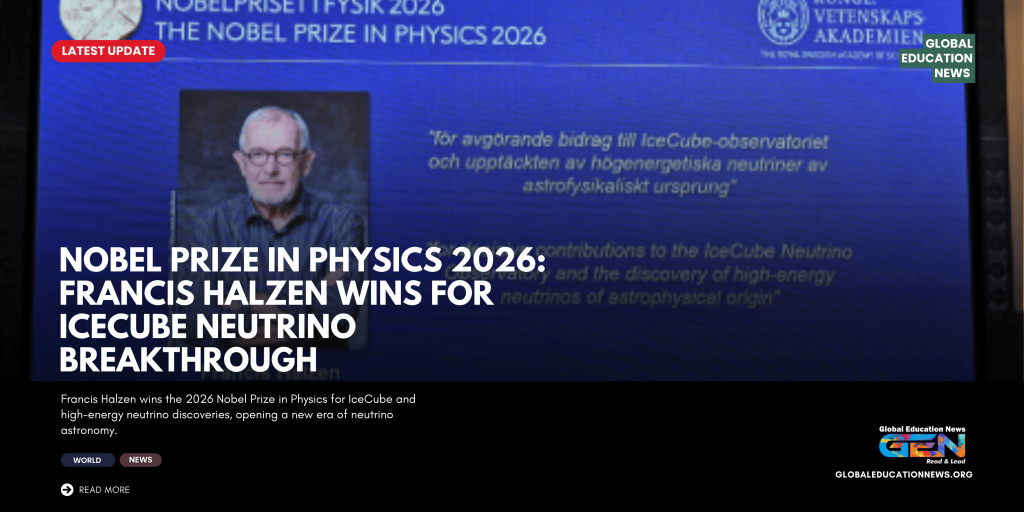
October 6, 2026 | Stockholm | Education News: Belgian-American physicist Francis Halzen has been awarded the 2026 Nobel Prize in Physics for his decisive contributions to the IceCube Neutrino Observatory and the discovery of high-energy neutrinos of astrophysical origin. The Royal Swedish Academy of Sciences announced the award on October 6.
Halzen’s work has helped establish a new way of studying the universe — not only through light and electromagnetic signals, but also through elusive subatomic particles called neutrinos.
At the heart of the achievement is IceCube, a giant neutrino detector embedded deep beneath the Antarctic ice at the South Pole. The observatory has opened a new window into some of the most energetic and violent phenomena in the universe.
Why Did Francis Halzen Win the 2026 Nobel Prize in Physics?
The Nobel Committee recognised Halzen for his contributions to the development of the IceCube Neutrino Observatory and the discovery of high-energy neutrinos originating from astrophysical sources.
His scientific vision was based on an unusual but powerful idea: Antarctic ice could be turned into a huge particle detector.
Neutrinos rarely interact with matter. That makes them extremely difficult to detect, but it also gives them an important scientific advantage. They can travel enormous distances through matter and across the universe without being significantly deflected or absorbed.
This means that when scientists detect a high-energy neutrino, they can use it as a messenger from an otherwise difficult-to-observe cosmic event.
What Are Neutrinos and Why Are They Called Ghost Particles?
Neutrinos are electrically neutral subatomic particles with extremely small masses that interact only very weakly with matter.
Because of this weak interaction, enormous numbers of neutrinos can pass through matter without leaving an obvious trace. Reuters described them as elusive “ghost particles,” reflecting the extraordinary challenge of detecting them.
For students studying physics, neutrinos are important because they sit at the intersection of particle physics, astrophysics and cosmology.
They can carry information from extreme environments that conventional telescopes may not fully reveal.
How Does the IceCube Neutrino Observatory Work?
IceCube uses approximately one cubic kilometre of Antarctic ice as part of its detector.
Thousands of digital optical modules are positioned deep beneath the surface, between roughly 1,450 and 2,450 metres below the ice. When a neutrino interacts in the ice, it can produce charged secondary particles that generate a faint flash of Cherenkov light.
IceCube’s optical sensors detect these flashes and record their timing and pattern. Scientists then use the information to reconstruct the direction and energy of the particle interaction.
| Nobel Physics 2026: Key Facts | Details |
|---|---|
| Laureate | Francis Halzen |
| Award | Nobel Prize in Physics 2026 |
| Affiliation | University of Wisconsin–Madison |
| Recognised for | Contributions to IceCube and discovery of high-energy astrophysical neutrinos |
| Observatory | IceCube Neutrino Observatory |
| Location | South Pole, Antarctica |
| Detector scale | About one cubic kilometre of Antarctic ice |
| Main science | Neutrino astronomy and particle physics |
| Nobel announcement | October 6, 2026 |
| Prize amount | 12 million Swedish kronor |
The prize carries a total award of 12 million Swedish kronor, about US$1.2 million.
How Did Antarctic Ice Become a Telescope for Neutrinos?
The idea behind IceCube changed how scientists could approach neutrino detection.
Instead of constructing a conventional telescope that collects visible or other electromagnetic radiation, scientists could use the exceptionally clear Antarctic ice as a huge detection medium.
IceCube was completed in 2010 after several years of construction. Its detector strings carry thousands of optical modules through the ice, creating a large three-dimensional detection volume.
The result is effectively a neutrino telescope buried beneath the South Pole.
What Has IceCube Revealed About the Universe?
IceCube has helped establish neutrino astronomy, giving scientists another way to investigate extreme astrophysical environments.
High-energy neutrinos can originate in some of the universe’s most energetic processes, including exploding stars, gamma-ray bursts and phenomena associated with black holes and neutron stars.
The observatory has also contributed to research involving cosmic rays, neutrino properties, dark matter and other fundamental questions in physics.
This makes Halzen’s Nobel recognition broader than the development of a single detector. It represents the emergence of a new observational approach in modern astronomy.
Why Is the 2026 Physics Nobel Important for STEM Students?
The Nobel-winning research offers a strong example of how modern science combines multiple disciplines.
Students interested in physics, astronomy, astrophysics, mathematics, computer science and engineering can see several STEM fields working together in IceCube.
The project involves:
- Particle physics
- Astrophysics
- Astronomy
- Detector engineering
- Computer science
- Data analysis
- Mathematics
- Antarctic science
- International scientific collaboration
The observatory itself is operated through a large international collaboration involving hundreds of researchers and institutions.
For students, the bigger lesson is that major scientific discoveries increasingly emerge from teams combining different technical skills.
What Does Francis Halzen’s Nobel Mean for the Future of Neutrino Astronomy?
The Nobel recognition comes as IceCube research continues to develop.
In 2026, the IceCube Upgrade was completed, adding more than 600 new and enhanced optical sensors and calibration instruments. The upgrade is expected to improve neutrino reconstruction and enable scientists to reanalyse years of archived data.
Scientists are also planning IceCube-Gen2, a substantially larger next-generation facility designed to expand the search for high-energy neutrinos and investigate extreme astrophysical environments in greater detail.
That means Halzen’s Nobel-winning scientific vision is not simply a landmark from the past. It continues to shape the next generation of neutrino research.
Why Is This a Major Science Education Story?
The 2026 Nobel Prize in Physics provides an accessible example of how a fundamental physics question can lead to an entirely new form of astronomy.
For schools and universities, the story connects textbook concepts — particles, light, energy, matter and forces — with an enormous real-world scientific facility operating beneath Antarctic ice.
It also demonstrates the importance of long-term research. IceCube required years of engineering, international collaboration and scientific investment before it could produce the observations that transformed neutrino astronomy.
For students considering STEM careers, the project illustrates how physics research can lead to opportunities spanning astronomy, computing, engineering, instrumentation and data science.
Frequently Asked Questions
Who won the Nobel Prize in Physics 2026?
Francis Halzen won the 2026 Nobel Prize in Physics for his decisive contributions to the IceCube Neutrino Observatory and the discovery of high-energy neutrinos of astrophysical origin.
What is Francis Halzen known for?
Francis Halzen is known for his work in neutrino physics and his leadership in the development of the IceCube Neutrino Observatory at the South Pole.
What is IceCube?
IceCube is a giant neutrino observatory embedded in Antarctic ice near the South Pole. It uses thousands of optical sensors to detect light produced when neutrinos interact in the ice.
What are high-energy astrophysical neutrinos?
They are extremely energetic neutrinos produced by powerful astrophysical processes and sources beyond Earth. Because neutrinos can travel through matter with little interaction, they can provide information about distant cosmic environments.
Why is the IceCube Observatory important?
IceCube has enabled scientists to study the universe through neutrinos, establishing a new form of astronomy and providing information about some of the most energetic processes in the cosmos.
Where is the IceCube Observatory located?
The IceCube Neutrino Observatory is located at the South Pole in Antarctica, with its primary detector embedded deep beneath the Antarctic ice.
How much is the 2026 Nobel Prize in Physics worth?
The 2026 Nobel Prize carries a monetary award of 12 million Swedish kronor.
The Bigger Picture
Francis Halzen’s 2026 Nobel Prize in Physics marks a milestone for neutrino astronomy and demonstrates how a bold scientific idea can reshape an entire field.
By turning Antarctic ice into a giant detector, the IceCube project has given scientists a new way to investigate the universe and study particles capable of carrying information across enormous cosmic distances.
For the education sector, the story is equally significant. It shows students how physics, astronomy, engineering, computing and mathematics converge in frontier research — and how fundamental scientific questions can eventually produce entirely new ways of observing the cosmos.
Global Education News will continue tracking major Nobel Prize developments, breakthrough research and international STEM achievements shaping education and scientific discovery.