October 5, 2026 | Lucknow | Education News:
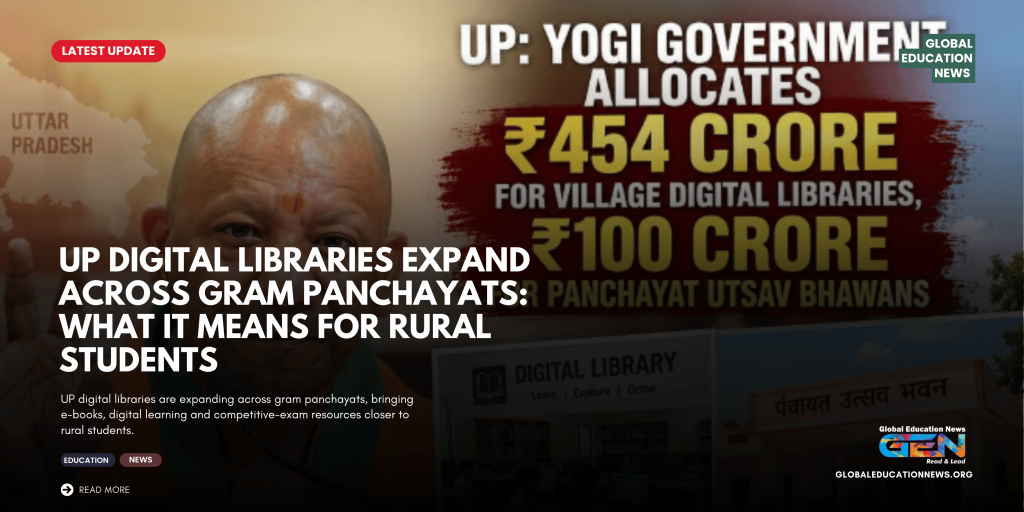
Uttar Pradesh is pushing digital learning deeper into rural India as its UP digital libraries initiative expands access to books, computers, internet-enabled learning and competitive-exam resources at the gram panchayat level. The latest state-level claims point to digital libraries reaching 57,600 gram panchayats, while the Panchayati Raj Department’s dedicated implementation programme has been developing digital-library facilities in a first phase covering 11,350 gram panchayats.
The larger story is not simply about putting computers inside village buildings. It is about changing where educational opportunity is located.
For years, students in rural Uttar Pradesh preparing for UPSC, UPPSC, SSC, banking, defence and other competitive examinations have often had to depend on district towns or cities for coaching, books, internet access and structured study material. The new digital-library model attempts to move at least part of that learning infrastructure closer to their homes.
The initiative also puts the urban-rural digital learning gap under a sharper spotlight: having a smartphone is one thing; having reliable study material, a quiet learning space, high-speed connectivity, e-books, video lessons and practice tests is another.
What is the UP digital library initiative?
The Uttar Pradesh government’s Gram Panchayat Digital Library programme is designed to establish technology-enabled learning spaces within rural communities.
Official project documents describe a cloud-based digital library and e-learning platform with academic and non-academic content, including e-books, educational videos, skilling courses, quizzes and mock tests. The planned system is designed for students from school through higher education as well as young people and other community users.
The project also includes access to competitive-exam preparation resources covering examinations such as JEE, NEET, SSC, banking, UPSC, UPPSC, defence, police and other tests.
That makes the programme broader than a conventional village reading room.
| Key feature | What it means for rural learners |
|---|---|
| Digital library | Access to electronic books and learning resources |
| Computers and internet | Technology-enabled study without travelling to a city |
| E-books and videos | Multimedia learning beyond printed textbooks |
| Mock tests and quizzes | Practice for competitive examinations |
| Competitive-exam content | Support for UPSC, UPPSC, SSC, banking, NEET, JEE and others |
| Mobile access | Learning can potentially continue beyond the library |
| Hindi and English content | Wider accessibility for different learners |
| Progress and assessment tools | Scope for tracking learning and test performance |
How many gram panchayats are covered by UP digital libraries?
This is where the numbers need careful reading.
The latest statements highlighted on October 5, 2026, say that digital libraries have reached 57,600 gram panchayats, compared with roughly 76 state- and district-level e-library locations before 2017.
Separately, the Panchayati Raj Department’s dedicated digital-library project documents specify the establishment of 11,350 digital libraries in gram panchayats in the initial project framework. The department describes these facilities as libraries with computers, printers, UPS systems, smart TVs, furniture, books, e-books and digital educational material.
The two figures therefore should not automatically be treated as identical measurements of the same rollout stage.
The 57,600 figure is being used in recent public statements to describe the wider reach of digital libraries across gram panchayats, while the 11,350 figure appears in the specific Panchayati Raj digital-library implementation framework.
For readers and students, the important takeaway is the direction of travel: Uttar Pradesh is attempting to make village-level digital learning infrastructure a large-scale part of its rural education ecosystem.
Why are UP digital libraries important for rural education?
The biggest barrier to education is not always the absence of a school.
For older students and competitive-exam aspirants, the problem can be access to high-quality learning resources after school hours.
A student preparing for a competitive examination may need:
- Reference books
- Current-affairs material
- E-books
- Video lectures
- Online tests
- Practice questions
- Internet access
- A computer
- A place to study
- Information about applications and examinations
In a city, these resources may exist within a short distance of a student’s home.
In a village, accessing the same ecosystem can require travel.
A digital library changes the geography of that opportunity.
Can rural students prepare for competitive exams from their villages?
The programme is specifically designed to support this possibility.
The official digital-library project framework includes online learning and test-preparation facilities for major competitive examinations, with mock tests, assessments and performance analytics among the proposed features.
That could be particularly relevant for students preparing for UPSC, UPPSC, SSC, banking, defence, police, NEET and JEE.
However, a library is not a substitute for every form of coaching.
Competitive examinations also require sustained preparation, guidance, doubt resolution, quality study material and disciplined practice. The value of a rural digital library will therefore depend on how effectively students can use the resources available rather than simply whether a computer or smart TV has been installed.
What facilities will students find in these digital libraries?
The project specifications point to a relatively technology-rich model.
Facilities and services described in the official documents include computers, printers, smart TVs, e-books, educational videos, digital learning modules, quizzes and online test preparation. The proposed platform also includes tools such as text search, notes, learning-progress dashboards and assessment features.
In other words, the model combines the traditional library with elements of an online learning centre.
That distinction matters.
A student who cannot afford multiple test-series subscriptions or does not have a reliable personal computer may gain access to resources that were previously concentrated in urban coaching ecosystems.
How could digital libraries narrow the urban-rural education gap?
The digital divide is not simply about internet connectivity.
There are at least four layers:
Access: Can students connect to the internet?
Devices: Do they have a computer, tablet or smartphone?
Content: Can they access good-quality books, lectures and practice material?
Learning environment: Do they have a place where they can study consistently?
UP’s digital-library approach attempts to address several of these layers simultaneously.
The state has also highlighted broader technology-led education infrastructure. Recent reporting cites more than 32,000 schools with smart classrooms, more than 15,000 schools with ICT labs, and nearly 60 lakh young people receiving smartphones or tablets as part of the wider digital-learning push.
The challenge now is ensuring that these investments translate into sustained learning outcomes.
Why is the gram panchayat an important location for a digital library?
The location is central to the initiative’s logic.
A district-level library serves a wider geographical area, but students may still need to travel significant distances to reach it.
A gram panchayat facility moves the resource closer to the learner.
The broader rural-governance infrastructure is also changing. Uttar Pradesh has been developing gram secretariats as local centres for digital services, while the digital-library initiative adds an education and knowledge-access function to this village-level infrastructure.
That creates the possibility of the village secretariat becoming more than an administrative building.
It can potentially become a place where residents access government services, students study, young people learn digital skills and competitive-exam aspirants use online resources.
What is the biggest challenge for UP’s rural digital learning push?
Infrastructure is only the first step.
The real test will be usage and learning outcomes.
A digital library can provide computers and e-books, but students still need:
- Reliable electricity and internet
- Functional equipment
- Updated study material
- Trained staff
- Safe and accessible study hours
- Digital literacy
- Regular maintenance
- Guidance on how to use online resources
- Monitoring of actual student usage
The official project specifications themselves recognise the need for cloud hosting, technical support, multilingual content and the ability to handle a very large user base.
That indicates the scale of the challenge: maintaining thousands of local digital learning points is more complicated than creating them.
Could UP’s digital libraries change competitive-exam preparation?
Potentially, yes—but their strongest impact may come from reducing the first barrier to preparation.
A student who previously needed to travel to a nearby town simply to access a reference book, computer or mock test could potentially obtain those resources locally.
That does not eliminate the urban advantage overnight.
Students in major cities may still have access to established coaching centres, larger libraries, peer networks and specialised teachers. But rural digital libraries can narrow one part of that gap: access to information and learning infrastructure.
That is why the initiative matters beyond Uttar Pradesh.
It reflects a broader shift in Indian education policy—from building educational infrastructure only around schools and colleges to creating distributed learning infrastructure within communities.
UP digital libraries: What changes for students?
| Earlier challenge | Potential change through digital libraries |
|---|---|
| Travel to towns for study resources | Learning resources available closer to home |
| Limited access to reference books | E-books and physical books |
| Dependence on personal devices | Shared computers and digital facilities |
| Limited mock-test access | Online quizzes and competitive-exam tests |
| City-centric learning resources | Panchayat-level learning access |
| Limited digital exposure | Regular interaction with digital educational tools |
| Higher travel costs | Reduced need for some education-related travel |
The word “potential” matters.
Whether these benefits become widespread will depend on implementation quality, availability of resources and how regularly students use the facilities.
What does the expansion mean for rural education in Uttar Pradesh?
The significance of UP digital libraries extends beyond examination preparation.
The official project framework covers school students, undergraduate and postgraduate learners, youth, women, children and other community users.
That means the infrastructure could eventually support:
School education: supplementary books, videos and learning resources.
Higher education: e-books and online academic material.
Competitive exams: mock tests and examination preparation.
Skills: online skilling courses and certification.
Digital literacy: greater familiarity with computers and online information.
Reading culture: combining physical books with digital resources.
This makes the initiative relevant to the wider question of how rural India can participate in an increasingly digital education economy.
What should students know about UP digital libraries?
Students should see these facilities as additional learning infrastructure, not as an automatic guarantee of exam success.
The most useful approach would be to combine library resources with official examination syllabi, reliable textbooks, regular practice and structured study plans.
For competitive exams in particular, students should verify examination information through the official website of the relevant examination authority because dates, eligibility, syllabi and application rules can change.
FAQ: UP Digital Libraries and Rural Education
What are UP digital libraries?
UP digital libraries are technology-enabled learning facilities being developed at the gram panchayat level to provide rural communities with books, e-books, digital educational content, computers and online learning resources.
How many gram panchayats have digital libraries in Uttar Pradesh?
Recent statements highlighted on October 5, 2026, say digital libraries have reached 57,600 gram panchayats. Separately, the Panchayati Raj Department’s dedicated project framework identifies 11,350 gram panchayats for a specific digital-library rollout.
Can students use UP digital libraries for competitive-exam preparation?
Yes. The official project framework includes test-preparation resources for examinations such as UPSC, UPPSC, SSC, banking, NEET, JEE, defence and police examinations.
What facilities are available in UP gram panchayat digital libraries?
The planned facilities include computers, printers, smart TVs, internet connectivity, books, e-books, digital learning content, video lessons, quizzes and mock tests.
Why are digital libraries important for rural students?
They can reduce the distance between rural students and learning resources by bringing books, digital content, computers and examination-preparation material closer to villages.
Will digital libraries replace coaching centres?
No. Digital libraries provide access to learning resources, but they do not automatically replace teachers, coaching, mentoring or individual guidance.
What is the main challenge for rural digital libraries?
Long-term success will depend on reliable internet and electricity, functioning equipment, updated content, trained support staff, maintenance and regular student usage.
The bigger education story
Uttar Pradesh’s digital-library expansion is ultimately about a simple question: Does a student’s postal address determine how much educational opportunity is available to them?
The answer will depend on implementation.
If village-level digital libraries remain functional, well-stocked and actively used, they can become more than technology projects. They can serve as community learning hubs where school students discover new subjects, college students access academic resources and competitive-exam aspirants prepare without making every study trip a journey to a city.
That is the real promise of rural education infrastructure: not bringing a city into every village, but ensuring that living outside a major city does not automatically mean living farther away from opportunity.
Global Education News will continue tracking how India’s states are taking education infrastructure beyond classrooms and campuses and into the communities where students live.