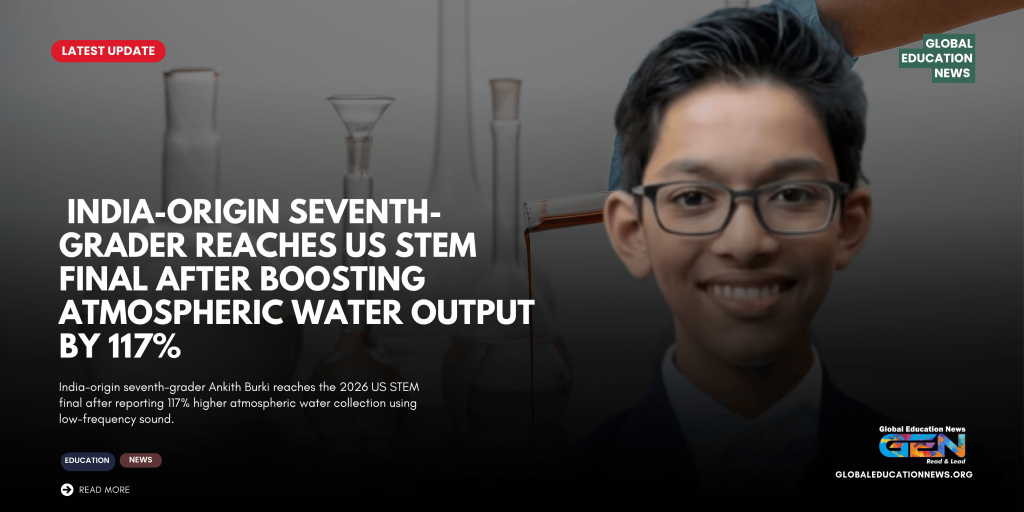
October 5, 2026 | California, US | Education News: Ankith Burki, an India-origin seventh-grader in California, has reached the 2026 Thermo Fisher Scientific Junior Innovators Challenge after developing an experimental atmospheric water generator designed to investigate whether low-frequency sound can increase the amount of water collected from humid air. Under the conditions of his experiments, the project recorded a 117% increase in water collection, turning a school-level STEM project into an example of how young students are tackling real-world problems through scientific research.
The STEM innovation focuses on a deceptively simple question: Can sound help pull more water from the air? Burki’s project explores that possibility by studying atmospheric moisture and whether low-frequency sound can influence the water-generation process. The idea connects classroom science with one of the world’s most pressing challenges — improving access to water in places where conventional sources are limited.
His selection as a finalist also puts a spotlight on the growing role of student-led STEM research, where school students are moving beyond textbook experiments to investigate questions involving climate, water, energy and technology.
Who Is Ankith Burki and What Did His STEM Project Discover?
Ankith Burki is a seventh-grade student in California whose project examines ways to improve atmospheric water collection.
His atmospheric water generator is designed to extract water from humid air. The innovation being tested is the use of low-frequency sound during the water-collection process.
Under the reported experimental conditions, adding the sound-based approach resulted in a 117% increase in water collected compared with the relevant baseline.
The finding is significant as a student research result, but it should be understood within the conditions of the experiment rather than interpreted as proof that the technique will produce the same improvement in every environment.
How Does an Atmospheric Water Generator Make Water From Air?
An atmospheric water generator, commonly known as an AWG, is a technology that captures moisture already present in the atmosphere and converts it into liquid water.
The basic concept is similar to what happens when water vapour encounters a sufficiently cool surface: moisture can condense into droplets.
An AWG typically involves several stages:
- Air enters the system.
- Moisture in the air is captured or condensed.
- The resulting water is collected.
- Depending on the system, the water may undergo treatment before use.
The technology is especially interesting in regions where humidity is relatively high but conventional water access is difficult.
Burki’s project adds another experimental variable — low-frequency sound — to investigate whether the water-collection process can be improved.
What Did Ankith Burki Change in the Water-Generation Process?
The project investigated whether low-frequency sound could increase atmospheric water collection.
The reported result was a 117% increase in water output under the experimental conditions.
That makes the project interesting for two reasons.
First, it explores a technology that could potentially contribute to alternative water-generation methods.
Second, it demonstrates how a school student can frame a real-world problem as an experimentally testable scientific question.
The key scientific issue is not simply the percentage increase. It is understanding why the increase occurred, whether the result can be consistently reproduced and how the effect changes under different humidity, temperature and equipment conditions.
Why Is a 117% Increase in Atmospheric Water Output Significant?
A 117% increase means the experimental setup produced substantially more collected water than the comparison condition used in the project.
However, the number needs context.
Water collection from air depends on factors such as:
- humidity;
- temperature;
- airflow;
- condensation efficiency;
- equipment design;
- energy consumption;
- operating time;
- environmental conditions.
Therefore, a percentage improvement recorded in a controlled experiment does not automatically translate into the same increase in real-world water production.
The value of the project lies partly in identifying a potentially useful experimental relationship that can be tested further.
How Could Sound Help an Atmospheric Water Generator?
This is one of the most intriguing questions raised by the project.
Sound consists of mechanical waves that can influence physical systems. The project investigates whether low-frequency sound can affect conditions involved in atmospheric water collection.
Rather than assuming the mechanism is already established, the student research asks whether introducing sound can alter the process sufficiently to increase water collection.
That makes the work a useful example of experimental STEM thinking:
Question → hypothesis → controlled testing → measurement → comparison → result.
Further research would be needed to establish exactly how the observed effect works and whether it remains effective at larger scales.
Why Does Atmospheric Water Generation Matter for the Global Water Challenge?
The world’s water problem is not simply about the total amount of water on Earth. It is also about where usable water is located, how it is accessed and whether communities have reliable supplies.
Atmospheric water generation is therefore attracting attention as one possible technology for producing water from moisture in the air.
Its potential applications could be particularly interesting in humid environments where atmospheric moisture is abundant.
But AWG systems also face challenges, including:
- energy requirements;
- humidity dependence;
- equipment costs;
- maintenance;
- water treatment;
- scalability.
Student research such as Burki’s does not solve these challenges by itself, but it demonstrates how younger researchers can begin investigating possible improvements.
What Is the Thermo Fisher Scientific Junior Innovators Challenge?
The Thermo Fisher Scientific Junior Innovators Challenge is a major US science and engineering competition for middle-school students.
Reaching the 2026 final places Burki’s project among a group of student innovations selected for their scientific and engineering work.
For a seventh-grader, reaching a national-level STEM competition represents a significant academic milestone.
It also highlights a broader trend in science education: students are increasingly being encouraged to work on research questions connected to real-world problems rather than limiting STEM learning to classroom exercises.
Why Is Ankith Burki’s Project Important for STEM Education?
The project demonstrates several elements that educators often want to develop through STEM education.
Problem identification
The project begins with a practical problem: how to improve water collection.
Scientific experimentation
Instead of simply building a device, the project tests a specific variable — low-frequency sound.
Data-based evaluation
The reported 117% improvement comes from comparing experimental water collection with a baseline.
Interdisciplinary thinking
The project connects physics, environmental science, engineering and technology.
Real-world relevance
The research addresses water access, a challenge extending far beyond the classroom.
This combination makes the project particularly relevant to conversations about how schools can encourage scientific curiosity and independent research.
How Can School Students Turn STEM Ideas Into Real Research?
Burki’s project illustrates an important lesson for students interested in STEM innovation: a strong project does not necessarily begin with an enormous invention.
It can begin with a focused question.
A student might ask:
Can a particular variable change the performance of an existing system?
From there, the research process can involve designing an experiment, establishing a comparison, collecting measurements and examining whether the result is reproducible.
That approach can turn a classroom curiosity into a genuine research project.
What Could Happen to Atmospheric Water Technology Next?
The next stage for this type of research would be testing.
A promising experimental result needs to be examined under different conditions and, eventually, at larger scales.
For atmospheric water generation, important questions include:
- Does the improvement remain consistent at different humidity levels?
- How much additional energy does the technique require?
- Can the system operate efficiently for longer periods?
- Does the effect work with different generator designs?
- Can the technology be scaled economically?
- Is the additional water production worth the energy input?
These questions matter because more water output alone is not enough for a technology to become practical.
The system must also be efficient, reliable and affordable.
Ankith Burki Atmospheric Water Generator Project: Key Facts
| Key fact | Details |
|---|---|
| Student | Ankith Burki |
| Grade | Seventh grade |
| Location | California, United States |
| Project | Atmospheric water generation |
| Experimental idea | Investigating low-frequency sound |
| Reported result | 117% increase in water collection under the experimental conditions |
| STEM competition | 2026 Thermo Fisher Scientific Junior Innovators Challenge |
| Core subjects | Science, technology, engineering and environmental research |
| Global issue addressed | Water access |
| Key research question | Can low-frequency sound improve atmospheric water collection? |
FAQs: Ankith Burki, Atmospheric Water Generator and STEM Innovation
Who is Ankith Burki?
Ankith Burki is an India-origin seventh-grade student in California who developed an experimental atmospheric water-generation project.
What did Ankith Burki’s project investigate?
The project investigated whether low-frequency sound could increase water collection from humid air using an atmospheric water-generation system.
How much did the water collection increase?
The project reported a 117% increase in water collection under its experimental conditions compared with the relevant baseline.
What is an atmospheric water generator?
An atmospheric water generator is a system that extracts moisture from air and converts it into liquid water, typically through processes involving condensation or other moisture-capture methods.
Why is Ankith Burki’s project important?
It connects school-level STEM research with a major real-world challenge: finding additional ways to access and collect water.
Did the project prove that sound can solve water shortages?
No. The reported experiment demonstrates an increase under the tested conditions, but further research would be needed to establish the mechanism, reproducibility, efficiency and real-world scalability of the approach.
What competition did Ankith Burki reach?
He reached the 2026 Thermo Fisher Scientific Junior Innovators Challenge, a major US science and engineering competition for middle-school students.
Why is atmospheric water generation being studied?
Atmospheric water generation offers a potential way to obtain water from moisture in the air, particularly in environments where humidity is available but conventional water sources may be limited.
What challenges does atmospheric water generation face?
Energy consumption, humidity dependence, equipment costs, maintenance, water treatment and scalability are among the important challenges that researchers must consider.
What Ankith Burki’s STEM Innovation Shows
The most striking part of Ankith Burki’s project is not simply the 117% figure. It is the question behind it.
A seventh-grader looked at atmospheric water generation and asked whether something as unconventional as low-frequency sound could change how much water the system collected.
That is the kind of question that sits at the heart of scientific research: observe a problem, propose an idea, test it and let the evidence determine what happens next.
As water security becomes a bigger global concern, projects that connect school science with real environmental challenges can offer students an early pathway into research and innovation.
Global Education News will continue following student innovators, STEM competitions, emerging education technologies and young researchers whose projects connect classroom learning with problems beyond the classroom.