Education News Worldwide
New Delhi, India– Not every student can learn between the same four walls, on the same timetable, at the same speed.
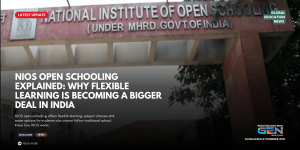
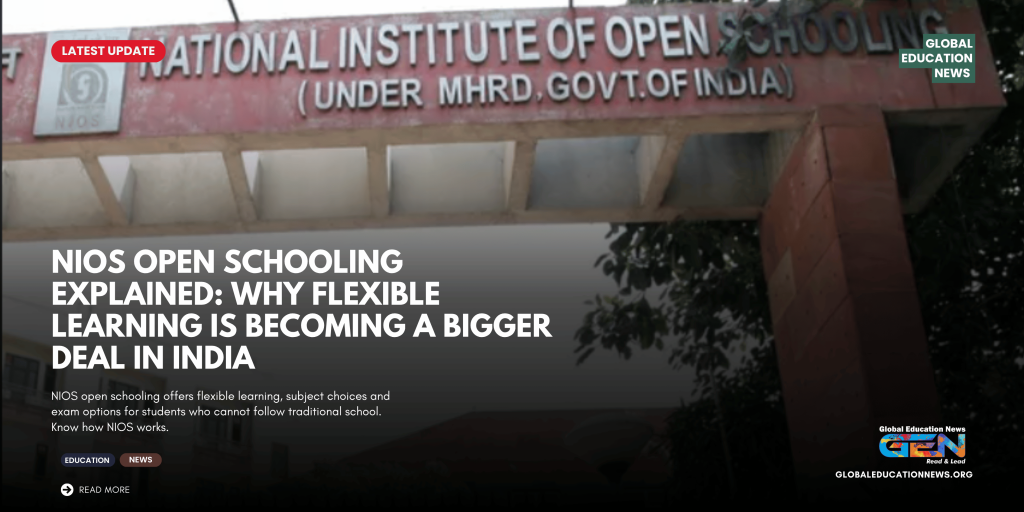
That is where the National Institute of Open Schooling (NIOS) enters the picture. For students balancing sport, work, family responsibilities or other educational needs — and for learners who have stepped away from formal schooling — NIOS open schooling offers something conventional schools often cannot: flexibility.
The idea is becoming more relevant as India confronts a large out-of-school population. The Ministry of Education said in March 2026 that nearly 2 crore children aged 14–18 were not attending school, citing PLFS 2023-24 data. The government has since moved to strengthen the open-schooling framework through NIOS and State Open Schools.
But NIOS is not simply a “second chance” board.
It represents a different way of organising school education — one in which time, pace, subject choice and examination schedules can be more adaptable to the learner.
NIOS Open Schooling: What Makes the System Different?
NIOS was established in 1989 and operates as an autonomous institution under the Ministry of Education. It provides secondary and senior secondary education alongside vocational and other programmes through an open and distance learning model.
Its central idea is straightforward: education should not stop because a student cannot follow the conventional school routine.
At the secondary and senior secondary levels, NIOS provides flexibility in subject selection, pace of learning and, in specified cases, transfer of credits from other recognised boards.
That can matter enormously to a student whose circumstances do not fit the standard school calendar.
A young athlete may need more time for training. A learner with family responsibilities may not be able to attend school every day. Someone who left school years ago may need a route back into formal education.
For such learners, flexibility is not a luxury.
It can determine whether education continues at all.
NIOS Admission: Who Is the Flexible Route Designed For?
NIOS is built around a broad learner base rather than a single type of student.
Its programmes can serve school dropouts, learners returning to education, students seeking alternative academic arrangements and people looking to combine education with other responsibilities.
For the secondary course, NIOS says a learner who has passed Class 8 and has valid proof of being at least 14 years old can apply. It also allows a self-certificate route stating that the learner has studied enough to pursue the secondary course.
The system also has an unusual feature for school education: there is no upper age limit for admission to its secondary and senior secondary courses.
That changes the meaning of “school-going age”.
A person who left education at 15 does not necessarily lose the opportunity to return at 20, 30 or later.
Flexible Learning Means More Than Studying From Home
One of the easiest misconceptions about NIOS is that open schooling simply means sitting at home with books.
The actual model is broader.
NIOS uses self-learning materials and learner support centres, while its system can include audio-video resources and face-to-face contact classes. Learners can study according to their own circumstances rather than following the fixed daily timetable of a conventional school.
Its flexibility also extends to examinations.
NIOS provides an On-Demand Examination System (ODES) for eligible learners, allowing students to take examinations when they are ready under the applicable rules. Its Citizen’s Charter also describes multiple examination opportunities within the registration period and the ability to accumulate credits over time.
That is a significant departure from the traditional model in which an entire academic year can appear to hinge on a single examination cycle.
Subject Choice Can Change the Academic Equation
Another important feature is subject flexibility.
NIOS says it offers 35 subjects at the secondary level and 41 at the senior secondary level, with learners able to choose subject combinations within the applicable rules.
For some students, this can provide room to align school education with longer-term interests.
The question is no longer simply:
“Which school will I attend?”
It can become:
“What do I need to study, and what learning structure allows me to do it?”
That shift is increasingly relevant in an education system where students pursue sports, arts, technology, competitive examinations, vocational skills and other activities alongside academic study.
NIOS and the Second-Chance Education Debate
The strongest case for NIOS may not be the student who is comfortably progressing through conventional school.
It may be the student who is in danger of leaving education altogether.
The Ministry of Education has identified dropout and out-of-school children as a major challenge. In March 2026, it said that more than 50 lakh students fail board examinations each year, while nearly 2 crore adolescents aged 14–18 are outside school.
In May 2026, the Ministry said it was examining how NIOS, State Governments and district administrations could work together to mainstream out-of-school children, particularly those aged 14–18. Officials specifically identified NIOS and State Open Schools as flexible pathways for learners who cannot return to regular schools.
That gives open schooling a much larger role than simply providing an alternative examination board.
It becomes part of the effort to prevent education from becoming a dead end.
But Flexibility Comes With a Catch
There is another side to the NIOS story, and it should not be ignored.
Flexibility can empower students — but it can also demand more self-discipline.
A conventional school provides a daily structure: teachers, classmates, fixed periods, attendance routines and frequent reminders. An open-learning student may have considerably more responsibility for organising study, keeping track of assignments and preparing for examinations.
Recent reporting on NIOS has highlighted concerns at some centres involving limited teaching support, monitoring and student guidance. Careers360, for example, reported accounts from learners and centre personnel describing difficulties around regular teaching and practical subjects.
These concerns should not be confused with the purpose of NIOS itself.
The national system is designed to provide flexibility. The quality of implementation and learner support can vary by centre and programme.
That distinction matters.
NIOS Is Not the Same as Delhi’s NIOS Project
The distinction has become particularly important because recent reports about Delhi have focused on a separate government programme involving students who struggled in mainstream schools.
India Today reported serious concerns about the implementation of Delhi’s NIOS Project, including low pass rates and weak follow-up for some students.
But that programme should not automatically be treated as a description of NIOS as a whole.
NIOS is a national open-schooling institution.
A state or city programme that uses NIOS for a particular group of students is a separate implementation model.
That distinction is essential when evaluating the system fairly.
The Digital Future of NIOS Is Already Taking Shape
The open-schooling model is also becoming more digital.
NIOS has a Virtual Open School platform offering live and on-demand classes, recorded learning resources, assignments, assessments and access to vocational and technology-oriented content. The platform lists areas including artificial intelligence, cybersecurity and Microsoft Office among its learning offerings.
The significance goes beyond convenience.
If open schooling is to serve students who live far from traditional learning centres, digital access can become one of the system’s most important tools.
But technology cannot replace every part of education.
Practical subjects, laboratory experience, mentoring and sustained academic support still require attention.
What NIOS Could Mean for the Future of School Education
The larger story is not really about NIOS versus CBSE, NIOS versus state boards or one schooling model defeating another.
It is about whether India’s education system can accommodate students whose lives do not follow a standard timetable.
UNESCO’s framework on flexible learning pathways similarly describes flexibility as a way of enabling learners to move across different forms and stages of education, including second-chance and alternative pathways.
India’s own policy direction is moving in that direction.
The government has set a target of achieving 100% gross enrolment from pre-school to secondary level by 2030 under NEP 2020, while simultaneously acknowledging the scale of students currently outside the system.
That makes flexible education more than an alternative for a small group.
It could become part of the country’s broader strategy for keeping learners connected to education.
The Real Question Is Not Whether NIOS Is “Better”
For one student, a regular school may provide exactly the structure they need.
For another, that same structure may become an obstacle.
NIOS offers a different proposition: choose subjects within the available framework, study at a more flexible pace, use learner-support mechanisms, and take examinations through flexible routes where eligible.
That does not make open schooling effortless.
It makes it adaptable.
And as students increasingly combine academics with sport, work, family responsibilities, vocational training or periods away from formal education, adaptability may become one of the defining features of the next generation of school education.
The future of learning may not belong to one timetable.
It may belong to pathways that allow students to keep moving, even when life forces them to take a different route.