WORLD NEWS
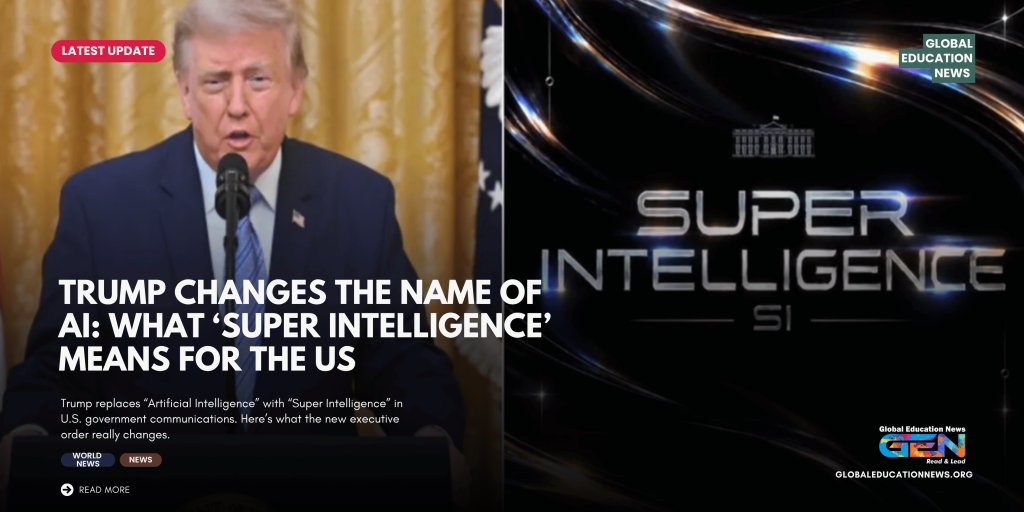
Washington, D.C. — President Donald Trump has formally moved to replace the term “Artificial Intelligence” with “Super Intelligence” across the U.S. executive branch, turning a naming debate that began publicly days earlier into an official government policy. The Trump Super Intelligence executive order, signed on September 29, instructs federal departments and agencies to use “Super Intelligence” and “SI” in official correspondence, websites, reports, policy documents and other non-statutory material.
The order, titled “Inaugurating the Era of Super Intelligence,” does not mean that the technology itself has suddenly changed. Nor does it erase existing federal rules that use the term artificial intelligence.
That distinction is at the heart of what Trump has actually ordered.
Trump AI Rename: What the Executive Order Changes
The White House says the terminology should reflect what it describes as the rapidly advancing capabilities of frontier AI systems.
Under the order, federal agencies are directed, “to the maximum extent permitted by law,” to replace Artificial Intelligence (AI) with Super Intelligence (SI) in official communications. The directive covers government correspondence, public communications, websites, reports, policy documents and other non-statutory material.
The order also makes a crucial qualification: previously issued regulations, presidential actions, contracts, grants and historical documents do not have to be rewritten simply because the terminology has changed.
So, for now, the change is primarily linguistic and administrative.
The technology remains the same.
What Does “Super Intelligence” Mean Under Trump’s Order?
The phrase has a very different history in technology discussions from the way the executive order uses it.
In AI research, superintelligence has commonly been used to describe hypothetical systems whose intellectual capabilities would surpass those of humans across a broad range of domains.
Trump’s executive order takes a broader administrative approach.
For the purposes of implementing the order, “Super Intelligence” and “SI” are temporarily defined using the existing federal statutory definition of artificial intelligence under 15 U.S.C. §9401(3). The order therefore does not immediately create a completely new legal category of technology.
That could change later.
The White House has instructed the Assistant to the President for Science and Technology to submit proposed legislative language within 60 days for a federal definition of “Super Intelligence” and “SI.” The proposal must consider whether the new definition should modify, expand or supersede the existing statutory definition of artificial intelligence.
That 60-day deadline may therefore prove more consequential than the name change itself.
Why Trump Wanted to Replace “Artificial Intelligence”
Trump had already announced his preference for the new terminology during his September 22 address to the United Nations General Assembly, saying the United States would use “super intelligence” instead of “artificial intelligence” in government documents. At the time, it was unclear exactly how the change would be implemented.
The executive order now provides the mechanism.
The White House frames the move around the rapid evolution of frontier systems, arguing that modern AI increasingly amplifies human capabilities and enables advances in areas such as science and medicine.
The administration’s argument is essentially about language catching up with technology.
But the terminology itself remains contested.
From AI to SI: A Rebranding or a New Technology Category?
For federal employees, the difference will soon be visible everywhere.
A government website discussing AI could instead refer to Super Intelligence. A federal report could use SI. Official correspondence may adopt the new terminology as well.
But outside that administrative vocabulary, companies, researchers, universities and the public are not suddenly operating with a different technology.
The order applies specifically to the executive branch and largely to non-statutory government material. It does not instruct Congress to rewrite every federal law containing the words “artificial intelligence,” nor does it require old government documents to be rewritten.
That makes the announcement less a technological switch than a government-wide terminology policy — at least at this stage.
Why the Timing Matters: Trump’s Broader AI Policy
The name change arrived alongside a much larger conversation about how the United States intends to govern increasingly powerful AI systems.
On September 29, Trump also met with leading technology executives, while major companies agreed to a voluntary framework concerning AI safety. Reuters reported that executives from companies including OpenAI, Anthropic, Google, Meta and Nvidia backed commitments involving internal controls and independent auditing.
The White House has therefore placed two ideas side by side: accelerating advanced technology while relying substantially on industry-led safety measures.
That combination has drawn different reactions from technology leaders, policymakers and critics. The debate is no longer simply about what AI can do. It is also about who should set the boundaries for it.
The Bigger Question: Will “SI” Become the New Government Standard?
For now, the answer inside the federal executive branch is yes.
The order directs agencies to adopt the new terminology wherever legally permitted. But the long-term status of “Super Intelligence” depends partly on what happens next.
The White House has explicitly asked for proposed legislation that could establish a federal definition of SI and potentially amend existing statutory references to AI.
That opens the door to a more substantive legal debate.
If Congress eventually changes federal statutes, the impact would extend well beyond government websites and press releases. If it does not, “SI” could remain principally an executive-branch terminology choice layered over an existing legal framework.
What the Trump Super Intelligence Order Does — and Does Not Do
What changes
- Federal executive agencies are directed to use “Super Intelligence” and “SI” instead of “Artificial Intelligence” and “AI” in covered official communications.
- The change applies to government correspondence, websites, reports, policy documents and other non-statutory material.
- The White House has ordered work toward a possible federal definition of “Super Intelligence.”
What does not immediately change
- Existing AI regulations do not automatically disappear.
- Previously issued regulations and presidential actions do not have to be rewritten.
- Existing contracts and grants are not automatically altered.
- The underlying technology has not been renamed in the scientific sense.
- The order does not itself amend every federal statute that uses “artificial intelligence.”
That distinction is easy to lose amid the headline that America has “renamed AI.”
It has not renamed the technology everywhere.
It has changed the vocabulary used by its executive branch.
The AI Debate Is Moving Beyond a Name
The significance of Trump’s move may ultimately depend less on whether Americans begin saying “SI” and more on whether the terminology becomes attached to a new legal and regulatory framework.
Competitor coverage has largely emphasized different pieces of the story: the symbolic nature of the rebranding, the voluntary AI safety agreement with technology companies, the expansion of data centres, and the political debate over regulation.
The executive order itself points to the next stage: a proposed federal definition within 60 days.
That is where the language change could become something more substantial.
For now, AI is still AI in much of the world — and under existing U.S. law. Inside the federal executive branch, however, the preferred government vocabulary has officially shifted to “Super Intelligence.”