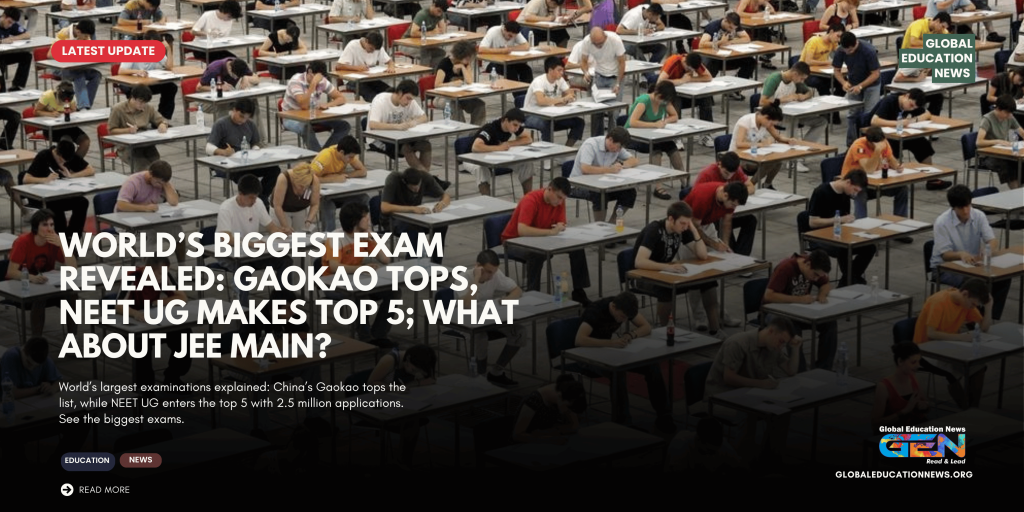
New Delhi, India — For millions of students, an examination is a few hours in a classroom. For governments, it can be a national logistical operation.
A new comparison of the world’s largest examinations by applicant volume puts China’s Gaokao at the top, with about 12.9 million candidates, while India’s NEET UG appears in fifth place with roughly 2.5 million applications. The comparison, based on figures cited in recent SBI Research analysis, also places examinations such as Brazil’s ENEM, China’s national civil-service and postgraduate entrance tests, Türkiye’s YKS and Nigeria’s UTME among the world’s biggest.
For India, the list offers a striking picture. NEET UG, UPSC CSE, JEE Main and UGC NET are not simply large examinations; together they represent different gateways into medicine, public service, engineering and higher education.
But the numbers need context. Application figures in cross-country comparisons can come from different years and definitions, and the latest official Indian data do not always match the rounded figures used in comparative rankings.
That distinction matters.
The World’s Largest Examinations: Where Do Gaokao and NEET UG Rank?
The SBI comparison places the examinations broadly in the following order by applicant volume:
| Rank | Examination | Country | Approx. applications |
|---|---|---|---|
| 1 | Gaokao | China | 12.9 million |
| 2 | ENEM | Brazil | 4.8 million |
| 3 | National Civil Service Examination (Guokao) | China | 3.7 million |
| 4 | National Master’s Entrance Examination | China | 3.4 million |
| 5 | NEET UG | India | ~2.5 million |
| 6 | YKS | Türkiye | ~2.4 million |
| 7 | UTME | Nigeria | ~2.2 million |
| 8 | SAT | US/International | ~2.0 million |
| 9 | SSC and equivalent examinations | Bangladesh | ~1.8 million |
| 10 | ACT | US | ~1.4 million |
| 11 | UPSC Civil Services Examination | India | ~1.2 million |
| 12 | HSC and equivalent examinations | Bangladesh | ~1.2 million |
| 13 | JEE Main | India | ~1 million |
| 14 | UGC NET | India | ~0.8 million |
The figures are approximate and represent the comparative applicant volumes cited in the SBI Research analysis rather than a single synchronized global examination-year database.
That caveat is particularly relevant when comparing NEET UG 2026 with the ranking.
The National Testing Agency’s official information shows that 22,75,011 candidates registered for NEET UG 2026, or about 2.28 million. The examination was conducted nationally on May 3, 2026, with a re-examination later held for affected candidates.
So why does the global comparison cite about 2.5 million?
Because the international ranking is a comparative research exercise drawing on figures that are not necessarily identical in year, definition or counting method. It should therefore be read as a scale comparison, not as a definitive 2026 league table built from one common dataset.
Gaokao: Why China’s Exam Is So Large
China’s Gaokao, officially the national college entrance examination, dwarfs most other individual examinations.
In 2026, approximately 12.9 million students were scheduled to take the exam, according to China’s Ministry of Education. That was down slightly from the record 13.35 million candidates in 2025.
The scale is difficult to comprehend from an Indian perspective.
The Gaokao is not merely another entrance test. It is the principal national mechanism through which students compete for university places, making the examination deeply connected with higher education and future career opportunities.
Its size creates a national logistical challenge involving examination centres, transportation, security, technology, accessibility and emergency planning.
The Chinese government has said authorities use measures to maintain examination security and combat cheating, including stronger monitoring and intelligent inspection systems. In 2025, the Ministry of Education also highlighted arrangements for candidates with disabilities, including Braille question papers for blind candidates.
The scale, therefore, is not only about the number printed on a registration sheet. It is about building an examination system capable of moving and monitoring millions of candidates simultaneously.
NEET UG Is India’s Biggest Single Entrance Examination by Candidate Volume
India does not have one examination equivalent to the Gaokao covering the entire higher-education entrance landscape.
Instead, the system is divided among several major national examinations.
NEET UG is the largest of them by candidate volume in recent comparisons.
The examination is the common entrance route for undergraduate medical education in India. The National Testing Agency conducts it, while the National Medical Commission framework provides for a uniform NEET for undergraduate medical admissions across medical institutions.
In 2026, more than 22.75 lakh candidates registered for NEET UG. That makes the exam one of the largest high-stakes entrance tests anywhere in the world, even before considering state-level examinations and other national tests.
And the significance goes beyond the registration count.
A single NEET score can determine access to a highly competitive medical-admission system, placing enormous importance on examination security, fairness, result processing and counselling.
JEE Main, UPSC CSE and UGC NET Show a Different Side of India’s Exam Culture
The global comparison becomes more revealing when India’s other major examinations are considered.
JEE Main
The Joint Entrance Examination Main serves as a major gateway to engineering education, including admissions to institutions such as the NITs and IIITs.
The 2026 examination recorded about 13.55 lakh registrations, with approximately 13.05 lakh candidates appearing, according to figures cited by Indian Express.
The SBI comparison uses a rounded figure of around one million applicants, placing JEE Main among the world’s largest examinations.
UPSC Civil Services Examination
The UPSC Civil Services Examination operates in a completely different category. It is a recruitment examination rather than a university entrance test.
Yet its application volume—around 1.2 million in the SBI comparison—puts it among the largest competitive examinations globally.
That makes the global ranking more than a list of university entrance tests. It demonstrates how several countries use mass examinations to allocate access to education, employment and public institutions.
UGC NET
The UGC NET is another major Indian examination included in the comparison, with roughly 800,000 applicants cited in the SBI analysis.
Unlike NEET or JEE Main, UGC NET serves the academic and research ecosystem, including eligibility for Assistant Professor and Junior Research Fellowship pathways.
India’s presence across all these categories is significant because it shows the sheer breadth of its examination infrastructure.
India and China Are Solving Different Examination Problems
A simple ranking can make Gaokao and NEET UG appear directly comparable. They are not.
China’s Gaokao functions as a broad national university-admission examination for a huge student population.
India’s examination architecture is fragmented by purpose.
A student seeking medicine takes NEET UG. An engineering aspirant may take JEE Main and potentially JEE Advanced. University applicants may encounter CUET UG or institution-specific routes. Someone seeking entry into the civil services faces the UPSC CSE.
The result is an examination ecosystem with multiple large tests rather than one dominant national gateway.
Indian Express has previously highlighted this distinction, noting that India’s major entrance examinations operate separately for different professional and academic tracks, while China’s Gaokao functions on a much broader national scale.
This is one of the most important points missing from a simple “world’s biggest exams” ranking.
Exam size is not the same thing as exam function.
Why SBI Research Is Looking at Gaokao
The comparison comes at a particularly sensitive moment for India’s examination system.
SBI Research has examined China’s examination-management model while discussing possible lessons for India, including logistics, question-paper security, accountability, contingency planning and candidate grievance mechanisms.
Recent coverage of the report also says SBI Research has proposed changes to the institutional framework of the National Testing Agency, including a separate legal framework, an independent governing structure and stronger mechanisms for examination standards and candidate appeals.
The recommendations reflect a broader question:
What does it take to run a high-stakes examination when millions of candidates depend on the result?
At that scale, security cannot stop at the examination hall door.
Question-paper custody, transportation, centre management, identity verification, technology, scoring, appeals and contingency arrangements all become part of examination integrity.
The Real Lesson From the World’s Biggest Exams
The most revealing figure in the comparison is not necessarily Gaokao’s 12.9 million.
It is the gap between the size of these examinations and the systems required to operate them.
China’s 2026 Gaokao involved about 12.9 million candidates. India simultaneously operates several national examinations, with NEET UG alone registering more than 22 lakh candidates and JEE Main, CUET and other tests adding millions more across different admission routes.
That changes the definition of a successful examination.
For a small test, a mistake may affect a handful of candidates.
For a national examination involving millions, one failure can ripple through admissions, academic calendars, family finances and students’ plans for an entire year.
That is why the emerging global conversation around the world’s largest examinations is not really about who occupies first place.
It is about whether examination systems can remain secure, transparent, accessible and resilient when millions of futures pass through them at the same time.
And on that measure, the Gaokao–NEET comparison offers India a much larger question than a ranking table: how should a country design an examination system when scale itself becomes one of the biggest challenges?