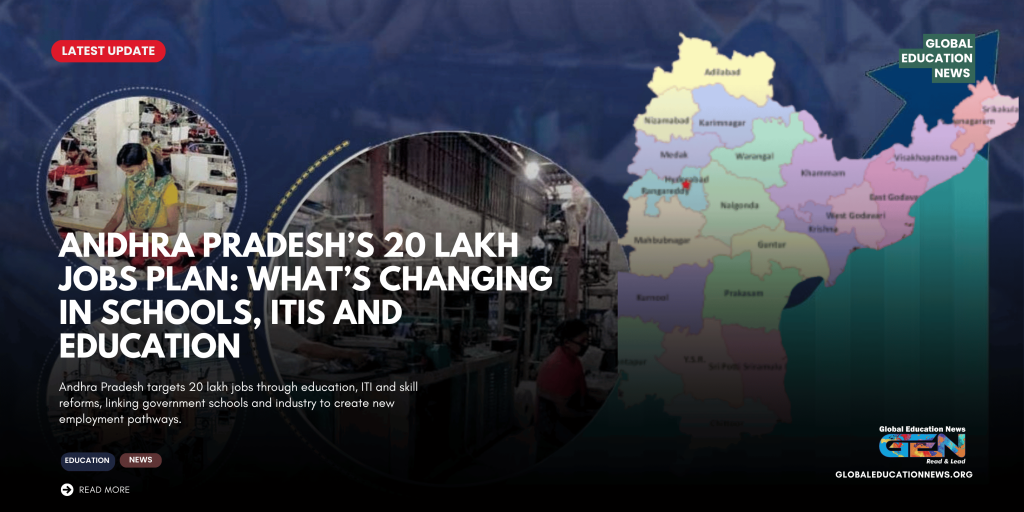
Vijayawada, Andhra Pradesh — Andhra Pradesh is putting employment at the centre of its education reform agenda, with the state government targeting 20 lakh jobs over five years while attempting to reshape how students move from classrooms into the workplace.
The strategy goes beyond government recruitment. It includes stronger industry-education linkages, skill development, vocational training and reforms in government schools and Industrial Training Institutes (ITIs). Education and IT Minister Nara Lokesh has repeatedly described job creation as a central objective of the state’s development programme.
The approach comes as Andhra Pradesh tries to address a familiar problem: students can spend years in formal education and still leave without the practical skills employers are seeking.
The government’s answer is to bring those two worlds closer.
Andhra Pradesh 20 Lakh Jobs Target: Why Education Is at the Centre
The Andhra Pradesh 20 lakh jobs target is being pursued through a mix of skill development, industrial investment, recruitment, job fairs and employment initiatives rather than through government vacancies alone.
In September, the government said around 7.28 lakh jobs had already been grounded through various sectors and programmes, including Mega DSC recruitment, police recruitment, MSMEs, skill development, food processing, IT and electronics and tourism.
That distinction matters.
A target of 20 lakh jobs cannot be achieved simply by expanding public-sector recruitment. The state is therefore trying to make education and vocational training more closely reflect the sectors expected to generate employment.
From degrees to employable skills
The underlying policy shift is straightforward: education should not end with a certificate.
It should give students skills that have a place in the labour market.
The state has already been expanding vocational education in government schools. During the 2026-27 academic year, skill education was being offered to students in Classes VI to XII across 1,599 government schools, while the NCERT-developed Kaushal Bodh curriculum was being used as a pre-vocational programme for Classes VI to VIII.
That creates a longer pathway — introducing students to practical skills before they reach college, ITI or employment.
Government Schools Are Being Drawn Into the Skills Strategy
The most significant part of the reform may be what happens before students reach an ITI.
Andhra Pradesh’s School Education Department says it directly manages around 62,000 schools and 2.8 lakh teachers. Its stated reform agenda includes curriculum changes aligned with the National Education Policy 2020, stronger infrastructure and greater use of digital and academic interventions.
The state is also continuing programmes such as Vidya Sakthi, which uses technology-enabled remedial education in English, mathematics and science for Classes VI to IX. The programme was continued for 2026-27 across 4,720 identified government and other state-supported schools.
The emerging model has two tracks.
One focuses on strengthening academic foundations.
The other asks what practical skills students should acquire alongside them.
That combination could become particularly important for students who do not immediately move into conventional university education.
ITIs Are Being Repositioned Around Industry Demand
The reform conversation extends beyond schools to the state’s ITIs.
Andhra Pradesh was the first state to operationalise the Centre’s PM-SETU programme through the Visakhapatnam ITI cluster, according to the Press Information Bureau. PM-SETU is designed to modernise government ITIs, introduce industry-aligned courses and strengthen links between training institutions and employers.
The national programme envisages upgrading 1,000 government ITIs through a hub-and-spoke model, comprising 200 hub ITIs and 800 spoke ITIs.
For Andhra Pradesh, the model has a particular relevance because the state has identified iron and steel, pharmaceuticals, IT and related sectors as areas of specialisation under PM-SETU.
The idea is not simply to renovate buildings or install new equipment.
The larger objective is to make training reflect the jobs available in the surrounding economy.
Why industry-linked ITIs matter
A student learning a trade in an institute disconnected from modern workplaces can graduate with qualifications that do not fully match employer requirements.
Industry participation can change that equation through:
- Updated course content
- Modern equipment and laboratories
- Apprenticeships and workplace exposure
- Industry-designed training
- New courses linked to emerging sectors
- Stronger pathways from training to employment
The Centre’s PM-SETU framework explicitly identifies industry linkage and demand-driven skilling as core objectives.
Private Skills Universities Could Add Another Layer
Andhra Pradesh is also considering changes at the higher-education level.
In August, the state Cabinet approved the draft Andhra Pradesh Private Skills Universities (Establishment & Regulation) Bill, 2026. The proposal envisages self-financed skills universities operating through a hub-and-spoke model that could integrate ITIs, polytechnics and industrial units.
If implemented, the model would add another link between vocational education and industry.
It also reflects a broader shift in how governments are thinking about higher education: not simply as a route to academic degrees, but as part of a larger skills and employment ecosystem.
The Jobs Target Will Depend on What Happens Outside Government Recruitment
The state’s recent employment numbers illustrate the scale of the challenge.
In September, the government said about 7.28 lakh jobs had been grounded through different initiatives while reiterating the 20-lakh target. Separately, the state Cabinet approved investment proposals worth ₹22,177.84 crore in September, with an estimated employment potential of 19,739 jobs from those projects.
These figures also show why education reform alone cannot create jobs.
Schools can improve foundational learning. ITIs can improve employability. Universities can strengthen technical and professional skills.
But sustained employment ultimately depends on businesses investing, industries expanding, infrastructure developing and workers finding opportunities that match their skills.
Education can prepare people for those opportunities. It cannot create all of them by itself.
What the Andhra Pradesh Model Could Mean for Students
For students, the biggest potential change is that vocational education may become less of a separate route and more of a normal part of schooling.
A Class 7 or Class 8 student may encounter pre-vocational learning. A secondary-school student may receive exposure to specific job-linked skills. An ITI student could train on equipment and curricula shaped more closely by industry. A graduate may encounter skills universities or industry-linked programmes.
The intended journey is increasingly visible:
School → Skills → Industry → Employment
That is a significant departure from the older assumption that academic education and vocational education must remain separate.
The unanswered question
The success of the strategy will ultimately be measured not by the number of programmes announced, but by outcomes.
Can students find jobs after training?
Do employers recognise the qualifications?
Are courses updated quickly enough as technology changes?
Do rural and government-school students receive the same quality of vocational exposure?
And can the state sustain industry partnerships at the scale required for millions of young people?
Those questions will determine whether Andhra Pradesh’s education reforms become a durable employment pipeline or remain a collection of individual initiatives.
For now, the direction is clear. The state is attempting to make education, skills and industry part of the same employment conversation — with the 20-lakh-jobs target providing the headline goal.