New Delhi — For students preparing for India’s biggest entrance examinations, the most important changes at the National Testing Agency may now be happening long before they enter an examination centre.
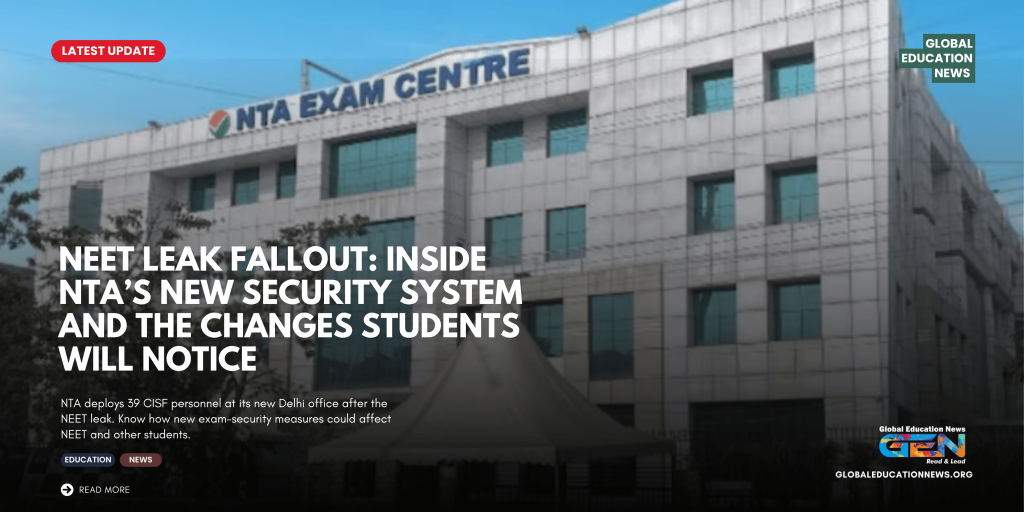
The NTA has shifted confidential and sensitive operations to a new facility at the Government of India Press Building on Minto Road in central Delhi, where 39 CISF personnel have been deployed to secure confidential areas. The new arrangements include tighter access control, frisking, X-ray baggage screening and Door Frame Metal Detectors at entry and exit points.
The move follows the NEET-UG paper-leak controversy and comes as the testing agency undertakes a much wider restructuring of its examination systems.
For Education News Worldwide, the development matters beyond India. NEET is one of the world’s largest medical entrance examinations, and changes to how its question papers are prepared, secured and delivered could affect millions of students who compete for medical seats each year.
NTA Exam Security 2026: What Has Changed?
The new Minto Road facility provides more than 55,000 square feet of space for NTA operations. The fifth floor and portions of the fourth and sixth floors have been allotted to the agency, with confidential areas specifically demarcated for tighter monitoring. Sensitive operations have been shifted from the earlier Okhla office.
The CISF deployment is intended to create a controlled security layer around those areas.
Personnel will regulate access to confidential sections and conduct screening at entry and exit points. The measures include physical frisking, X-ray baggage screening and metal-detector checks.
But the security overhaul does not stop at the door.
From Question Paper Creation to Results
The NTA is working on standard operating procedures covering the examination cycle from beginning to end.
These procedures address question-paper setting, translation, printing, packing, tracking and movement, as well as examination-day protocols, centre security and result-related processes.
The agency is also introducing or strengthening technology-based safeguards, including Aadhaar-based biometric authentication, facial authentication, CCTV monitoring, AI-based tools, mobile jammers and multi-tier examination oversight.
That creates a very different security architecture from simply adding guards to an office.
The aim is to make the entire chain harder to compromise.
Why the NEET Leak Changed the Conversation
The latest measures follow serious scrutiny of examination security after the NEET-UG paper-leak controversy.
According to reporting on the CBI investigation, gaps were identified in the checking and monitoring of people entering and leaving confidential sections. The investigation identified three subject experts as primary sources of the leaked paper, according to the chargesheet cited by multiple reports.
The findings put attention on a basic but critical question: who has access to an examination paper before millions of students see it?
A paper leak does not require a failure at the examination centre. A weakness earlier in the chain can be enough.
That is why the NTA’s latest reforms are focusing heavily on the stages before examination day.
NTA Is Changing More Than Its Office
The Minto Road move is only one component of a larger institutional overhaul.
The NTA is moving toward a more specialised organisational structure, with greater emphasis on areas such as information security, test security, assessment, technology and candidate experience. Additional officers have also joined the agency as part of the restructuring process.
The government has also been implementing recommendations from the K. Radhakrishnan-led High-Level Committee on Examinations, while a separate high-powered task force headed by Infosys co-founder Nandan Nilekani is examining broader examination reforms.
The Supreme Court has also sought updates from the Centre on implementation of examination reforms, emphasising that changes need to become institutionalised rather than remain temporary measures.
Four Layers of Question-Paper Checks
Another proposed change is greater scrutiny of question papers before they reach students.
The government has said the NTA will introduce a four-tier system designed to identify factual, typographical, language and translation errors. The system is part of a broader attempt to reduce weaknesses in the question-paper process.
For students, this could matter almost as much as physical security.
A secure question paper is useful only if the questions themselves are accurate, clearly translated and properly reviewed.
Could NEET-UG Become a Computer-Based Exam?
One of the biggest unresolved questions in the NTA overhaul concerns the future format of NEET-UG.
A high-powered task force is examining whether the medical entrance examination should eventually move from pen-and-paper testing to Computer-Based Testing (CBT). The proposal is still under consideration and is not an announced change to the examination format.
The debate is complicated by India’s enormous geographical and social diversity.
Any move to CBT would require sufficient infrastructure across regions and would have to consider candidates in rural and low-connectivity areas. The government has specifically identified questions around infrastructure and equity as part of the evaluation.
For students, this means one thing: a possible future change should not be confused with the current NEET examination format.
Until an official notification changes the rules, students should continue following the examination pattern announced by the NTA.
What Students Can Expect From the New Security System
Most students will not see the Minto Road office or the people working behind the confidential examination system.
They will, however, encounter the consequences of a more tightly controlled testing environment.
Biometric identification, facial authentication, CCTV surveillance and stronger centre-level security are among the measures being strengthened across the examination ecosystem.
For a student, these measures can mean more identity checks and stricter monitoring during an examination.
The larger objective is straightforward: ensure that the candidate who prepares for months receives the same examination opportunity as every other candidate.
That is particularly important for competitive examinations such as NEET, JEE and other national-level tests where a single examination can influence a student’s next stage of education.
Why This Matters Beyond India
The NTA’s overhaul is also relevant to the wider international education conversation.
Across Education News Worldwide, examination security has become increasingly connected with cybersecurity, artificial intelligence, biometric authentication, data protection and digital testing infrastructure.
India’s experience illustrates why.
Modern examination systems are no longer simply about printing question papers and transporting them to centres. They increasingly involve digital databases, candidate authentication, automated systems, computer networks and large-scale data processing.
Each layer creates new possibilities — and new security responsibilities.
The NTA’s decision to combine physical security with technology, cybersecurity and procedural controls reflects that changing reality.
The Real Test Begins With the Next Examination
The 39 CISF personnel at Minto Road are one visible sign of the NTA’s reset.
The more significant changes are less visible: tighter access controls, revised SOPs, specialist staffing, cybersecurity measures, question-paper checks and technology-assisted monitoring.
The agency has effectively moved from treating examination security as a centre-level concern to treating it as a full-chain responsibility.
For students, that is the change worth watching.
The success of the overhaul will ultimately be measured not by the size of the new office or the number of security personnel deployed, but by whether future examinations can be conducted with consistent security, accuracy and confidence.
For millions of students in India — and for the global education community watching how one of the world’s largest examination systems evolves — that is the real story behind the NTA’s new security wall.