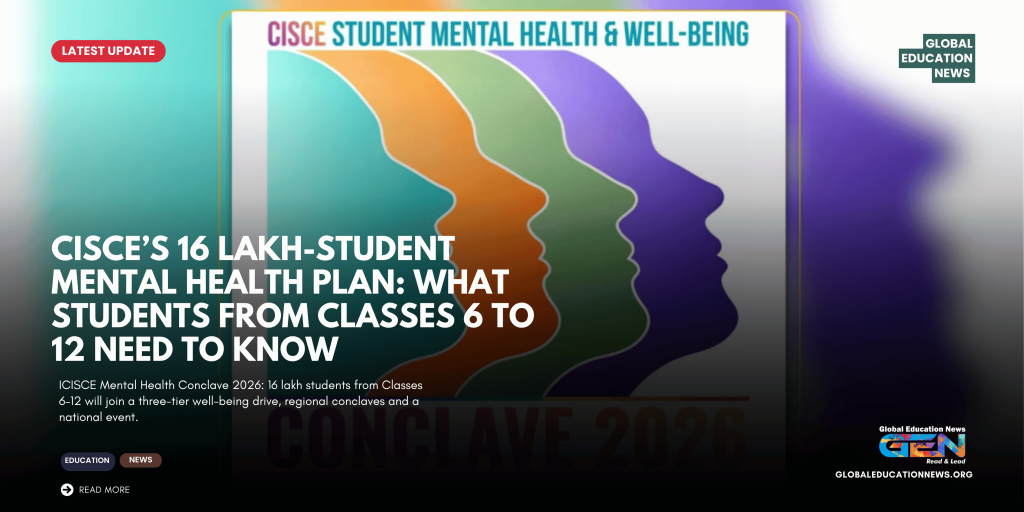
New Delhi, India — The country’s school mental-health conversation is moving beyond counselling rooms and one-off awareness sessions. The Council for the Indian School Certificate Examinations (CISCE) is preparing a nationwide Student Mental Health and Well-Being Conclave 2026, bringing nearly 16 lakh students from Classes 6 to 12 into a structured programme spanning more than 3,300 affiliated schools.
The scale is significant. Around 32,000 teachers are also expected to participate, while the initiative will progress through school-level discussions, regional conclaves and a national gathering in Hyderabad. The stated objective is not simply to talk about student mental health, but to collect students’ experiences and turn them into recommendations for schools and policymakers.
The initiative will coincide with World Mental Health Day on October 10, 2026, before culminating in the national conclave from November 20 to 22 at the CISCE Centre of Excellence in Hyderabad.
CISCE Mental Health Initiative: What Will Students Discuss?
The first phase will run from October 4 to 31 across CISCE-affiliated schools.
Instead of a single national event, CISCE has designed the programme as a three-tier process. Students will first discuss mental health and well-being in their own classrooms, allowing concerns to emerge from the school level before selected representatives take them to regional and national forums.
The school-level discussions will focus on four broad themes:
- Student stress and academic pressure
- Emotional well-being, digital life and positive relationships
- Drugs, substance abuse and healthy choices
- Building resilience and help-seeking behaviour
The approach puts everyday school experiences at the centre of the exercise. Academic pressure, friendships, digital habits and the ability to ask for support are being treated as interconnected parts of student well-being rather than separate issues.
The Telegraph reported that schools have been asked to conduct one structured 40–45-minute discussion each week during the four-week October programme, with class teachers facilitating the sessions and documenting key findings.
Three-Tier CISCE Student Mental Health Conclave Explained
The structure of the CISCE Student Mental Health Conclave 2026 is designed to move from thousands of classrooms to a much smaller national forum.
Tier 1: School-Level Mental Health Dialogues
From October 4 to 31, students in Classes 6 to 12 will participate in structured discussions at their respective schools.
The objective is to create a repository of student perspectives while encouraging schools to strengthen listening, empathy, peer support and appropriate pathways for seeking help.
Schools will consolidate their findings and share observations and examples of practices that support student mental health.
Tier 2: Regional Student Conclaves
The second stage will move online.
Regional conclaves are scheduled across 18 regions from November 4 to 14. Selected student representatives and teacher mentors will examine the concerns and experiences gathered during the school-level discussions.
This stage is significant because the programme does not end when a classroom discussion is completed. The findings are intended to travel upward through the system, allowing recurring concerns and promising school practices to be identified at a wider level.
Tier 3: National Student Mental Health Conclave
The final stage will bring together selected representatives in Hyderabad from November 20 to 22.
CISCE plans to have 72 students representing 18 regions, along with 18 teacher mentors, mental-health and policy experts, CISCE leadership and representatives of partner organisations and the media.
The national gathering will therefore be much smaller than the programme that feeds into it. That is deliberate: millions of classroom experiences are intended to inform a focused national discussion.
16 Lakh Students, but the Real Focus Is Student Voice
The headline figure — nearly 16 lakh students — captures the reach of the initiative. But the more consequential element is what CISCE intends to do with the information gathered from those students.
The council says the exercise will seek to move the conversation from speaking about students’ mental health to listening to students themselves. Their experiences are expected to contribute to practical recommendations and stronger school practices.
That distinction gives the programme a different character from a conventional awareness campaign.
A poster about stress can raise awareness. A classroom discussion can reveal concerns. A structured process that collects those concerns, compares them across regions and feeds them into a national framework has the potential to inform how schools respond to student well-being.
Whether that ambition translates into sustained changes in schools will depend on what happens after the conclave.
Student Mental Health Charter, Well-Being Index and White Paper
CISCE has outlined several concrete outputs from the initiative.
One of the key proposed outcomes is a CISCE Student Mental Health Charter. It is expected to set out principles, rights, responsibilities and recommendations aimed at creating emotionally safe and supportive school environments.
The council also plans to work towards a Student Well-being Index, a repository of exemplary school practices and a White Paper on Emerging Mental Health Concerns among Adolescents.
These proposed outputs could give schools something more durable than a one-time event: a common framework for discussing student well-being and identifying practices that can be adapted across different school settings.
The initiative may eventually become a biennial programme linked to World Mental Health Day, according to CISCE.
Why Classes 6 to 12 Are at the Centre
The decision to include Classes 6 to 12 gives the programme a broad age range, covering students through middle school, secondary school and the senior-secondary years.
That matters because the pressures students encounter can change considerably as they move through school. Younger adolescents may be navigating friendships, identity and changing digital environments, while older students often face examinations, academic choices and decisions about higher education.
CISCE’s four discussion themes attempt to capture several of these overlapping pressures rather than treating academic performance as the sole measure of student well-being.
The emphasis on resilience and help-seeking is particularly notable. A school environment that recognises stress but does not make it easier for students to ask for support leaves the conversation incomplete.
From Classroom Conversations to Policy Recommendations
The most ambitious part of the CISCE mental health initiative is the proposed link between student experiences and institutional decision-making.
CISCE Chief Executive and Secretary Dr Joseph Emmanuel said the initiative is intended to create a culture in which students are heard and their experiences help shape how schools approach mental health, resilience and support.
The programme consequently puts students in a role beyond that of participants.
Their classroom discussions will become source material for regional conversations. Selected representatives will then carry those perspectives to the national forum, where the council plans to develop recommendations and broader well-being frameworks.
That creates a clear chain: classroom → school findings → regional discussion → national conclave → proposed charter and policy framework.
What Happens After the November Conclave?
That may become the most closely watched question once the three-tier programme concludes.
CISCE has outlined several potential outcomes, including the Student Mental Health Charter, Student Well-being Index, best-practice repository and adolescent mental-health white paper. It has also indicated that the conclave could become a recurring biennial initiative.
The success of the exercise, however, will ultimately be measured by what schools do with the findings.
For students and teachers, the immediate phase begins in October. For CISCE, the larger task will be converting thousands of classroom conversations into practical guidance that schools can actually use.
The 2026 conclave, in that sense, is not just an event scheduled for Hyderabad. It is an attempt to build a national conversation from the school classroom upward — with students supplying much of the evidence about what that conversation should look like.