BENGALURU, KARNATAKA — A classroom idea can be easy to write down. Turning it into something that works in the real world is much harder.
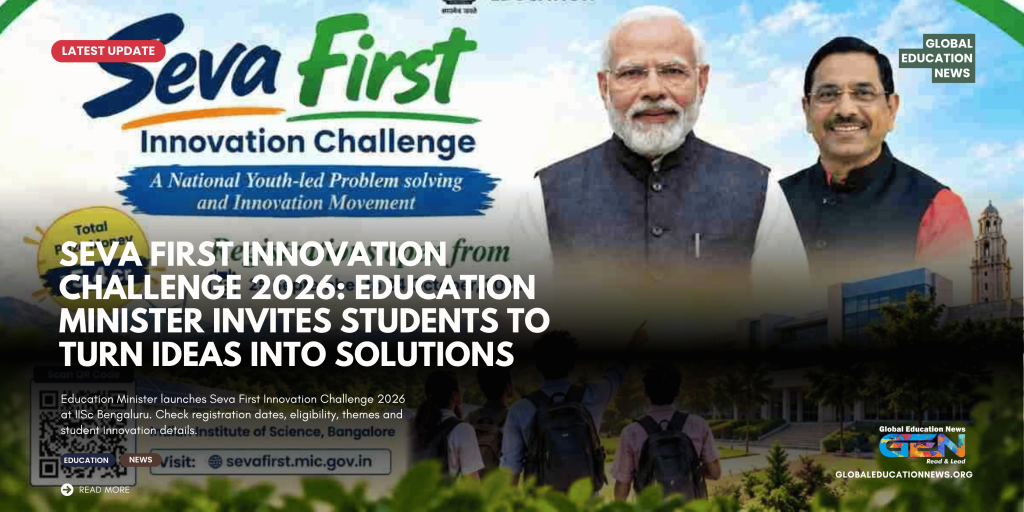
That gap is at the heart of the Seva First Innovation Challenge 2026, which was launched at the Indian Institute of Science (IISc), Bengaluru, on September 25. The initiative, organised jointly by the Union Education Ministry, AICTE and UGC, with IISc Bengaluru as the nodal institute, is designed to help students identify problems in their communities and develop solutions that can be tested, refined and potentially taken towards implementation.
The challenge will bring together young participants from schools, ITIs, polytechnics, colleges and universities across Karnataka, Tamil Nadu, Kerala, Andhra Pradesh, Telangana, Andaman and Nicobar Islands, Lakshadweep and Puducherry.
For students, the proposition is different from a conventional competition. A promising idea could move beyond a presentation and into mentoring, prototyping, laboratory testing, incubation and pilot funding.
What Is the Seva First Innovation Challenge 2026?
The Seva First Innovation Challenge 2026 is a national innovation initiative built around a simple premise: students should not only identify problems but also work towards practical solutions.
The programme gives young innovators different entry points depending on their educational level.
Three Levels of Participation
The challenge has three broad participation categories:
- Junior: Students from Classes 6 to 12.
- Technical: Students from ITIs and polytechnics.
- Open: Undergraduate and postgraduate students and research scholars.
The expectations rise with each level.
School students can identify local problems and propose working solutions or ideas connected to services and governance. ITI and polytechnic students will focus more heavily on engineering, fabrication, electronics and process-based solutions.
For undergraduate students, postgraduates and research scholars, the emphasis moves towards prototypes and pilots with a credible route towards deployment.
That progression is one of the more significant features of the programme. It attempts to connect classroom learning with the messy, practical problems that exist outside campuses.
Five Themes Put Students at the Centre of Real-World Problems
The Seva First Innovation Challenge themes cover areas that affect everyday life and national development.
The five themes are:
- Clean and Sustainable Bharat
- Prosperous Farmers, Prosperous Bharat
- Healthy and Inclusive Bharat
- Educated and Skilled Bharat
- Secure Bharat
The breadth is deliberate. A student interested in agriculture can approach a farming problem; another can work on sustainability, healthcare, education or security.
The challenge therefore gives students a framework while leaving room for solutions rooted in their own communities.
From Student Idea to Prototype: What Happens After Registration?
This is where the programme differs from an ordinary idea competition.
Selected participants will have access to academic and industry mentorship, laboratories, fabrication facilities, testing support and incubation. The initiative also provides for seed and pilot funding, field-testing opportunities and guidance related to intellectual property protection.
Promising solutions may also be connected with government ministries, state governments, urban and rural local bodies, public sector undertakings and industry for possible adoption.
That creates a potential chain:
Problem → Idea → Prototype → Testing → Pilot → Possible Adoption
For a student innovator, the value lies not only in recognition but in having a route to test whether an idea actually works.
Seva First Innovation Challenge Registration: Important Dates
Registration for the challenge opens on September 25, 2026, and the official PIB announcement says the registration window will remain open until October 24, 2026.
The programme is scheduled to culminate in a National Finale in New Delhi from December 10 to 17, 2026.
Students considering participation should therefore pay attention not only to the registration deadline but also to the requirements for developing and presenting their ideas.
Which Students Can Participate?
The initiative has deliberately widened its pool beyond conventional university innovation cells.
Eligible participants include students from:
- Schools
- Industrial Training Institutes
- Polytechnics
- Colleges
- Universities
The three-level structure means that a Class 6 student and a postgraduate researcher are not expected to solve problems in the same way.
Instead, the challenge recognises different stages of technical ability and academic experience.
Why IISc Bengaluru Is the Nodal Institute
The choice of Indian Institute of Science, Bengaluru, as the nodal institute gives the programme a strong research and technical base.
IISc will be associated with coordinating the initiative, while the Education Ministry, AICTE and UGC are jointly organising it.
For students, the significance goes beyond the IISc name. Access to laboratories, technical mentorship and testing facilities can help bridge a common weakness in student innovation: having an interesting idea without the resources to determine whether it can survive outside a classroom presentation.
The Bigger Shift: From Innovation as a Competition to Innovation as a Process
Much of student innovation begins with competitions, hackathons and project exhibitions. The difficult part comes afterwards.
Can the prototype work outside controlled conditions? Can it be produced affordably? Does it solve the problem it was designed for? Can a local authority, government department or industry partner actually use it?
The Seva First Innovation Challenge attempts to address some of those questions by building mentorship, testing, incubation and pilot support into the programme itself.
That makes the initiative relevant not only to students looking for awards, but also to institutions seeking ways to connect education with community problem-solving.
Eight Southern States and Union Territories in the First Phase
The initial challenge will cover five states and three Union territories:
Karnataka, Tamil Nadu, Kerala, Andhra Pradesh, Telangana, Andaman and Nicobar Islands, Lakshadweep and Puducherry.
With schools, technical institutions and universities participating across these regions, the initiative could produce solutions shaped by very different local conditions—from agriculture and rural services to urban sustainability, healthcare and education.
The challenge’s stated objective is to build a culture of community-rooted innovation, encouraging young people to move from identifying a problem to developing a solution that can be tested and potentially implemented.
What Students Should Know
For students considering the Seva First Innovation Challenge 2026, the central message is straightforward: the competition is not asking only for an impressive idea.
It is asking participants to understand a real problem, build a credible solution and demonstrate why that solution could work.
The strongest projects, therefore, will need to connect innovation with usefulness.
The first step is registration. The more difficult—and potentially more rewarding—step comes afterwards: taking an idea from the page into the real world.