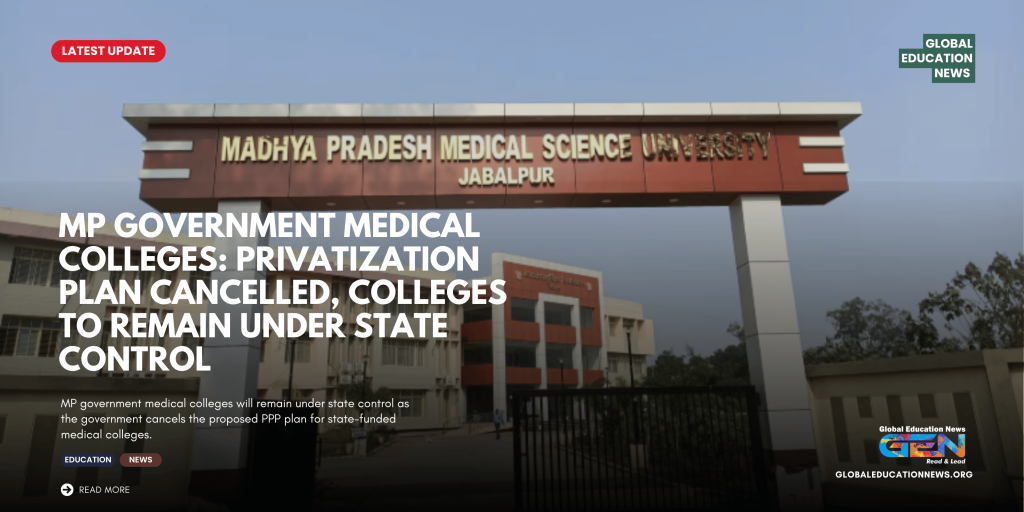
BHOPAL, MADHYA PRADESH — The Madhya Pradesh government has reversed course on the proposed private operation of certain state-funded medical colleges, issuing a clarification that institutions built by the state or under construction with state funds will continue to be operated and maintained by the government.
The decision comes amid a wider debate over the proposed use of the Public-Private Partnership (PPP) model in Madhya Pradesh medical colleges, particularly after questions were raised over the proposed management of the newly established Damoh Medical College and Hospital. The government’s clarification was issued late on September 24, according to reports.
For medical students, doctors and patients, the announcement matters because the management structure of a government medical college can affect how public medical education and hospital services are administered.
Madhya Pradesh Government Medical Colleges to Stay Under Government Management
The state government’s latest position is specific: medical colleges constructed by the Madhya Pradesh government, or those being constructed with state government funds, will not be handed over to private entities for operation under the PPP model.
Deputy Chief Minister and Health and Medical Education Minister Rajendra Shukla confirmed that such institutions would remain under government operation and maintenance.
The clarification is significant because the debate had centred on whether privately managed operations could be introduced into institutions created with public money.
The government has now drawn a clear line around state-funded medical colleges.
What the Government Clarified
The latest position means:
- State-built medical colleges will remain under government operation.
- Medical colleges being constructed with state funds will also remain under government management.
- Such colleges will not be handed to private companies for operation through the PPP model.
- The clarification followed debate surrounding the proposed management structure for Damoh Medical College and Hospital.
Damoh Medical College Became the Flashpoint
The Damoh Medical College and Hospital emerged as a central point in the discussion over PPP-based management.
Recent reports said the proposal to operate the institution through a PPP arrangement faced objections, including from local political representatives and others concerned about how a state-funded medical institution should be managed. NDTV’s report on September 24 noted opposition to the proposal and said the college building had involved substantial public expenditure.
The controversy also needs to be viewed against Madhya Pradesh’s broader expansion of medical education.
The Union Health Ministry said on September 18 that the state had increased its MBBS seats from 5,600 to 6,120 in 2026, adding 520 seats in one year. The Centre also noted that new medical colleges were being developed in several parts of Madhya Pradesh.
That expansion makes the question of how new colleges are operated more consequential for students, faculty and patients.
Why the PPP Model Became a Major Issue
PPP, or Public-Private Partnership, is not simply another name for privatization. It is a model in which public authorities and private entities can share responsibilities under an agreed arrangement.
That distinction matters in Madhya Pradesh because the state is pursuing more than one model for expanding medical education infrastructure.
In September, the Union government said Madhya Pradesh was using a PPP approach for new medical colleges in Dhar, Panna, Katni and Betul, with those institutions targeted for establishment by December 2027.
At the same time, the state’s latest clarification says colleges constructed by the state or under construction with state funds will not be given to private entities for operation under PPP.
The two developments are therefore not necessarily contradictory. They point to different categories of medical-college projects and different institutional arrangements.
What This Means for Medical Students
For MBBS aspirants, the most immediate question is not simply whether a college is called “government” or “PPP”. Students also need to look at factors such as:
- ownership and management structure;
- tuition and other fees;
- seat intake;
- faculty and clinical training;
- attached hospitals and patient load;
- infrastructure;
- hostel and student facilities;
- recognition and regulatory status.
The government’s latest clarification provides greater clarity about the management of state-funded medical colleges, but it does not by itself settle every question surrounding the wider PPP model in Madhya Pradesh medical education.
The Bigger Medical Education Picture in Madhya Pradesh
Madhya Pradesh is expanding its medical education capacity at a time when India is adding MBBS seats and medical institutions.
According to the Union Health Ministry, the state’s MBBS capacity reached 6,120 seats in 2026, up from 5,600 the previous year. Government medical colleges also increased their super-speciality seats from 63 to 73, while private medical colleges increased theirs from 29 to 53.
The expansion is intended to increase the state’s medical workforce and extend specialised healthcare capacity beyond the largest urban centres.
But expansion also brings a second question: who should operate the institutions once the buildings, equipment and academic infrastructure are in place?
The latest government clarification provides one answer for state-funded colleges: the state government will retain responsibility for their operation and maintenance.
What Happens Next?
The immediate uncertainty around the operation of state-funded medical colleges has been reduced by the government’s September 24 clarification.
The larger policy debate, however, is likely to continue because Madhya Pradesh is simultaneously expanding medical education through government institutions and exploring PPP-based models for some new projects.
For students and patients, the distinction between these models will matter most when it translates into practical questions about fees, access, clinical training, hospital services and the long-term administration of medical colleges.
For now, the government’s latest announcement establishes a clear position: medical colleges built or being built with Madhya Pradesh government funds will remain under government operation rather than being handed to private entities through the PPP model.