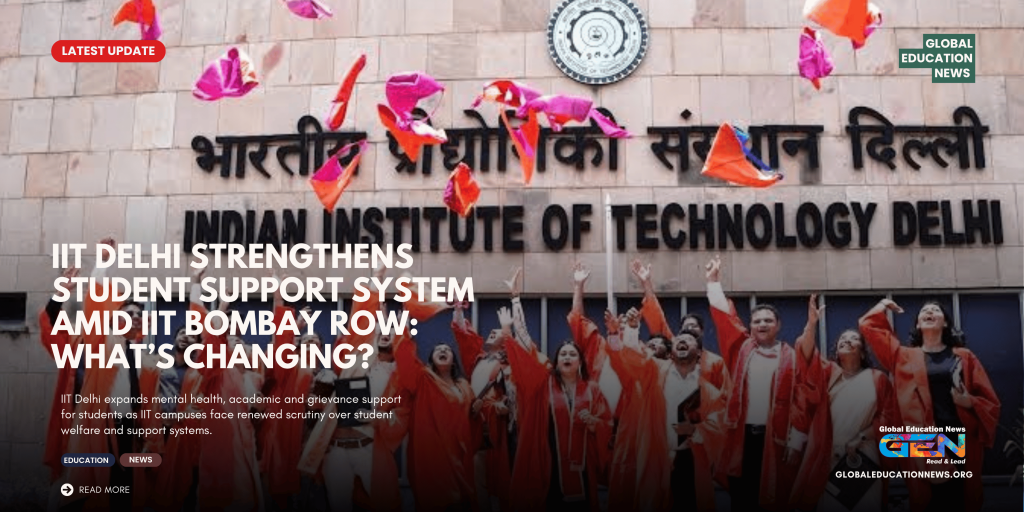
NEW DELHI — IIT Delhi is expanding attention to student mental health, academic flexibility and grievance redressal, putting its existing support mechanisms under renewed focus amid the continuing debate over student welfare at the Indian Institutes of Technology. The move comes as the IIT system faces wider questions about academic pressure, institutional support and how quickly students can raise concerns when they are struggling.
Rather than relying on counselling alone, IIT Delhi’s framework covers several parts of campus life — from academic assistance and faculty interaction to confidential counselling, grievance mechanisms and diversity initiatives.
The institute has said student welfare remains a fundamental priority.
IIT Delhi Mental Health Support: What Has Changed?
IIT Delhi’s approach combines mental health support with academic and institutional safeguards, reflecting the reality that student distress can intersect with academic difficulties, isolation, discrimination or unresolved grievances.
Among the measures highlighted by the institute are counselling services, mentorship programmes, academic assistance and multiple channels through which students can raise concerns.
The institute has also expanded its UG Buddy Programme to include postgraduate and international students. The initiative is intended to strengthen peer connections and help students navigate campus life.
Its National Resource Centre for Value Education in Engineering also incorporates wellness-related activities, including yoga and meditation modules.
Academic Support Is Part of the Mental Health Framework
One of the more significant aspects of IIT Delhi’s response is its focus on academic difficulties.
The institute’s Academic Progress Group, operational since 2023, provides evening tutoring and support for students dealing with credit backlogs. Faculty-student engagement is also supported through the Student-Teacher Interaction Council, semester-level interactions, faculty office hours, project guidance, hostel engagement and Class Committee feedback.
That matters because academic support and mental health support do not always operate in separate lanes. For students struggling with coursework or falling behind, access to timely academic assistance can become an important part of the wider support network.
IIT Delhi Grievance Redressal: Multiple Channels for Students
IIT Delhi has also highlighted a centralised, reference-tracked ERP grievance portal through which students can raise concerns.
The system operates alongside other institutional channels, including the Board for Student Welfare, SC/ST and OBC cells, hostel wardens, the Internal Complaints Committee and confidential counselling channels.
The institute’s grievance framework also specifically addresses caste-related concerns. IIT Delhi says complaints involving caste discrimination are to be handled through established institutional procedures, with designated faculty advisers and officials available for SC/ST-related concerns.
The significance of these mechanisms lies not simply in the number of channels available, but in whether students can use them without uncertainty about where a complaint will go and what happens after it is submitted.
Why IIT Delhi’s Measures Are Drawing Attention Now
The timing has given the measures greater significance.
The IIT Bombay controversy following the death of a student has triggered broader discussion among students and faculty about examination-related procedures, emotional support and institutional responses to difficult situations. Faculty members from several IITs have discussed the need for clearer protocols around examination malpractice and more sensitive handling of students facing distress.
At IIT Bombay, students have also sought changes involving mental health support, grievance mechanisms and institutional accountability. A panel established by the institute is examining the circumstances surrounding the recent incident.
The developments have therefore widened the conversation beyond any single campus.
IIT Delhi Had Already Announced Welfare Measures
IIT Delhi’s latest emphasis on student welfare is not entirely new.
In an August 2026 statement, the institute said it had already strengthened its support infrastructure, including academic flexibility, mentorship, mental health services, diversity initiatives and grievance redressal.
The institute said its revised curriculum, introduced in 2025, reduced first-semester credit loads and added life-skills courses. First-year departmental classes were capped at 30–60 students, while weekend examinations were minimised.
IIT Delhi also said the minimum CGPA requirement for the BTech degree had been removed from the 2024–25 academic year.
These measures point to a broader institutional strategy: reduce avoidable academic pressure while giving students more routes to seek assistance.
Counselling Infrastructure and Professional Support
IIT Delhi has also described a network of professional mental-health support.
In an August statement, the institute said students could access empanelled counsellors whose costs are reimbursed by the institute, along with 15 on-campus counsellors, one full-time psychiatrist and two part-time psychiatrists, including specialists associated with AIIMS and VIMHANS.
The institute has said treatment costs are borne by IIT Delhi.
It also announced plans for an external ombudsperson to address grievances that remain unresolved through existing internal mechanisms. An external inquiry committee was also proposed to examine a separate student-welfare matter and identify further measures that might strengthen institutional support.
Diversity and Inclusion Become Part of the Conversation
Student welfare at IIT Delhi also extends into questions of diversity and inclusion.
The institute’s Office of Diversity and Inclusion, established in 2022, oversees initiatives relating to non-discrimination and accessibility. Its programmes address issues involving caste, gender, language, region and ethnicity.
IIT Delhi also has an Initiative for Caste Equity and an Office of Accessible Education, alongside its SC/ST and OBC-related support structures.
That broader approach is significant because student welfare is not limited to counselling rooms. A student’s experience of belonging, access to faculty, academic support and the ability to raise a grievance can all shape the campus environment.
The Bigger Question for IITs
The developments at IIT Delhi and IIT Bombay have placed a larger question before India’s premier engineering institutions: What should a modern student-support system look like when academic competition, institutional rules and personal difficulties intersect?
The answer cannot rest on counselling services alone.
Universities need clear academic procedures, accessible grievance mechanisms, professional mental-health support, effective mentorship and systems that allow students to raise concerns before problems become crises.
The current discussion across the IIT system suggests that student welfare is increasingly being treated as an institutional responsibility rather than a service operating on the margins of academic life.
For IIT Delhi, the challenge now is implementation.
A support system matters only when students know where to turn, feel able to use it and receive an appropriate response when they do.