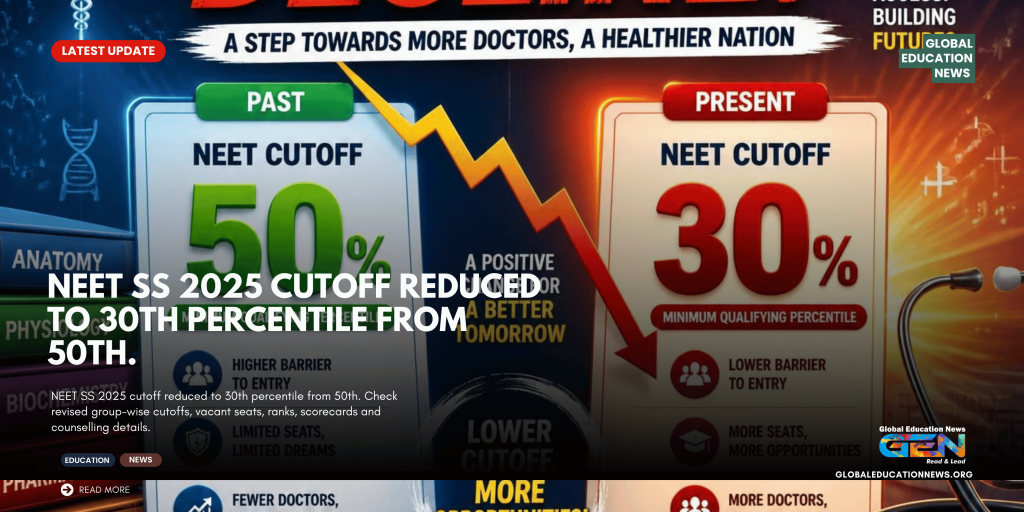
NEW DELHI, INDIA — A major change has opened a fresh route for candidates who appeared for NEET SS 2025, with the National Board of Examinations in Medical Sciences (NBEMS) reducing the qualifying cut-off from the 50th percentile to the 30th percentile.
The revised qualifying criteria mean candidates who secured 30th percentile or above in their respective NEET SS 2025 question paper groups are now considered qualified. NBEMS has shared the revised result with the Medical Counselling Committee (MCC) of the Directorate General of Health Services.
The decision follows developments in the Supreme Court concerning vacant super-speciality seats. After the second round of NEET SS counselling, 1,857 super-speciality seats remained vacant, prompting the Centre to agree to a lower qualifying percentile for the special counselling process.
For thousands of doctors seeking admission to advanced medical training, the change is significant. But the revised percentile does not mean that existing NEET SS ranks have been recalculated.
NEET SS 2025 Cutoff: What Has Changed?
The most important change is straightforward.
The qualifying threshold has moved:
- Earlier qualifying percentile: 50th percentile
- Revised qualifying percentile: 30th percentile
- Applicable candidates: Those appearing in the respective NEET SS 2025 question paper groups
- Revised result: Shared with MCC
- Question paper group-specific ranks: No change
- Fresh scorecards: No new scorecards will be issued
The reduction is therefore about eligibility for the revised counselling process, not a rewriting of the examination’s original ranking system.
That distinction matters.
A candidate whose rank was declared earlier will retain that rank even though the qualifying threshold has now been lowered.
NEET SS 2025 Revised Cutoff: Group-Wise Scores
The revised qualifying marks vary because NEET SS uses different question paper groups. The examination is scored out of 600, and the 30th-percentile cut-off is different for each group.
| NEET SS 2025 Question Paper Group | 30th Percentile Cut-off |
|---|---|
| Anaesthesiology | 249 |
| Critical Care Medicine | 254 |
| ENT | 247 |
| Medical | 175 |
| Medical Oncology | 180 |
| Microbiology | 306 |
| Obstetrics and Gynaecology | 325 |
| Orthopaedics | 256 |
| Paediatric | 231 |
| Pathology | 238 |
| Pharmacology | 213 |
| Psychiatry | 302 |
| Radiodiagnosis | 315 |
| Respiratory Medicine | 285 |
| Surgical | 243 |
The Obstetrics and Gynaecology group has the highest revised qualifying score at 325, while the Medical group has the lowest at 175.
Candidates should therefore check the cut-off against the question paper group they appeared for, rather than treating 30th percentile as a single marks figure for every discipline.
Why Did NBEMS Lower the NEET SS Cutoff?
The immediate issue was the number of vacant super-speciality seats.
According to information presented during the court proceedings, 1,857 seats remained vacant after the second round of NEET SS counselling. The vacant seats included places in highly specialised medical and surgical disciplines.
The Centre subsequently agreed to lower the qualifying percentile from 50th to 30th for the proposed Special Stray Vacancy Round.
The objective is to expand the pool of candidates who can participate and give the counselling authorities a larger pool from which to fill seats that otherwise could remain unused.
That makes the change more than a technical adjustment to an examination cut-off. It is tied directly to the problem of vacant seats in India’s super-speciality medical education system.
What Does the 30th Percentile Mean for NEET SS Candidates?
For candidates who were below the earlier 50th-percentile qualifying threshold but have now reached the 30th percentile, the revised rule creates a new opportunity to participate in the applicable counselling process.
But clearing the revised qualifying threshold does not automatically guarantee a seat.
Seat allotment will still depend on factors including rank, available seats, eligibility requirements and the counselling process.
The distinction between qualifying and securing admission is particularly important when discussing the NEET SS cutoff reduction.
The new threshold expands eligibility. It does not create an automatic admission entitlement.
NEET SS 2025 Rank Will Not Change
NBEMS has specifically clarified that the reduction in the qualifying percentile will not alter the question paper group-specific ranks declared on January 23, 2026.
This means candidates should not expect a new ranking exercise simply because the qualifying threshold has changed.
The revised decision determines who is considered qualified under the new threshold. The ranking already declared by NBEMS remains intact.
No Fresh NEET SS 2025 Scorecards
Another important clarification concerns scorecards.
NBEMS has said that fresh scorecards will not be issued following the reduction in the qualifying percentile.
Candidates therefore need to understand that the absence of a new scorecard does not mean the revised qualification has not been recognised.
The revised result has been communicated to the MCC for the counselling process.
MBBS Marks Will Still Be Verified
NBEMS has also reiterated that candidates’ aggregate marks in their MBBS professional examinations, as provided in their NEET SS 2025 application forms, will be checked against their original credentials at the time of admission.
This becomes particularly relevant where MBBS aggregate marks were used as a tie-breaker in determining the NEET SS rank.
If information supplied in the application is found to be incorrect and that information was used to resolve a tie, NBEMS has stated that the candidate’s candidature can be cancelled.
What Happens to the 1,857 Vacant NEET SS Seats?
The vacant-seat problem sits at the centre of the latest policy change.
Reports on the court proceedings put the number of vacant super-speciality seats after Round 2 at 1,857. Careers360 reported the breakdown as 1,094 DM/MCh seats and 763 DNB-SS seats.
The proposed Special Stray Vacancy Round is intended to give eligible candidates another opportunity to compete for these remaining seats.
The Centre has indicated that the MCC will conduct the special round, with the process linked to the handling of remaining vacant seats.
The precise counselling schedule remains a separate matter and candidates should rely on official MCC and NBEMS announcements for dates and seat availability.
NEET SS 2025 Cutoff Reduction: What Candidates Should Check
Candidates affected by the revised qualifying criteria should focus on four things:
1. Check the Correct Question Paper Group
The revised cut-off is not identical across all NEET SS groups. Candidates should compare their result with the cut-off corresponding to their own question paper group.
2. Confirm Eligibility
Meeting the 30th percentile makes a candidate qualified under the revised threshold, but other admission and counselling conditions continue to apply.
3. Watch MCC Counselling Updates
The revised result has been shared with MCC, which is responsible for the relevant counselling process.
4. Do Not Expect a New Rank
The question paper group-specific ranks declared in January remain unchanged, and NBEMS has said fresh scorecards will not be issued.
A Lower Cutoff, but a Larger Question
The NEET SS 2025 cutoff reduction arrives at an unusual point in India’s medical education calendar.
On one side are candidates who now have another opportunity to compete for super-speciality seats. On the other is a large pool of vacant seats in advanced medical programmes that institutions have been unable to fill through the regular counselling process.
Lowering the qualifying percentile addresses the immediate mismatch between available seats and eligible candidates.
What remains to be seen is how many of the newly eligible candidates eventually secure seats and how effectively the special counselling round reduces the vacant-seat pool.
For candidates, however, the first fact is clear: 30th percentile is now the revised qualifying threshold for NEET SS 2025 under the announced change, replacing the earlier 50th-percentile benchmark.
The next stage will be counselling — and, for those who have spent months waiting outside the earlier eligibility line, that process could determine whether the revised cutoff becomes a genuine second chance or simply another step in an already competitive admission cycle.