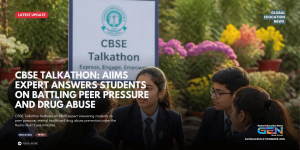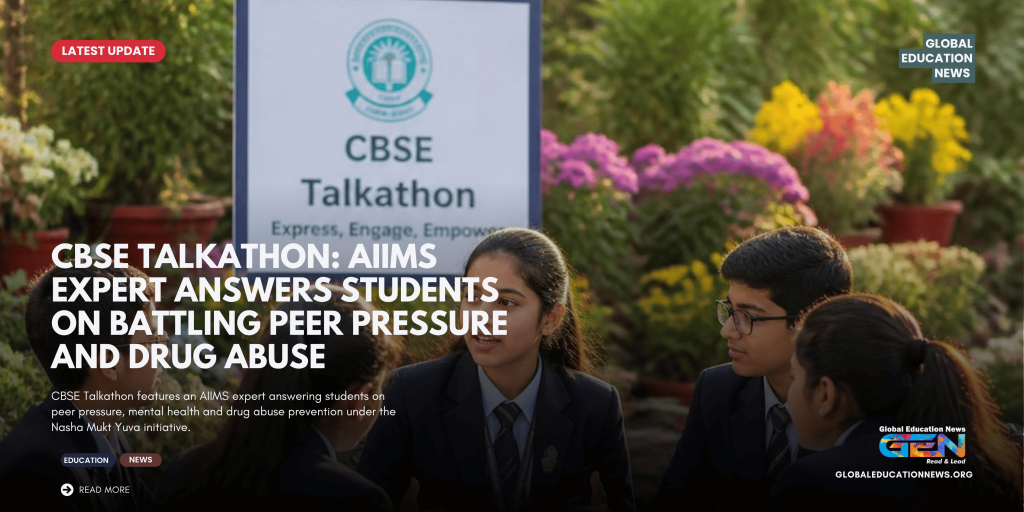
NEW DELHI — The Central Board of Secondary Education (CBSE) has taken its drug abuse prevention campaign directly to school students, hosting a 45-minute interactive Talkathon that put young people’s questions at the heart of the discussion.
Titled “Nasha Mukt Yuva for Viksit Bharat,” the September 20 session brought together experts from psychiatry, drug enforcement and school education to address concerns around substance abuse, peer pressure, mental health, early intervention and responsible decision-making. Students were invited to participate through social media, turning what could have been a conventional awareness programme into a direct conversation with specialists.
The initiative comes as schools face the broader challenge of helping adolescents navigate social pressure and emotional difficulties while ensuring that concerns about substance use are met with timely, informed support.
CBSE Talkathon focuses on drug abuse prevention and peer pressure
The central message of the CBSE Talkathon was not simply to warn students about substance abuse, but to create a space where they could ask questions and receive guidance.
Questions raised during the programme touched on mental health, peer pressure and steps towards de-addiction, according to reports on the event. Experts also stressed the value of patient listening, empathy and non-judgmental support when young people are facing difficulties.
That approach matters in a school setting. Students who feel unable to speak openly about pressure or personal difficulties may be less likely to seek help early. By bringing such questions into a moderated public discussion, CBSE sought to make prevention part of everyday student awareness rather than an issue discussed only after a serious problem emerges.
Students take an active role in the conversation
Two Class 12 students hosted the programme: Samiya from PM SHRI Kendriya Vidyalaya, Sector 4, R.K. Puram, Delhi, and Rohit Singh from PM SHRI Kendriya Vidyalaya No. 3, Delhi Cantt.
Students submitted questions and messages through platforms including Instagram and X, with selected questions taken up during the session. The programme was streamed through CBSE’s official YouTube channel.
The format gave students something often missing from traditional awareness campaigns: a visible role in framing the conversation themselves.
AIIMS, NCB and educators bring different perspectives
The panel combined expertise from healthcare, enforcement and school education.
Among those participating were Professor Nand Kumar from the Department of Psychiatry at AIIMS, New Delhi; Alka Awasthi, principal of Mayoor School, Noida; and Anees C., Additional Director of the Narcotics Control Bureau in New Delhi.
Their involvement allowed the discussion to move beyond a single perspective. Mental health professionals can address psychological and behavioural concerns, educators can discuss the school environment and student support, while drug-enforcement officials can explain the wider consequences of substance abuse and the importance of prevention.
For schools, that combination points towards a broader model of awareness: prevention, identification of concerns, supportive intervention and access to appropriate help.
Why mental health and early intervention featured prominently
One of the more significant aspects of the CBSE initiative was its connection between substance-abuse prevention and student well-being.
The questions received from students included concerns about mental health and peer pressure, while the discussion also addressed early intervention and ways of supporting people who may need help.
This reflects a practical reality for schools. Prevention cannot depend entirely on warnings. Students also need trusted adults, counsellors, teachers and families who can listen to concerns before they escalate.
The emphasis on early support therefore gives the Talkathon a wider educational dimension. It places student well-being alongside academic development as part of the school’s responsibility.
CBSE’s anti-drug awareness campaign extends beyond one Talkathon
The September programme is part of a longer series of CBSE efforts to strengthen awareness around substance abuse.
CBSE documents show that the board has previously issued advisories and conducted awareness initiatives with the Narcotics Control Bureau. In 2024, for example, the board collaborated with the NCB on awareness activities involving students, teachers and parents, including school-level campaigns and educational activities.
The CBSE and NCB partnership has also included programmes designed to strengthen preventive education and awareness in schools. A 2025 awareness programme at Sanskriti School in New Delhi, for instance, brought together more than 500 students and teachers and included discussions on early intervention and rehabilitation.
The latest Talkathon builds on that continuing effort by putting direct student interaction at the centre.
From awareness campaign to everyday school support
The bigger challenge begins after a 45-minute programme ends.
Awareness campaigns can introduce students to the risks associated with substance abuse, but sustained prevention depends on what happens inside schools and homes afterward. Teachers, counsellors, parents and peer groups can all play a role in creating an environment where students feel comfortable seeking help.
The CBSE Talkathon’s emphasis on peer pressure, mental health and early intervention reflects that wider approach. It also places responsibility on educational institutions to ensure that awareness is accompanied by accessible support.
For students, the message was straightforward: asking questions is part of prevention, and seeking help should not be treated as a failure.
‘Nasha Mukt Yuva’ links student well-being with Viksit Bharat
The programme was organised under the broader theme of “Nasha Mukt Yuva for Viksit Bharat”, following the national call for a drug-free India.
CBSE officials have linked the initiative to the longer-term goal of preparing young people to become healthy and responsible citizens. The underlying argument is that India’s development ambitions depend not only on academic achievement, but also on the physical, emotional and social well-being of its younger generation.
That makes the Talkathon more than a one-day awareness event. It represents an attempt to bring prevention, student participation and school-based support into the same conversation.
And for the students who asked the questions, the value may lie in something simpler: having an opportunity to raise concerns openly and hear informed answers from people whose job is to help them navigate difficult situations.