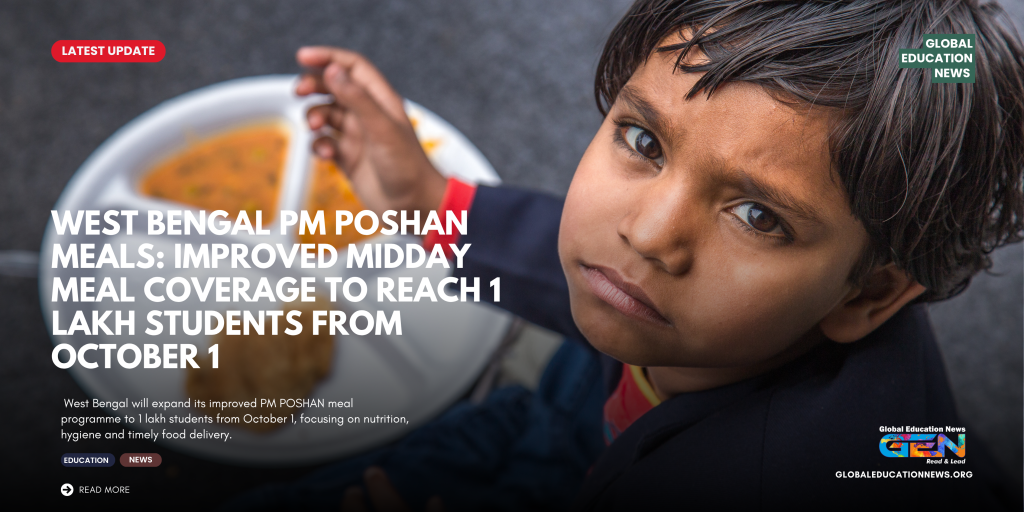
Kolkata, West Bengal — West Bengal is set to significantly expand its improved PM POSHAN meals programme, bringing the upgraded midday meal service to 1 lakh students from October 1, up from the current 45,000 beneficiaries.
The expansion marks another step in the state’s effort to strengthen school nutrition through freshly prepared meals, centralised kitchens and tighter quality standards. The programme is being implemented in collaboration with the Annamrita Foundation, an associate organisation of ISKCON, using centralised modern kitchens to prepare and distribute meals to participating schools.
The state government has said the broader objective is to gradually extend the improved meal service to students across government and government-aided schools in West Bengal.
PM POSHAN Meals to Reach 1 Lakh Students From October 1
The latest expansion will add another 1 lakh students to the improved meal initiative from October 1, according to the announcement.
The programme had initially begun on August 1, when centrally prepared meals were introduced for approximately 30,000 students. Following the initial rollout, another 15,000 students were brought under the programme, taking the current coverage to 45,000.
The next phase will therefore substantially widen the reach of the centralised meal system.
The stated focus is broader than simply increasing the number of beneficiaries. The government has highlighted balanced nutrition, hygienic preparation, prescribed calorie and protein levels, and timely delivery as key elements of the initiative.
From 30,000 to 1 Lakh: How the Coverage Is Expanding
| Phase | Students Covered |
|---|---|
| Initial rollout from August 1 | Around 30,000 |
| Expanded coverage | 45,000 |
| From October 1 | 1 lakh |
The progression reflects a phased approach rather than an immediate statewide rollout.
Centralised Kitchens at the Heart of the Improved Meal Programme
A major feature of the initiative is the use of centralised modern kitchens.
Instead of relying solely on individual school kitchens, the model involves preparing meals at designated facilities before transporting them to schools. The government has said the system is intended to support automated and hygienic food preparation while maintaining prescribed nutritional standards.
That distinction matters for a programme serving large numbers of children. Consistency becomes as important as scale: meals need to meet nutritional requirements while reaching schools within the appropriate timeframe.
West Bengal’s PM POSHAN framework already specifies food norms for students, including prescribed quantities of food grains, pulses, vegetables and oil or fat for primary and upper-primary children.
Nutrition and Hygiene Remain Central to PM POSHAN
The PM POSHAN scheme, formerly associated with the Mid-Day Meal programme, is designed to provide hot, nutritious meals to eligible children in government and government-aided schools.
Under the national framework, states are responsible for providing meals to children in Bal Vatika and Classes I to VIII, while the Centre provides assistance for foodgrains and other components of the programme. States can also adapt menus to local conditions while remaining within prescribed nutrition and food norms.
For West Bengal, the latest expansion places particular emphasis on the quality of food reaching students.
The state government has described eliminating nutritional deficiencies among children as a priority and said it wants students to receive balanced and nutritious food in a clean environment.
Why the October Expansion Matters for Schoolchildren
For many students, the school meal is more than a midday break. It can be an important source of daily nutrition.
That makes the effectiveness of the programme dependent on several factors beyond the headline beneficiary number: the nutritional value of meals, food safety, portion consistency, delivery schedules and the ability of kitchens and schools to handle a larger operational load.
The West Bengal government has indicated that the present expansion is part of a longer-term plan to extend the improved meal system to all students in government and government-aided schools in the state.
The October 1 expansion is therefore being positioned as another stage in that wider plan.
PM POSHAN Expansion Comes Amid Changes in Meal Delivery
The development follows a series of changes surrounding centralised midday meal delivery in West Bengal.
The state school education department recently withdrew approval granted to the Akshaya Patra Foundation for supplying midday meals in four districts, including North 24 Parganas, Howrah, East Midnapore and Purulia. Reports said the September 11 order did not specify a reason for the withdrawal.
At the same time, the Annamrita Foundation continues to be involved in the improved meal initiative in Kolkata and other parts of the state.
The two developments underline the importance of implementation capacity as West Bengal prepares to increase the programme’s reach.
What Changes From October 1?
For students covered by the next phase, the key change will be access to the upgraded centralised meal service.
The programme is expected to focus on:
- Expanded coverage: The initiative will reach 1 lakh students from October 1.
- Freshly prepared meals: Food is prepared through centralised kitchen facilities.
- Nutrition standards: Meals are expected to maintain prescribed calorie and protein requirements.
- Hygiene: Automated and controlled preparation is intended to strengthen food-safety practices.
- Timely distribution: Centralised preparation is designed to support scheduled delivery to participating schools.
- Long-term expansion: The state has indicated an eventual goal of extending the model across government and government-aided schools.