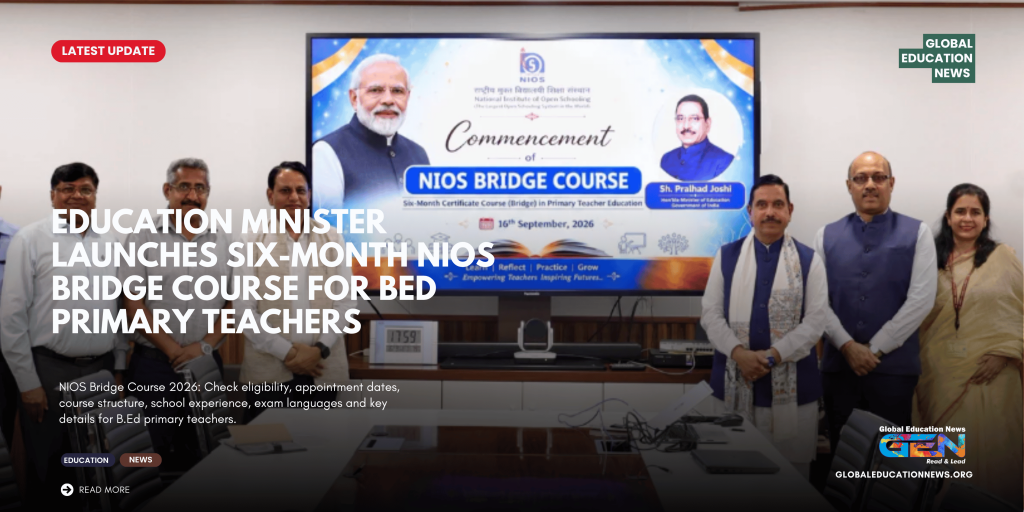
New Delhi — The Union Education Ministry has launched the NIOS Bridge Course 2026 for in-service primary teachers who hold a B.Ed. degree, creating a formal training and certification pathway for teachers working with Classes 1 to 5.
Union Education Minister Pralhad Joshi launched the six-month Certificate (Bridge) Course in Primary Teacher Education (PTE) in New Delhi on September 16. The programme will be implemented through the National Institute of Open Schooling (NIOS) under the framework of the National Council for Teacher Education (NCTE).
The course is aimed at bridging the pedagogical gap for eligible B.Ed.-qualified primary teachers and strengthening their understanding of young children’s learning and development. It combines theory with practical classroom experience rather than relying solely on online study.
NIOS Bridge Course 2026: Who is eligible?
The NIOS six-month bridge course is specifically designed for in-service primary teachers appointed with a B.Ed. qualification between June 28, 2018, and August 11, 2023, subject to the applicable NCTE conditions.
The programme follows directions arising from the Supreme Court’s April 8, 2024 judgment in the Devesh Sharma vs Union of India matter, which provided for development of a bridge course for certain primary teachers appointed without a Diploma in Elementary Education (D.El.Ed.) qualification.
NIOS also provides a separate route for candidates whose appointment dates fall outside the standard period if they have obtained a relevant court order. Such applicants are required to provide additional documents, including an affidavit, writ petition and copy of the court order.
Key eligibility conditions
According to the NIOS registration information, eligible applicants must:
- Be in-service primary teachers with a B.Ed. qualification.
- Have been appointed during the specified June 28, 2018 to August 11, 2023 period under the applicable NCTE notification.
- Complete the course within the prescribed timeframe.
- Meet the relevant conditions attached to their appointment and certification.
The NIOS portal also states that failure to complete the course within the required period can invalidate the appointment.
What does the NIOS six-month bridge course include?
The programme is not structured as a purely academic qualification. It combines coursework with practical experience in a primary-school setting.
The course consists of six theory courses and a school-based practicum, with the curriculum covering areas such as child development, educational psychology, curriculum, pedagogy and assessment. It also includes language pedagogy, mathematics pedagogy and learning related to the world around children.
The structure is designed to move teachers from theory to classroom practice.
School experience is a major component
Teachers must complete at least 20 teaching days of school experience, alongside at least 10 days of contact classes. NIOS also specifies a minimum 80% attendance requirement for the school-experience component.
The practical component includes lesson planning and teaching, portfolio work, activities with children and reflective journal writing. Teachers are expected to engage with areas such as language, mathematics, children’s play, art, craft, music, yoga, physical education and well-being.
That structure gives the course a distinctly classroom-focused character. The aim is not simply to add another certificate to a teacher’s file, but to address the specific developmental and pedagogical needs of children at the primary stage.
Why was the NIOS bridge course introduced?
The background goes beyond a routine teacher-training initiative.
The Supreme Court’s April 2024 directions led to the development of a bridge-course framework for eligible primary teachers who had entered service with B.Ed. qualifications but did not hold the D.El.Ed. qualification associated with primary-level teaching. NIOS subsequently developed the course within the NCTE framework.
The programme’s stated objectives include helping teachers understand the primary-school child, understand how young learners construct knowledge, design appropriate learning experiences and respond to differences involving language, gender, disability and socio-cultural and economic contexts.
For primary education, that distinction matters. Teaching a five-year-old and teaching a teenager demand different approaches, from classroom communication to assessment and lesson design.
NIOS Bridge Course: What qualification will teachers receive?
The programme leads to a Six-Month Certificate (Bridge) Course in Primary Teacher Education.
However, the NIOS portal makes an important qualification clear: the bridge course is intended for retaining the relevant existing employment and is not valid for teachers seeking subsequent employment as primary teachers.
That makes it different from a general route for anyone with a B.Ed. who wants to become a primary teacher.
The course is tied to the specific category of in-service teachers covered by the applicable regulatory and court framework.
NIOS Bridge Course 2026: How will the course be conducted?
The programme will follow the Open and Distance Learning (ODL) mode, allowing eligible teachers to continue their professional responsibilities while undertaking the course.
The academic component will be supported by digital self-learning materials, while the programme also incorporates online contact classes and practical school-based training.
The India Today report notes that the programme includes online contact sessions, school-based experience, practice teaching, reflective journals, portfolios, video tutorials, e-learning resources and digital platforms.
The combination is significant for working teachers: the course is designed around their existing professional responsibilities rather than requiring a conventional full-time classroom programme.
What languages can teachers use for the examination?
The medium of instruction is Hindi and English, according to the launch details.
However, teachers can write the theory examination in any of the 22 languages listed in the Eighth Schedule of the Constitution, according to the programme information reported by India Today.
This multilingual provision is particularly relevant to a nationwide teacher-training programme serving educators across different linguistic regions.
NIOS Bridge Course registration: What teachers should know
The NIOS bridge-course portal has handled registrations through its dedicated online platform, where eligible teachers can submit details and documents and monitor the status of their applications.
The portal’s latest registration information shows that registration windows have been opened and reopened during 2026, including a court-order registration window that ran from July 30 to September 3, 2026.
Therefore, teachers should check the official NIOS bridge-course portal for the currently active admission notice before attempting registration, rather than relying on older registration deadlines.
NIOS Bridge Course 2026: What teachers need to remember
The new programme brings together a legal requirement, teacher training and classroom practice.
For eligible B.Ed.-qualified primary teachers, the key points are:
- Course: Six-Month Certificate (Bridge) Course in Primary Teacher Education
- Implementing body: NIOS
- Regulatory framework: NCTE
- Target group: Eligible in-service primary teachers with B.Ed.
- Standard appointment window: June 28, 2018 to August 11, 2023
- Mode: Open and Distance Learning
- Contact classes: At least 10 days
- School experience: At least 20 teaching days
- School-experience attendance: Minimum 80%
- Instruction: Hindi and English
- Theory examination: 22 scheduled languages
- Purpose: Certification and professional preparation for eligible existing primary-school teachers
- Subsequent recruitment: NIOS states that the bridge course is not valid for seeking subsequent employment as a primary teacher.
The launch therefore marks more than the introduction of another teacher-training programme. It formalises a route for a defined group of in-service teachers while placing greater emphasis on the specialised skills needed in the primary classroom.
For teachers covered by the eligibility rules, the next step is not simply to enrol. It is to verify their appointment details, B.Ed. status and applicable regulatory or court documentation against the latest NIOS instructions before proceeding.