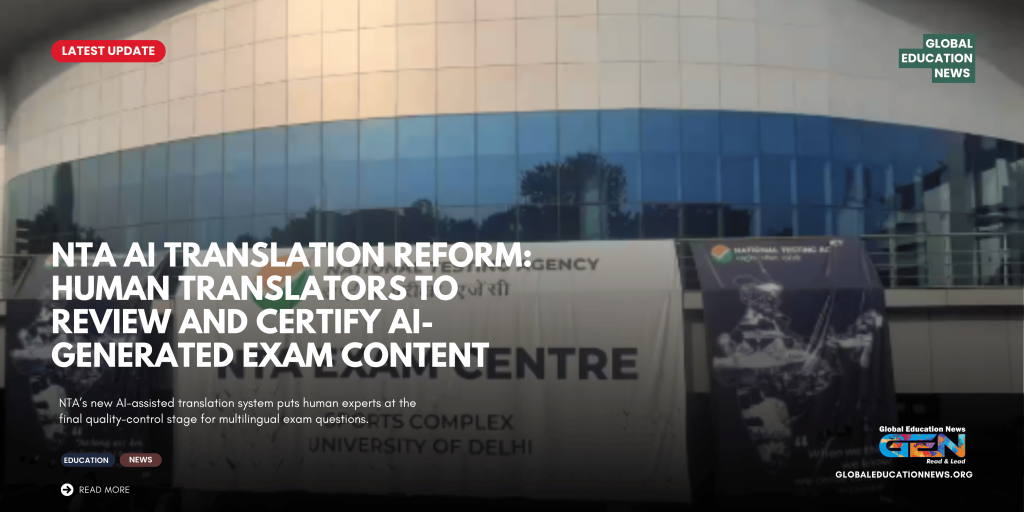
NTA is restructuring its translation process for national examinations, with AI handling the bulk of translation and human language experts checking accuracy, context and technical precision before content is certified.
The National Testing Agency (NTA) is changing the way examination questions are translated, bringing artificial intelligence and human oversight into a new two-stage system designed to improve multilingual accuracy while strengthening the security of sensitive examination material.
Under the revised arrangement, much of the translation from English into Indian languages will be carried out by an AI-based translation platform operating within NTA premises. Human experts, however, will remain responsible for checking the output, identifying linguistic, scientific, technical and contextual errors, recommending corrections and certifying the final translation.
The change affects examinations conducted by NTA in multiple Indian languages, including major tests such as NEET, JEE Main, CUET and UGC-NET. The agency is now seeking professionals for the newly defined role of “translation reviewer”, marking a significant shift from the conventional translator model used in earlier examination cycles.
NTA Translation Reviewers: What Will Change Under the New AI System?
The biggest change is in the division of work.
Instead of asking a human translator to independently translate every examination question, NTA’s proposed process separates translation from quality assurance.
The first stage will use an AI-powered translation platform to generate the initial versions. The second stage will place those translations before qualified human reviewers.
Those reviewers will be expected to:
- Check AI-generated translations for language errors
- Identify technical and scientific inaccuracies
- Examine contextual meaning
- Suggest appropriate corrections
- Ensure clarity and consistency
- Certify the final translation for examination use
The new role therefore makes human expertise a quality-control layer rather than merely a word-for-word translation function.
Why Human Review Still Matters
Translation in a high-stakes examination is more complicated than converting one sentence from English into another language.
A technically correct word can still produce an incorrect question if its context changes. Scientific terminology, mathematical language and subject-specific expressions can carry meanings that automated systems may not always interpret correctly.
That is why NTA’s new model retains human professionals at the final verification stage. The agency’s call for translation reviewers specifically highlights linguistic accuracy, clarity, consistency and contextual relevance.
AI Translation Will Happen Inside NTA’s Secure Infrastructure
The technology component of the new system is also closely tied to examination security.
NTA has specified that the bulk of the translation will be undertaken through an air-gapped AI-based translation platform deployed on NTA premises. Human translation reviewers will then work within a controlled and monitored environment to verify the output.
This is different from a conventional online translation workflow. The arrangement is designed to keep sensitive examination material within a controlled infrastructure.
The security restrictions extend to what reviewers can actually see.
According to the reported details, a reviewer will receive individual examination items one at a time, presented in a randomised order. The reviewer will not see the assembled question paper or the sequence in which the questions eventually appear.
Why NTA Is Tightening Examination Content Security
The restructuring comes as NTA continues a wider institutional reform programme covering the preparation and handling of examination material.
In May 2026, NTA outlined reforms covering question-paper preparation, translation, printing and logistics, alongside technology-based safeguards, cybersecurity, biometric systems and other examination-integrity measures.
The translation changes therefore form part of a broader attempt to redesign how examination content moves through the agency’s systems.
The move also follows heightened scrutiny of examination security after controversies surrounding the NEET UG examination and the subsequent investigation into the paper-leak case. Current reports note that translators and question-paper setters came under scrutiny during that investigation.
NTA’s new structure separates access to individual questions from access to the complete paper, creating another layer between content preparation and the final examination document.
NTA Seeks Translation Reviewers for 13 Indian Languages
The revised system is particularly significant because NTA conducts major examinations in multiple Indian languages.
The agency is seeking language experts who can review AI-assisted translations across 13 Indian languages. Applications for the translation-reviewer panel are part of a wider exercise to bring experienced academic and language professionals into NTA’s examination ecosystem.
The agency has also invited subject matter experts for roles covering question development, review, vetting, moderation, translation and transadaptation. The broader exercise is intended to strengthen the academic quality and consistency of examination content.
Applications Open Until October 9
NTA’s current invitations for subject matter experts and translation reviewers carry an October 9, 2026 application deadline, according to current reporting.
The recruitment is therefore not simply a technology exercise. It also creates a new human-review layer around AI-assisted examination content.
What This Means for NEET, JEE Main and Other NTA Exams
For students, the immediate significance is straightforward: the use of AI does not mean examination questions will be translated without human checking.
Instead, NTA’s proposed workflow places human experts at the verification and certification stage.
That distinction matters in multilingual examinations, where a poorly translated phrase can potentially affect how a candidate understands a question even when the original English version is accurate.
The new process is intended to address that risk by combining the speed of AI-assisted translation with expert human scrutiny before the material reaches the examination paper.
For NTA, the challenge will be to make that division of responsibilities work consistently across subjects, languages and examination cycles.
From Translator to Translation Reviewer: A New Role in NTA’s Exam System
The terminology itself signals the change.
The traditional translator’s job centred primarily on producing the translated version. The new translation reviewer role places greater emphasis on verification, quality assurance and certification.
That means language professionals will need more than fluency. They will need the ability to recognise whether a question retains its intended scientific or technical meaning after translation.
For an examination agency handling millions of candidates, that distinction can be consequential.
AI can accelerate the first stage of translation. Human experts remain responsible for determining whether the resulting text is accurate enough to be used in a high-stakes examination.
NTA’s Larger AI Push Is About More Than Translation
Translation is only one component of NTA’s wider technology overhaul.
The agency has previously outlined plans involving AI-driven integrity controls, biometric and face authentication, anomaly analytics, cybersecurity and modernisation of its technology infrastructure. Its institutional strengthening programme also includes reforms to examination governance, human resources, stakeholder communication and grievance redressal.
The translation initiative fits into that larger picture: technology is being introduced deeper into the examination pipeline, while human experts remain responsible for specialised checks where accuracy and judgement matter.
For candidates preparing for NEET, JEE Main, CUET, UGC-NET and other NTA examinations, the change is unlikely to alter the immediate process of preparing for the tests. But behind the examination screen, the machinery producing the question paper is undergoing a substantial redesign.
And this time, the translator’s role is changing with it.