Tamil Nadu — A promising research paper can take years to become a product. A strong artificial intelligence idea can remain inside a laboratory simply because its creators lack the funding, business expertise or industry connections needed to take it further.
IIT Madras is trying to shorten that journey.
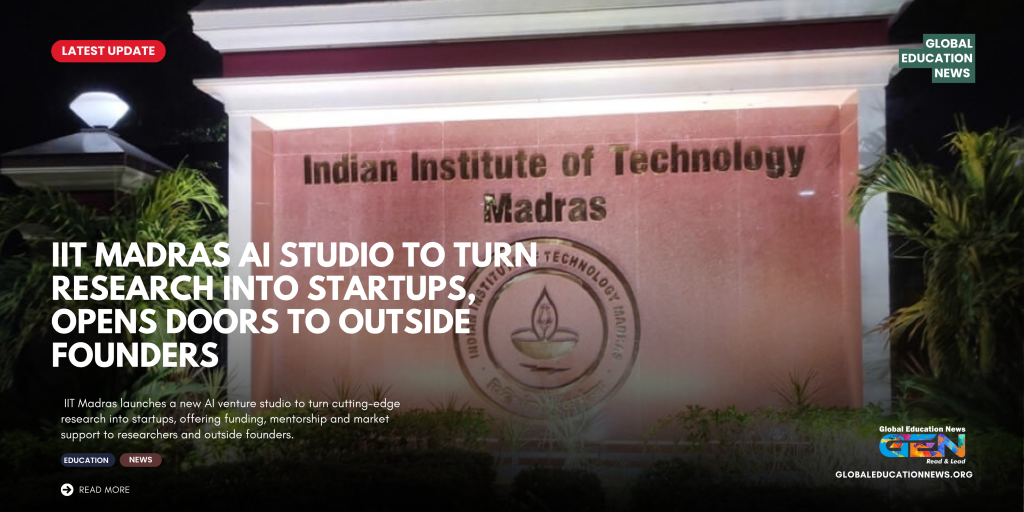
The Wadhwani School of Data Science and AI (WSAI) at the Indian Institute of Technology Madras is launching AI Studio, a venture studio designed to turn research in artificial intelligence, machine learning and data science into startups. Unlike programmes restricted to an institute’s own researchers, the initiative will also accept academic founders from other institutions and external entrepreneurs with relevant ideas or early-stage ventures.
Applications for the inaugural cycle are scheduled to open on October 3, 2026. Selected teams will move through training, technology development, market validation and funding preparation, with successful ventures potentially progressing into the IIT Madras Incubation Cell ecosystem.
The initiative comes at a time when India is trying to translate its expanding research base in artificial intelligence into products, companies and commercially useful technologies.
IIT Madras AI Studio targets the gap between research and startups
The central idea behind the IIT Madras AI Studio is straightforward: research should not stop at publication.
The studio will help teams determine whether a technical idea addresses a genuine market need, develop the technology, test its potential with users and prepare the venture for institutional funding and incorporation.
That makes the initiative different from a conventional incubation programme. Its emphasis is on moving an idea through the uncertain stage between research discovery and a viable business.
The programme will initially bring applicants through a broader training and bootcamp phase. A smaller group will then be selected for the full studio programme.
The selected ventures will receive support over a six-month development and evaluation programme, with an extension of up to three months possible for ventures moving towards an institutional funding round. Two cohorts are expected each year.
Who can apply to IIT Madras AI Studio?
One of the most notable features is the programme’s relatively open founder base.
The studio is intended for:
- IIT Madras and WSAI researchers
- Academic founders from other institutions
- External entrepreneurs
- Teams with an AI, machine learning or data science idea
- Existing early-stage ventures in these fields
That external access expands the initiative beyond the conventional university entrepreneurship model. A founder does not necessarily need to be an IIT Madras student or faculty member to enter the programme.
For researchers outside the IIT system, that could create a route to laboratories, technical expertise and an established incubation ecosystem that might otherwise be difficult to access.
What will selected AI startups receive?
The studio’s support package is designed to cover several stages of startup development.
Selected teams will have access to:
Seed funding: Early financial support to help teams develop their concepts.
Cloud and computing credits: Resources needed to build and test computationally intensive AI systems.
Research laboratories: Access to WSAI’s research infrastructure and capabilities.
Mentoring: Guidance from faculty, domain specialists and entrepreneurship experts.
Entrepreneur-in-Residence support: Experienced entrepreneurial input during the company-building process.
Product-market-fit assistance: Support in determining whether a proposed technology solves a problem customers actually need to solve.
The objective is to move teams beyond simply demonstrating that a technology works. They must also establish whether it can become a sustainable product or business.
From AI research to a potential IIT Madras startup
The intended pathway is relatively clear.
Research or idea → training and bootcamp → venture selection → technology development → market validation → funding preparation → potential spin-out.
That final step could be significant.
Ventures that successfully progress through the studio may move towards formal incorporation or spin-out into the IIT Madras Incubation Cell ecosystem, connecting the new companies with a wider network of entrepreneurship and deep-tech support.
IIT Madras already has an established technology-transfer and startup ecosystem. Its official technology-transfer platform lists hundreds of technologies and numerous companies that have emerged through its incubation activities.
The AI Studio therefore represents an additional layer: helping promising research reach the stage where incubation and commercialisation become realistic options.
Health AI, education AI and Indic-language technology among focus areas
The studio’s potential reach extends beyond generic AI applications.
Current coverage identifies areas including health AI, education AI, responsible AI and Indic language AI among its focus areas.
These fields have particular relevance in India.
Health-focused AI could address clinical and diagnostic challenges. Education AI could be applied to learning, assessment and academic support. Indic-language AI has the potential to tackle one of India’s longstanding technology challenges: building useful digital systems for users across the country’s many languages.
WSAI’s wider research portfolio already spans healthcare, agriculture, smart cities, financial analytics, manufacturing, energy and education, alongside foundational and responsible AI research.
That research base gives the new venture studio a broad pool of technical expertise from which potential startups can emerge.
IIT Madras wants research to move from the lab into the real world
The launch also reflects a broader shift taking place across India’s higher education and research institutions.
For years, the success of academic research has often been measured through publications, patents and scholarly recognition. Increasingly, universities are being asked to demonstrate how discoveries can translate into technologies, companies, jobs and solutions to real-world problems.
The Wadhwani Innovation Network has similarly focused on accelerating the commercialisation of academic research through partnerships with institutions including IITs and IISc, particularly in areas such as AI, health technology, quantum computing, biotechnology and advanced computing.
The challenge is substantial. Moving from laboratory research to a market-ready company requires more than technical expertise. Founders need customer feedback, product development, capital, business strategy and often a willingness to change the original idea.
That is the gap the IIT Madras AI Studio is designed to address.
IIT Madras deep-tech ecosystem already has a sizeable base
The new studio is not being created in isolation.
According to IIT Madras’s reporting cited in current coverage, its broader deep-tech incubation ecosystem has supported hundreds of startups, with a combined valuation of around $8 billion and more than 11,000 direct jobs.
Those figures provide context for the new AI initiative. The objective is not merely to produce prototypes, but to create a pipeline through which research can potentially become companies capable of attracting further investment and entering the market.
The institute’s technology-transfer ecosystem also lists established incubated companies and hundreds of technologies developed through research and development.
What makes the AI Studio different?
The distinguishing feature may ultimately be its position between university research and venture creation.
Traditional research programmes concentrate on discovery. Incubators generally support companies that already have a relatively defined business direction. The AI Studio is positioned earlier, helping researchers and entrepreneurs test whether a technical idea can become a product and whether that product can become a company.
That is especially relevant for AI and deep-tech ventures, where the distance between a scientific breakthrough and a commercially viable product can be considerable.
The studio’s success will therefore depend not simply on how many ventures enter the programme, but on how many can survive the difficult transition from promising technology to a product customers are willing to adopt.
Applications open October 3
For prospective founders, the immediate milestone is October 3, 2026, when applications for the inaugural AI Studio cycle are scheduled to open. The programme will subsequently operate through two annual cohorts, with winter and spring application cycles.
The initiative gives researchers and entrepreneurs another route to turn AI, machine learning and data science work into commercial ventures—with IIT Madras’s research infrastructure, mentors, funding support and incubation network forming the bridge between the laboratory and the market.
For India’s rapidly expanding AI ecosystem, that bridge may prove as important as the research itself.