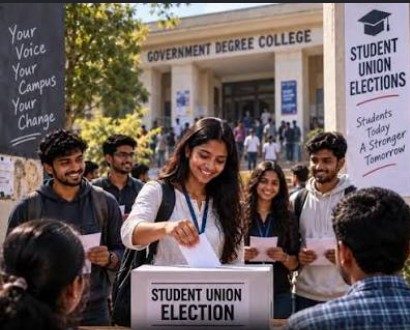
After nearly four decades, Karnataka’s college campuses are set to witness a return of student union elections. The State Cabinet has approved the reintroduction of elections in colleges and universities from the 2026-27 academic year, ending a ban that has kept formal campus elections out of the state since 1989.
But this comeback comes with a significant condition: political parties and student organisations will not be permitted to contest or campaign under their banners. The government says the objective is to give students an opportunity to practise democracy and develop leadership skills without allowing campus politics to become a platform for partisan activity.
Why Were Student Elections Banned?
Karnataka’s earlier ban followed concerns over violence, political interference and disruption to academic activities. In 1989, the then government ended student union elections across colleges and universities, replacing elected bodies in many institutions with nominated or advisory councils.
What was initially viewed as a temporary response eventually continued for 37 years. Generations of students passed through Karnataka’s higher-education institutions without participating in formal campus elections.
The absence of elections, however, did not completely remove student engagement from campuses. Students continued to raise concerns over fees, examinations, hostels and other issues, while political connections and student activism continued in less formal ways.
A Different Model of Campus Democracy
The new system is designed to bring elections back without recreating the political environment that contributed to their earlier ban.
Under the proposed structure, students will elect a president, two vice-presidents, a general secretary, two joint secretaries and a six-member executive committee. Several positions will be held by women, including one vice-president, one joint secretary and two members of the executive committee.
Importantly, there will be no caste-based reservation in these student elections, according to the government. Colleges also will not be forced to conduct elections if students collectively decide they do not want them.
No Party Banners, No Outside Campaigning
The most distinctive feature of Karnataka’s new student election rules is the attempt to separate student representation from organised political activity.
Political parties and their student wings will not be allowed to participate. Candidates must contest as students of their respective institutions rather than as representatives of external organisations. Outside political involvement and campaigning on campuses will also be restricted.
This approach seeks to create a middle ground between two competing concerns: giving young people practical experience of democracy while protecting colleges from political confrontation and disruption.
Why Student Elections Matter
Supporters of the move argue that campuses can serve as an early training ground for democratic participation.
An elected student representative has to listen to peers, identify common concerns, negotiate with administrators and take responsibility for decisions. These experiences can develop communication, leadership and organisational skills that extend beyond college life.
The Karnataka government has similarly described the initiative as a way to nurture leadership, responsibility and democratic values among students.
The policy also reflects a broader question about the role of higher-education institutions. Should colleges simply provide academic qualifications, or should they also prepare students to participate responsibly in public life?
The Challenge Will Be Maintaining the Balance
Bringing elections back after 37 years will not automatically resolve the debate over campus politics.
The success of the new system will depend on how effectively colleges enforce the restrictions on external political influence while still allowing students to express different opinions and compete fairly.
There is also a practical question about whether the absence of formal party affiliation will genuinely prevent political influence. Students may still have individual political views or informal connections. The government’s challenge will therefore be to distinguish between healthy democratic participation and organised partisan interference.
A New Chapter for Karnataka Campuses
Karnataka’s decision marks a major shift in its approach to student representation. The state is restoring a democratic process that disappeared from campuses in 1989, but it is doing so under a framework designed to prevent the violence and politicisation associated with the earlier system.
For today’s students, the change could offer an experience that several generations before them did not have: the opportunity to vote for representatives, campaign on campus issues and participate directly in institutional democracy.
The experiment will ultimately be judged by whether student elections can strengthen leadership and representation without allowing campuses to become arenas for external political battles.
For Karnataka’s colleges, the return of the ballot box is therefore more than a procedural change. It is an attempt to reopen the door to campus democracy — while keeping the party banners outside.