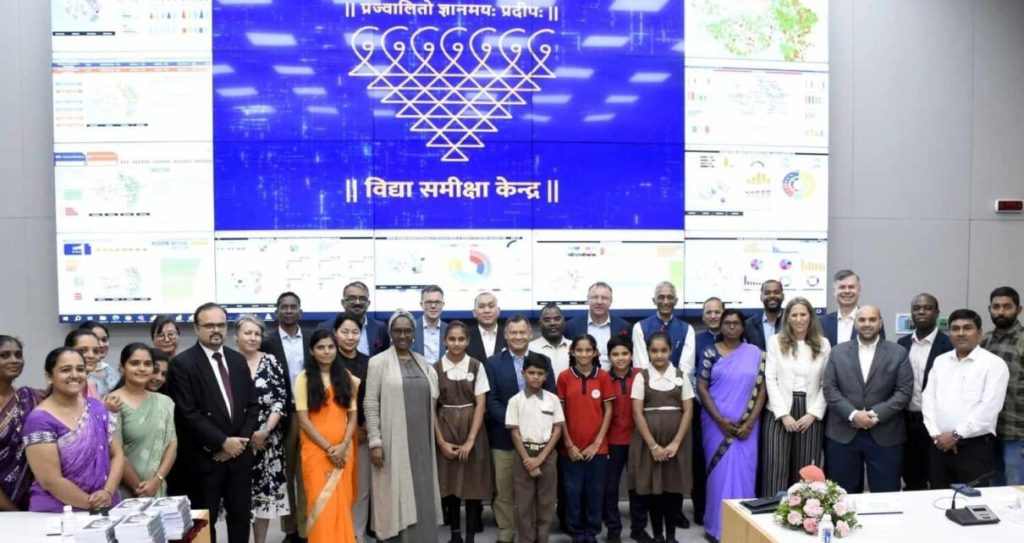
India’s school education system is increasingly moving from data collection to data-driven action.
At the centre of this shift are Vidya Samiksha Kendras (VSKs) — technology-enabled monitoring centres designed to bring together education data and provide administrators with a clearer, near real-time picture of what is happening across schools.
The Ministry of Education has highlighted the role of VSKs in using real-time data, technology and digital dashboards to strengthen monitoring and support informed decision-making in school education. The initiative is now established across 35 States and Union Territories and three national-level autonomous bodies — NCERT, CBSE and NIOS.
The larger ambition is straightforward but significant: instead of waiting for periodic reports to reveal problems, education administrators should be able to identify emerging gaps and respond to them much sooner.
What Are Vidya Samiksha Kendras?
A Vidya Samiksha Kendra is a technology-based education monitoring centre that brings together information from different parts of the school education system.
The idea emerged from the need to overcome a familiar problem in large education systems: huge amounts of data are generated by different programmes and platforms, but the information can remain fragmented.
The Ministry of Education’s 2022 framework for VSKs highlighted three key challenges:
- Visibility: knowing what is happening across the education system in near real time
- Insights: understanding what is working and where problems exist
- Coordinated action: using those insights to take timely corrective measures
VSKs were therefore conceived as a mechanism to integrate and analyse education data rather than allowing different datasets to remain isolated.
From School Data to Government Decisions
The significance of VSKs lies in what can be done with the information collected.
The system is designed to track several important aspects of school education, including:
- Student enrolment
- Attendance and participation
- Learning progress
- Dropout and retention
- Textbook delivery
- Teacher requirements
- School-level academic activities
- Non-academic activities
- Educational programme implementation
By bringing such information into digital dashboards, administrators can potentially identify areas requiring attention without waiting for lengthy reporting cycles.
The objective is not simply to produce more statistics. It is to help policymakers and education officials turn information into timely interventions.
Why Real-Time Monitoring Matters in School Education
Traditional education administration often relies on reports that move through several levels before reaching decision-makers.
That process can make it difficult to identify emerging problems quickly.
Consider a student at risk of dropping out.
If the problem becomes visible only after the student has already left school, bringing that child back can be considerably harder.
A data-driven monitoring system, by contrast, can help identify patterns associated with declining attendance, learning gaps or other warning signs earlier.
This is one reason VSKs are being positioned as an important component of data-driven school governance.
The objective is to move from:
Problem reported → Data compiled → Review conducted → Action taken
towards a more responsive model:
Data captured → Problem identified → Intervention planned → Outcome monitored
That change could have a significant impact when implemented effectively across India’s large and diverse school system.
Tracking Learning Outcomes Is a Major Focus
Enrolment alone does not tell the complete story of education.
A child may be enrolled in school but still struggle with foundational reading, writing or mathematics.
VSKs are therefore designed to incorporate information related to learning levels and academic achievement.
The Ministry’s broader education-data framework seeks to use assessment information alongside other datasets to provide a more comprehensive picture of student progress.
This approach is particularly relevant as India focuses increasingly on foundational learning and competency-based education under the National Education Policy (NEP) 2020.
The ultimate test of the system, however, will not be how much data is displayed on a dashboard. It will be whether the information results in better classroom support and improved learning outcomes.
VSKs Can Help Identify Students at Risk of Dropping Out
One of the most important potential applications of the system is identifying students who may be at risk of leaving school.
Government reporting has highlighted examples of technology-driven interventions being used for this purpose.
In Gujarat, for example, the state has used its education monitoring system to identify children considered at risk of dropping out and intervene before they leave the education system.
This illustrates how education data can move beyond administrative record-keeping.
Instead of simply recording who has dropped out, a responsive system can attempt to identify who may be at risk of dropping out and help authorities intervene earlier.
That distinction is crucial for improving retention.
The Role of Teachers and Schools
VSKs are not designed only to monitor students.
The system also seeks to identify support requirements for teachers and schools.
This can help administrators understand where additional academic resources, training, infrastructure or other forms of support may be required.
The broader objective is therefore not simply to hold schools accountable.
It is also to provide decision-makers with information that can help them allocate resources where they are most needed.
A school showing weak learning outcomes, for instance, may require targeted academic support rather than simply being marked as underperforming.
A National Education Data Network Is Taking Shape
The VSK initiative has expanded significantly since the Centre asked States and Union Territories to establish state-level systems.
The Ministry’s annual reporting indicates that VSKs are being developed across the country, while the Rashtriya Vidya Samiksha Kendra (RVSK) at NCERT provides a national-level institutional framework for integrated education monitoring.
The national system is designed to bring together multiple education datasets and provide a more integrated view of the school education ecosystem.
This creates the possibility of moving from isolated state or programme-level monitoring towards a more connected national education-data architecture.
How Technology Fits Into the VSK Model
The VSK framework combines several technological capabilities.
Digital Dashboards
Dashboards can present complex education data in a format that administrators can interpret more quickly.
Data Integration
Information from different education programmes and systems can be brought together to reduce fragmentation.
Artificial Intelligence and Analytics
The broader VSK framework envisages the use of big-data analysis, artificial intelligence and machine learning to identify patterns and generate useful insights.
Near Real-Time Monitoring
The goal is to reduce dependence on delayed reporting and provide decision-makers with more current information.
Together, these technologies can help transform education administration from a largely retrospective process into a more responsive one.
VSK and the 6A Education Data Framework
The national VSK framework has also adopted a broader data-capturing approach.
The Rashtriya Vidya Samiksha Kendra at NCERT has been associated with a “6A” framework covering areas such as:
- Attendance
- Assessment
- Accreditation
- Administration
- APAAR
- Artificial Intelligence
The objective is to create a more integrated understanding of the education system by connecting multiple dimensions of school administration and student learning.
The framework demonstrates how education technology is increasingly moving beyond digital content delivery towards system-level governance and analytics.
What VSKs Mean for Parents and Students
For students and parents, VSKs may appear to be a government administrative initiative operating behind the scenes.
But the potential effects can reach the classroom.
If data is used effectively, it could contribute to:
Earlier identification of learning gaps
Students struggling academically could be identified for additional support.
Better monitoring of attendance and retention
Patterns that indicate disengagement could receive earlier attention.
Improved textbook delivery
Authorities can monitor whether learning materials reach schools and students on time.
Better teacher support
School-level requirements can be identified and communicated to administrators.
More targeted use of public resources
Resources can potentially be directed towards schools and communities where needs are greatest.
The important word is potentially. Technology alone cannot guarantee these outcomes. The quality of data, local capacity and the willingness to act on the information remain equally important.
From Monitoring to Accountability
Another important dimension of VSKs is accountability.
The system can help administrators monitor whether educational programmes are being implemented as intended and whether expected outcomes are being achieved.
The Centre has said the initiative aims to improve academic performance, strengthen teacher accountability and promote effective utilisation of available resources.
However, accountability should ideally be accompanied by support.
If a dashboard identifies a school with poor outcomes, the next question should not only be “Who is responsible?”
It should also be:
“What support does this school need to improve?”
That distinction could determine whether data-driven governance becomes a tool for improvement or merely another layer of reporting.
The Big Challenge: Data Is Useful Only When It Leads to Action
The expansion of VSKs is an important technological development, but the system faces a fundamental challenge.
Collecting data is not the same as solving a problem.
A dashboard can identify an attendance decline. It cannot by itself determine whether the reason is transportation, family circumstances, economic pressure, migration, health or another local issue.
Similarly, a learning assessment can reveal that students are struggling with mathematics. It cannot automatically replace a trained teacher or provide the classroom intervention required.
The success of VSKs will therefore depend on what happens after the data reaches decision-makers.
Data Quality Will Be Critical
For a data-driven education system to work, the underlying information must be reliable.
Incorrect, outdated or incomplete data can lead to incorrect conclusions.
This means states and education departments will need robust systems for:
- Data verification
- Timely updating
- Interoperability
- Teacher and school training
- Technical support
- Responsible data use
- Monitoring of system performance
The larger the education network becomes, the more important these safeguards will be.
Privacy and Responsible Use Also Matter
The expansion of digital education monitoring inevitably raises questions about how student and school data is handled.
As systems integrate information across multiple platforms, protecting sensitive educational information becomes increasingly important.
The future of data-driven education cannot depend only on collecting more information. It must also involve responsible governance, appropriate access controls and secure handling of student data.
Trust will be essential if technology is to become a sustainable part of school administration.
VSKs and the Future of India’s School Education System
India’s school education system is too large and diverse to be managed effectively through traditional reporting mechanisms alone.
With millions of students, teachers and schools spread across urban, rural and remote regions, policymakers need timely information to understand where interventions are working and where additional support is required.
This is where Vidya Samiksha Kendras could become increasingly important.
The initiative represents a broader transformation in education governance:
From paperwork to digital dashboards.
From delayed reporting to near real-time monitoring.
From isolated datasets to integrated information.
From reactive intervention to early identification of problems.
And ultimately:
From data collection to data-informed decision-making.
What Comes Next for Vidya Samiksha Kendras?
The next phase will be less about establishing VSKs and more about making them genuinely useful at the ground level.
The Centre has already reported VSKs across 35 States and Union Territories and at NCERT, CBSE and NIOS.
The challenge now is to ensure that the information generated through these systems reaches the people who can act on it — district officials, school leaders, teachers and other education stakeholders.
If that happens, VSKs could become much more than monitoring centres.
They could evolve into decision-support systems for India’s school education sector, helping governments identify problems earlier, target interventions more effectively and measure whether those interventions are actually improving outcomes.