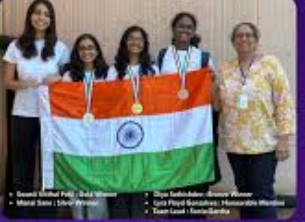
India has reached a new milestone in international competitive programming, with Swasti Patil of Pune emerging as one of the members of the Indian team that secured the country’s first-ever gold medal at the European Girls Olympiad in Informatics (EGOI) 2026.
The prestigious competition was held in Italy from May 12 to 18, 2026, bringing together talented young women in computing and algorithmic problem-solving. The Indian contingent’s performance was described as the country’s best-ever showing at the competition.
Patil was joined by Lyra Floyd Gonsalves of Mumbai, Mansi Sane of Mumbai and Diya Sathishdev of Chennai in the four-member Indian contingent. Together, they marked an important moment for India’s competitive programming ecosystem.
India’s First EGOI Gold: Why the Achievement Matters
The significance of the 2026 result goes beyond a single medal.
India’s first gold at the European Girls Olympiad in Informatics highlights the growing pool of young Indian talent in algorithms, computational thinking and programming. It also puts the spotlight on opportunities for girls to participate and excel in areas of STEM that have traditionally had lower female participation.
The achievement is particularly notable because EGOI is designed specifically to provide a global platform for young women with an interest and aptitude in informatics.
India’s 2026 performance therefore represents both a competitive success and an encouraging signal for the future of women in technology.
Meet the Indian EGOI 2026 Team
The Indian contingent consisted of four young programmers:
- Lyra Floyd Gonsalves — Mumbai
- Swasti Patil — Pune
- Mansi Sane — Mumbai
- Diya Sathishdev — Chennai
The team’s achievement came through the country’s established Indian Computing Olympiad (ICO) pathway, which identifies and develops students with strong abilities in competitive programming and algorithmic problem-solving.
Their success demonstrates the depth of talent emerging from India’s school-age computing community.
From Indian Computing Olympiad to the Global Stage
International achievements such as the EGOI gold do not happen in isolation.
India’s competitive programming ecosystem has a structured selection process through the Indian Computing Olympiad. The ecosystem includes competitions such as the Zonal Informatics Olympiad (ZIO) and Zonal Computing Olympiad (ZCO), followed by the Indian National Olympiad in Informatics (INOI).
The 2026 INOI results illustrate the scale of this talent pool. Sixty-one students received INOI medals, including 10 gold, 20 silver and 31 bronze medals, while 36 students qualified for the International Olympiad in Informatics Training Camp.
For EGOI, 12 students were shortlisted for the selection process from the INOI pool.
This pathway gives talented students an opportunity to progress from national-level programming contests to international competitions.
More Than 1,500 Students Entered the 2026 Selection Pipeline
The scale of participation also shows why the Indian team’s achievement is significant.
More than 1,500 students registered across the Zonal Informatics Olympiad and Zonal Computing Olympiad in the 2026 cycle. From this broader pool, students progressed through successive stages of national-level competition and selection.
For young programmers, these contests test much more than the ability to write code. They demand logical reasoning, mathematical thinking, algorithm design and the ability to solve unfamiliar problems under time constraints.
That combination of skills is increasingly relevant in fields ranging from artificial intelligence and cybersecurity to software engineering and advanced research.
Why Competitive Programming Matters in the Age of AI
The rise of artificial intelligence has changed the technology landscape, but foundational computing skills remain important.
Competitive programming develops the ability to break a complex problem into smaller components, identify patterns and construct efficient solutions. These are closely related to the computational thinking skills needed in modern technology fields.
India’s success at EGOI 2026 therefore comes at a time when the country is seeking to strengthen its pipeline of talent in AI, deep technology, semiconductors and advanced engineering.
The achievement of students such as Swasti Patil shows that this talent pipeline is being developed at a much earlier stage.
A Milestone for Girls in Computing
Perhaps the most important dimension of the EGOI achievement is its message for girls interested in technology.
Competitions dedicated to young women in informatics create an environment in which students can build confidence, compete internationally and see computing as a field in which they can pursue long-term careers.
The Indian team’s performance provides a visible example of what sustained participation in programming and problem-solving can lead to.
For schools and educators, it also reinforces the importance of giving students opportunities to explore coding beyond the conventional classroom curriculum.
Swasti Patil’s Achievement Adds to Pune’s Growing STEM Story
Swasti Patil’s success brings particular attention to Pune, a city with a strong educational and technology ecosystem.
Her achievement illustrates how students can develop advanced computing abilities outside the conventional boundaries of classroom learning. It also highlights the value of competitive programming as a pathway for students who enjoy mathematics, logic and technology.
At a time when schools are increasingly introducing coding, computational thinking and AI-related learning, stories such as Patil’s can encourage more students to explore these areas seriously.
What the EGOI 2026 Result Means for India
India’s first EGOI gold can be viewed through three broader developments:
1. Stronger international presence
The result establishes a new benchmark for India’s participation in the European Girls Olympiad in Informatics.
2. Greater visibility for women in technology
Young women succeeding at an international computing competition can help challenge outdated perceptions about who belongs in advanced technology fields.
3. A stronger competitive programming pipeline
The achievement demonstrates the value of structured national-level competitions in identifying and nurturing computational talent.
The Road Ahead for India’s Young Programmers
The EGOI result is unlikely to be an isolated achievement.
India already has an established competitive programming ecosystem connecting school-level contests with international opportunities such as the International Olympiad in Informatics (IOI) and Asia Pacific Informatics Olympiad (APIO).
The challenge now is to ensure that talented students from different backgrounds have access to quality mentorship, computing resources and opportunities to participate.
For girls in particular, expanding access could help India build a much larger pool of future programmers, researchers, engineers and technology entrepreneurs.
A Gold Medal, but Also a Bigger Message
Swasti Patil and her teammates have achieved something that will remain an important milestone in India’s computing Olympiad history: the country’s first-ever gold medal at EGOI.
But the larger story is about the emergence of a new generation of Indian students who are comfortable solving difficult computational problems on an international stage.
As India looks to build capabilities in artificial intelligence and other advanced technologies, achievements in foundational computing deserve equal attention. The skills developed through algorithmic problem-solving—curiosity, persistence, precision and logical reasoning—can form the foundation for much bigger accomplishments.
For Swasti Patil, the EGOI 2026 gold is a remarkable achievement. For Indian education and STEM, it is also a reminder of what can happen when young talent gets the opportunity to compete, learn and aim beyond the classroom.