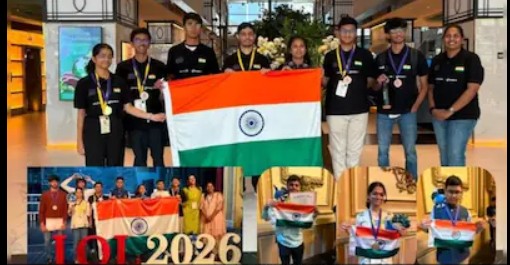
India has added another impressive achievement to its growing record at international academic Olympiads.
The Indian contingent at the International Linguistics Olympiad (IOL) 2026 in Romania won one gold medal, three bronze medals and an Honourable Mention, showcasing the country’s strength in language-based reasoning and problem-solving.
Shrilakshmi Venkatraman secured the gold medal for India, while Aarav Anil Rao, Nishanth Shankar Lakshmanan and Advay Misra won bronze medals. Soham Amit Pednekar received an Honourable Mention.
The result is particularly notable because the International Linguistics Olympiad does not primarily test memorised knowledge of languages. Instead, contestants are challenged to identify patterns, decode unfamiliar linguistic systems and apply logic to complex language problems.
Meet India’s IOL 2026 Medal Winners
India’s successful contingent produced a mix of medal-winning performances and an Honourable Mention.
Shrilakshmi Venkatraman — Gold
Shrilakshmi Venkatraman emerged as India’s top performer at the 2026 Olympiad, winning the country’s gold medal.
Her achievement highlights the importance of analytical thinking in linguistics, where competitors often need to identify grammatical or structural patterns from limited information.
Aarav Anil Rao — Bronze
Aarav Anil Rao secured a bronze medal, contributing to India’s strong overall performance.
Nishanth Shankar Lakshmanan — Bronze
Nishanth Shankar Lakshmanan also won bronze, adding another individual medal to India’s tally.
Advay Misra — Bronze
Advay Misra completed India’s trio of bronze-medal performances.
Soham Amit Pednekar — Honourable Mention
Soham Amit Pednekar received an Honourable Mention, further strengthening India’s overall showing at the competition.
What Is the International Linguistics Olympiad?
The International Linguistics Olympiad is a global academic competition that challenges school students to solve problems involving languages and linguistic patterns.
Unlike conventional language examinations, contestants do not necessarily need prior knowledge of the languages appearing in the problems.
Instead, they are expected to use:
- Logical reasoning
- Pattern recognition
- Analytical thinking
- Problem-solving
- Deduction
- Understanding of language structures
A typical problem may provide examples from an unfamiliar language and ask contestants to determine meanings, grammatical rules or relationships between words.
The challenge is therefore closer to solving a mathematical puzzle than taking a conventional language test.
Why Linguistics Olympiad Problems Are Different
Imagine being given a set of sentences in a language you have never studied.
You do not know the vocabulary.
You do not know the grammar.
You have no dictionary.
Yet, by comparing the examples carefully, you may be able to determine how the language works.
That is essentially the type of reasoning encouraged by linguistics Olympiad problems.
The process can be thought of as:
Observe → Compare → Identify patterns → Form a hypothesis → Test it → Solve
This makes the competition particularly valuable for developing analytical and computational thinking skills.
India Has Been Participating Since 2009
India’s participation in the International Linguistics Olympiad dates back to 2009.
Since then, the country has steadily built a strong record at the competition. With the 2026 results, India’s overall IOL tally has reached 37 medals — six gold, nine silver and 22 bronze — along with nine Best Solution awards and 19 Honourable Mentions, according to recent reporting.
The consistency of India’s performance indicates that interest in linguistics as a problem-solving discipline has grown significantly over the years.
IIIT Hyderabad’s Role in India’s Linguistics Olympiad Journey
International Institute of Information Technology Hyderabad (IIIT-H) has played an important role in mentoring India’s Panini Linguistics Olympiad team.
The institute took over mentoring responsibilities for the national linguistics Olympiad programme in 2015 and has continued to support the development of India’s participation at the international level.
The programme brings together students, mentors, problem setters and researchers with interests spanning linguistics, computer science and language technology.
This connection is particularly relevant as linguistics increasingly intersects with artificial intelligence and natural language processing.
From Panini Linguistics Olympiad to the International Stage
The journey to the International Linguistics Olympiad begins in India through the Panini Linguistics Olympiad (PLO).
Students compete through national-level selection stages before the strongest performers are identified for the international team.
The selected students then undergo intensive preparation and training before representing India at the IOL. The programme includes mentoring and problem-solving exercises designed around the distinctive format of international linguistics competitions.
This creates a structured pathway:
National competition → Selection → Training camp → International Olympiad → Global competition
Why Linguistics Matters in the Age of AI
The success of Indian students in linguistics comes at an interesting time.
Language has become one of the most important areas of artificial intelligence.
Technologies such as:
- Machine translation
- Voice assistants
- Speech recognition
- Large language models
- Search systems
- Text analysis
- Natural language processing
all depend on computers being able to process human language.
Understanding how languages work is therefore increasingly relevant not only to traditional linguistics but also to computer science and AI.
IIIT Hyderabad has specifically highlighted the connection between its linguistics Olympiad mentoring and broader work in natural language processing and language technologies.
Linguistics Is More Than Learning Languages
One misconception about linguistics is that it simply means learning many languages.
In reality, linguistics is the scientific study of language.
It examines questions such as:
- How are words formed?
- How do sentences convey meaning?
- Why do languages change?
- How are sounds organised?
- How do people understand unfamiliar linguistic structures?
- What patterns are shared across languages?
The Olympiad focuses heavily on the analytical side of these questions.
Students can therefore perform well without being multilingual, provided they have strong reasoning and pattern-recognition abilities.
The Connection Between Linguistics and Computational Thinking
The skills developed through linguistics problems overlap with those increasingly valued in technology and computer science.
A student solving an unfamiliar-language puzzle may need to:
- Gather information.
- Detect recurring patterns.
- Develop possible explanations.
- Test those explanations against new examples.
- Eliminate incorrect possibilities.
- Arrive at a logical solution.
This is remarkably similar to the reasoning process used in algorithmic problem-solving.
That is why linguistics Olympiads can provide useful intellectual training even for students who eventually pursue computer science, mathematics, AI or data science.
India’s Strong Run at Academic Olympiads Continues
The linguistics result comes during a particularly strong period for Indian students in international academic competitions.
In 2026, Indian teams have also achieved notable results in several major Olympiads.
India secured five gold medals at the International Physics Olympiad, sharing the top position with several other countries.
The country also won four gold medals at the International Chemistry Olympiad, its best-ever performance at the competition, according to the Homi Bhabha Centre for Science Education.
At the International Mathematics Olympiad, Indian students won two gold and four silver medals.
The performance across different disciplines highlights the breadth of India’s student talent — from mathematics and physics to chemistry, biology and linguistics.
What Students Can Learn From the IOL
The International Linguistics Olympiad offers an important lesson for students: academic excellence is not limited to conventional subjects.
Language itself can become a field for rigorous problem-solving.
Students interested in participating in similar competitions can develop their abilities by practising:
Pattern Recognition
Look for repeated structures rather than trying to memorise information.
Logical Reasoning
Build explanations from evidence rather than assumptions.
Language Awareness
Pay attention to how words, sounds and sentence structures interact.
Problem Solving
Treat unfamiliar problems as puzzles that can be broken into smaller parts.
Curiosity
Ask why a particular pattern exists and whether it works across different examples.
India’s Linguistics Olympiad Achievement: Key Facts
| Key Point | Details |
|---|---|
| Competition | International Linguistics Olympiad 2026 |
| Host country | Romania |
| India’s medals | 1 Gold, 3 Bronze |
| Additional recognition | 1 Honourable Mention |
| Gold medallist | Shrilakshmi Venkatraman |
| Bronze medallists | Aarav Anil Rao, Nishanth Shankar Lakshmanan, Advay Misra |
| Honourable Mention | Soham Amit Pednekar |
| India’s IOL participation | Since 2009 |
| Overall medal tally after 2026 | 37 medals |
| National pathway | Panini Linguistics Olympiad |
| Mentoring institution | IIIT Hyderabad |
The medal and student details are supported by reporting from the Indian Express, India Today and IIIT Hyderabad.
What Makes India’s 2026 Result Special?
India’s achievement is significant for two reasons.
First, the team has demonstrated that Indian students can compete successfully in a specialised international discipline that receives considerably less public attention than mathematics, physics or chemistry.
Second, the result highlights a broader idea about education: problem-solving ability can be developed through many different academic fields.
Linguistics combines language, logic and structured reasoning. Its growing relationship with AI and natural language processing makes these skills increasingly relevant beyond the Olympiad itself.