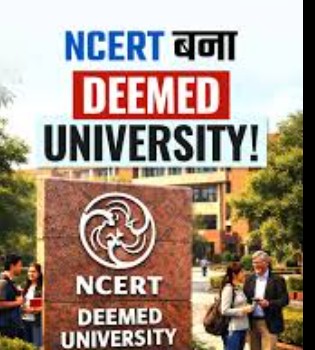
The National Council of Educational Research and Training (NCERT) has officially been granted the status of an Institution Deemed to be University under a distinct category, marking a major change in the role and scope of one of India’s most important education institutions.
The Union Ministry of Education has reiterated the grant of deemed-university status, confirming a decision that was formally notified in March 2026 following consideration of the University Grants Commission (UGC) recommendations.
The move gives NCERT a significantly broader academic mandate. The institution can now develop and conduct research programmes, doctoral programmes and innovative academic programmes, moving beyond its traditional role in curriculum development, textbook preparation and school-education research.
But the change has also reopened an important debate:
Can NCERT expand its academic role without weakening its autonomy as the country’s leading institution for school education?
What Exactly Has Changed for NCERT?
NCERT was established in 1961 as an autonomous organisation under the Union government to assist and advise governments on policies and programmes for improving school education.
Its responsibilities have traditionally included:
- Developing model school textbooks
- Supporting curriculum development
- Conducting educational research
- Developing supplementary learning materials
- Providing teacher education
- Advising governments on school-education policies
- Promoting innovative practices in education
The deemed-university status adds another dimension to this mandate.
NCERT can now undertake a wider range of higher-education activities, including doctoral and innovative academic programmes, under the applicable regulatory framework.
This represents a structural shift from an institution primarily focused on school education towards one that can also operate as an academic and research institution.
Six NCERT Institutions Included Under the New Status
The new status is not restricted to NCERT’s headquarters in New Delhi.
It covers NCERT along with six constituent institutions, including the Regional Institutes of Education (RIEs) in:
- Ajmer
- Bhopal
- Bhubaneswar
- Mysuru
- Shillong
The framework also includes the Pandit Sunderlal Sharma Central Institute of Vocational Education (PSSCIVE), Bhopal.
The inclusion of these institutions gives the new university structure a nationwide footprint and could strengthen NCERT’s role in teacher education and educational research.
Why Was NCERT Given Deemed University Status?
The decision follows a process that began several years ago.
According to the notification-related information, NCERT applied through the UGC portal for deemed-university status under the distinct category.
A Letter of Intent was issued in August 2023, following which NCERT submitted its compliance report in November 2025. The UGC expert committee considered the compliance and the matter was subsequently approved by the Commission at its meeting on January 30, 2026.
The Union Education Ministry then issued the formal notification on March 30, 2026.
The process therefore predates the latest public confirmation and reflects a multi-stage institutional and regulatory review.
What Can NCERT Do Under the New Status?
The most immediate change is the expansion of NCERT’s academic mandate.
Doctoral Programmes
NCERT can develop research-oriented doctoral programmes in areas connected with education and allied fields.
Innovative Academic Programmes
The institution can introduce new academic programmes designed around emerging needs in education.
Expanded Research
The new status can strengthen NCERT’s capacity to conduct structured higher-education research.
Greater Academic Scope
NCERT can operate with a broader university-level academic mandate while continuing its work in school education.
This could create a closer connection between educational research, teacher preparation and school-system reform.
Why the Move Could Strengthen Educational Research
India’s school-education system faces complex challenges involving curriculum, assessment, teacher preparation, learning outcomes, technology and inclusion.
A university-level research ecosystem within NCERT could potentially provide a stronger institutional base for studying these issues.
For example, researchers could examine:
Curriculum → Classroom practice → Teacher preparation → Assessment → Learning outcomes
The findings could then feed back into school-education policy and curriculum development.
This is potentially one of the strongest arguments for the new status.
NCERT already has extensive expertise in school education. Giving it greater capacity to conduct advanced academic research could connect that expertise with doctoral-level scholarship.
The Autonomy Question: Why Experts Are Concerned
The expansion of NCERT’s mandate has also generated concerns about institutional autonomy.
The issue is not whether NCERT should conduct more research.
The central question is under whose regulatory framework that research and academic activity will operate.
NCERT was created as an autonomous organisation with a specific national role in school education.
The transition into the deemed-university framework brings it under the regulatory ambit of the UGC. The 2026 notification itself places NCERT under Section 3 of the UGC Act, 1956.
Some faculty members had previously expressed concerns that this could potentially dilute NCERT’s academic autonomy.
An earlier internal objection, reported by The Indian Express, argued that bringing NCERT under the deemed-university framework could amount to surrendering part of its academic autonomy to the UGC.
Why NCERT’s Autonomy Matters
NCERT is not simply another higher-education institution.
Its work influences the education of millions of school students through:
- Textbooks
- Curriculum frameworks
- Teacher-training resources
- Educational research
- Assessment-related work
- Policy advice
- Learning materials
Because of this, decisions made within NCERT can have effects far beyond university campuses.
Its autonomy therefore has a direct relationship with the credibility and independence of school-education research and curriculum development.
Does Deemed University Status Mean NCERT Will Stop Making Textbooks?
No.
The new status does not eliminate NCERT’s existing responsibilities in school education.
NCERT will continue its established work in areas such as educational research, curriculum support and development of learning resources.
The change instead gives the institution an additional academic role.
The challenge will be to ensure that the new university functions complement, rather than overshadow, NCERT’s traditional national responsibilities.
Will NCERT Be Able to Award Degrees?
The deemed-university framework enables an institution to conduct recognised higher-education programmes and award degrees in accordance with applicable regulations.
This means NCERT’s academic activities can extend beyond research reports, training programmes and school-education materials.
Its six constituent institutions could also become important centres for teacher education and specialised academic programmes within the new framework.
The exact programmes, admissions and academic structures will depend on the regulations and approvals governing implementation.
A Potential Boost for Teacher Education
One particularly important area is teacher education.
NCERT’s Regional Institutes of Education already have long-standing roles in teacher preparation and educational research.
The new structure could strengthen opportunities for advanced research in:
- Teacher education
- Educational psychology
- Curriculum studies
- Assessment
- Inclusive education
- Educational technology
- School leadership
- Vocational education
This could help create a stronger pipeline between educational research and classroom practice.
NCERT and the Future of Educational Research
The new status comes at a time when India’s education system is undergoing major changes.
The National Education Policy 2020 has encouraged multidisciplinary learning, research, teacher development, competency-based education and greater use of technology.
NCERT is already central to implementing many of these reforms.
A stronger research-oriented structure could help the institution evaluate what works in classrooms and what does not.
For example, research could examine whether new curriculum approaches actually improve:
- Conceptual understanding
- Critical thinking
- Foundational learning
- Teacher effectiveness
- Student engagement
- Assessment quality
The long-term value of the university status will therefore depend heavily on the quality and independence of the research it produces.
The UGC Connection: What It Means
The University Grants Commission plays a central regulatory role in India’s higher-education system.
NCERT’s new status brings its university-level activities within the relevant UGC framework.
This can provide:
Standardisation:
Academic programmes can operate within recognised higher-education norms.
Quality assurance:
Research and academic programmes can be subject to applicable regulatory and accreditation requirements.
Degree recognition:
University-level qualifications can operate within the established higher-education framework.
But regulation also creates the autonomy question.
The key policy challenge is finding the right balance between national academic standards and NCERT’s specialised institutional mandate.
NCERT’s New Role Could Create a Bridge Between School and University Research
One of the most interesting possibilities is that NCERT could become a stronger bridge between India’s school and higher-education systems.
Traditional university research sometimes remains distant from classroom realities.
NCERT, by contrast, works directly on school education.
A university-level research structure within NCERT could connect:
Research → Teacher Education → Curriculum → Classroom → Assessment → Policy
If that connection works effectively, the new status could have a wider impact on India’s education system.
What Are the Risks?
The new status also creates several challenges that will need careful management.
Risk 1: Mission Diversion
NCERT could potentially devote increasing attention to university-level programmes while its core school-education responsibilities remain demanding.
Risk 2: Regulatory Complexity
The institution will have to navigate the requirements associated with its new higher-education status while continuing its existing national functions.
Risk 3: Autonomy Concerns
Greater regulatory oversight could raise questions about academic independence and institutional decision-making.
Risk 4: Resource Allocation
Research, doctoral programmes and new academic activities will require faculty, infrastructure and funding.
Risk 5: Conflicting Priorities
NCERT will need to ensure that its new academic role complements rather than competes with its responsibility for school education.
What Students and Teachers Could Gain
If implemented well, the change could eventually create new opportunities for both students and educators.
For Students
- New research-oriented academic programmes
- Doctoral opportunities
- Specialised education courses
- Greater exposure to educational research
For Teachers
- Advanced professional development
- Research opportunities
- Higher academic qualifications
- Greater engagement with evidence-based educational practices
For the School System
- Better educational research
- Stronger teacher preparation
- Evidence-based curriculum development
- Improved understanding of classroom challenges
NCERT Deemed University Status: Key Facts
| Key Point | Details |
|---|---|
| Institution | National Council of Educational Research and Training |
| New status | Institution Deemed to be University |
| Category | Distinct category |
| Legal framework | Section 3, UGC Act, 1956 |
| Formal notification | March 30, 2026 |
| UGC approval | January 30, 2026 |
| Letter of Intent | August 2023 |
| Compliance report | November 2025 |
| Constituent units | Six |
| New academic scope | Research, doctoral and innovative programmes |
| Existing core role | School education, curriculum, textbooks and research |
The institutional timeline and constituent units are based on the Ministry notification-related reporting and the earlier explanation of the UGC approval process.
The Bigger Question: What Should NCERT Become?
The debate around NCERT’s new status is ultimately about institutional identity.
Should NCERT remain primarily India’s apex school-education research and curriculum institution, or should it evolve into a broader academic university while retaining its existing responsibilities?
The new framework appears designed to pursue both objectives.
That makes implementation especially important.
NCERT’s strength lies in its specialised knowledge of school education. Its new university status should ideally use that expertise to build a stronger research and teacher-education ecosystem rather than turning the institution into a conventional university disconnected from its original purpose.