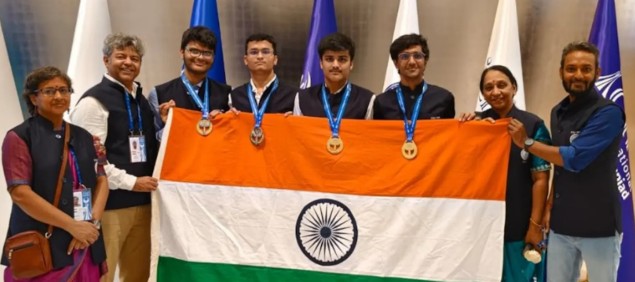
India has achieved a historic milestone in global science competitions by winning four gold medals at the 58th International Chemistry Olympiad (IChO) 2026, held in Tashkent, Uzbekistan, from July 10 to 19. With every member of the Indian team securing a gold medal, the country registered its best-ever performance in the prestigious competition and shared the joint first position globally alongside China, Vietnam, and an individual participant from Russia.
The achievement marks a landmark moment in India’s scientific journey and comes amid an extraordinary year in which Indian students have also excelled in international Mathematics, Physics, and Biology Olympiads.
India’s Gold Medal Winners
The four-member Indian team delivered a flawless performance, with all participants winning gold medals.
Gold Medalists
- Kabeer Chhillar (Haryana) – JEE Advanced 2026 AIR 2
- Debadatta Priyadarshi (Odisha)
- Harshit Singhal (Punjab)
- A fourth team member also secured a gold medal, completing India’s perfect medal tally.
The success of students from diverse regions reflects the depth of scientific talent emerging across the country.
A Historic Achievement for India
The International Chemistry Olympiad is one of the world’s toughest competitions for secondary school students, testing participants through advanced theoretical and laboratory examinations.
India’s four-gold sweep represents its strongest performance since joining the Olympiad programme. More significantly, the country finished among the world’s top performers, reinforcing India’s rising status in global STEM education.
The competition attracted 363 students from 93 countries, making the achievement even more significant.
Chemistry: The Foundation of Modern Innovation
Chemistry lies at the heart of many modern technologies, from pharmaceuticals and biotechnology to renewable energy, semiconductors, and materials science.
The concepts explored in Olympiads often extend beyond school-level learning. For example, understanding molecular structures and chemical bonding forms the basis of advanced scientific research.
The Role of HBCSE and India’s Olympiad Ecosystem
India’s success in international Olympiads is supported by a rigorous talent identification and training system coordinated by the Homi Bhabha Centre for Science Education (HBCSE) under the Tata Institute of Fundamental Research (TIFR).
Students progress through multiple stages of national examinations before receiving advanced training in theory and laboratory skills.
The process includes:
- National-level chemistry examinations
- Selection camps
- Intensive laboratory training
- Mentoring by experienced scientists
- Pre-departure international preparation camps
This structured ecosystem has played a key role in India’s consistent success in global competitions.
India’s Golden Year in Science Olympiads
The Chemistry Olympiad success adds to an exceptional run for Indian students in 2026.
India’s Recent International Olympiad Achievements
| Olympiad | Performance |
|---|---|
| International Chemistry Olympiad | 4 Gold |
| International Mathematics Olympiad | 2 Gold, 4 Silver |
| International Biology Olympiad | 1 Gold, 3 Silver |
| International Physics Olympiad | Multiple medals |
These achievements underline India’s growing strength in mathematics, chemistry, biology, and physics education.
Why Olympiad Success Matters
International Olympiads are not merely competitions; they help identify future scientists, innovators, and technology leaders.
Many former Olympiad participants go on to become:
- Researchers
- Chemists
- Engineers
- Biotechnologists
- Artificial Intelligence experts
- Faculty members at leading institutions
- Entrepreneurs
India’s strong performances reflect the country’s increasing focus on research, innovation, and knowledge-driven growth.