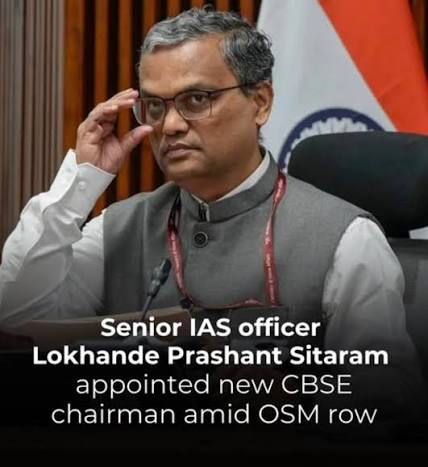
The Central Government has appointed Lokhande Prashant Sitaram, a senior Indian Administrative Service (IAS) officer, as the Chairperson of the Central Board of Secondary Education (CBSE). The appointment, approved by the Appointments Committee of the Cabinet (ACC), comes as part of a leadership reshuffle aimed at ensuring continuity in the functioning of India’s largest school education board. He will hold the position on an additional charge basis while continuing as Additional Secretary in the Ministry of Home Affairs, until a regular chairperson is appointed or further orders are issued.
The leadership transition comes at an important juncture for CBSE, which has been implementing major reforms in examinations, digital evaluation systems, competency-based learning, and technology-driven education.
Key Highlights
- Lokhande Prashant Sitaram appointed as CBSE Chairperson on an additional charge basis.
- He is a 2001-batch AGMUT cadre IAS officer.
- He will simultaneously serve as Additional Secretary in the Ministry of Home Affairs.
- The appointment has been approved by the Appointments Committee of the Cabinet (ACC).
- He succeeds Rahul Singh, who has been transferred to the Department of Agriculture and Farmers Welfare.
- The arrangement will remain in place until a regular CBSE Chairperson is appointed.
Who Is Lokhande Prashant Sitaram?
Lokhande Prashant Sitaram is a 2001-batch IAS officer of the AGMUT (Arunachal Pradesh, Goa, Mizoram and Union Territories) cadre with extensive administrative experience across governance, public administration, and policy implementation.
His educational background reflects a blend of engineering and management. He holds:
- Bachelor of Engineering (Mechanical Engineering)
- Post Graduate Diploma in Industrial Engineering from the former National Institute of Industrial Engineering (NITIE), now IIM Mumbai
His technical and managerial expertise is expected to support CBSE’s ongoing digital and academic reforms.
Why This Appointment Matters
CBSE is not merely an examination board—it shapes school education for millions of students in India and abroad.
The board is responsible for:
- Conducting Class 10 and Class 12 Board Examinations
- Developing academic policies
- Designing curriculum and assessment frameworks
- Affiliation of schools
- Teacher capacity building
- Skill education initiatives
- Implementation of competency-based learning
- Digital examination reforms
A leadership change therefore carries significance not only for administration but also for the future direction of India’s school education system.
Leadership Change Amid Continuing Reforms
The appointment comes during a period of significant transformation within CBSE.
Over the past few years, the board has introduced several reforms, including:
Competency-Based Assessment
Greater emphasis on analytical thinking, application-based questions, and conceptual understanding rather than rote memorisation.
Digital Evaluation
Expansion of digital assessment processes aimed at improving efficiency, transparency, and timely declaration of results.
Technology Integration
Promotion of Artificial Intelligence, coding, digital literacy, cybersecurity awareness, and emerging technologies in school education.
Skill-Based Learning
Greater focus on vocational education, entrepreneurship, and industry-relevant competencies.
The new leadership will oversee the continued implementation of these reforms while addressing operational challenges.
Strengthening Digital Education
India’s education ecosystem is rapidly embracing digital transformation.
CBSE has increasingly encouraged schools to adopt:
- Smart classrooms
- AI-based learning resources
- Digital laboratories
- Coding education
- Online teacher training
- Cyber safety awareness
- Digital assessment tools
With a Chairperson who possesses both engineering and administrative expertise, stakeholders expect greater momentum in technology-enabled education.
Focus Areas Likely Under the New Leadership
Education experts believe the coming years will require sustained attention in several key areas.
Examination Reforms
Making assessments more transparent, student-friendly, and competency-oriented.
AI and Emerging Technologies
Supporting implementation of AI education and digital literacy initiatives in schools.
Teacher Development
Strengthening professional development programmes to improve classroom practices.
Student Well-being
Balancing academic excellence with mental health, life skills, and holistic development.
Inclusive Education
Ensuring equitable access to quality education across urban and rural schools.
Challenges Before the New Chairperson
Leading CBSE involves managing one of the world’s largest school education systems.
Some immediate priorities include:
- Ensuring smooth conduct of board examinations.
- Enhancing the reliability of digital evaluation systems.
- Supporting implementation of the National Education Policy (NEP) 2020.
- Expanding competency-based learning.
- Strengthening cybersecurity and digital infrastructure.
- Maintaining transparency in examination processes.
- Improving stakeholder communication.
Addressing these priorities will be central to maintaining public confidence in the board.