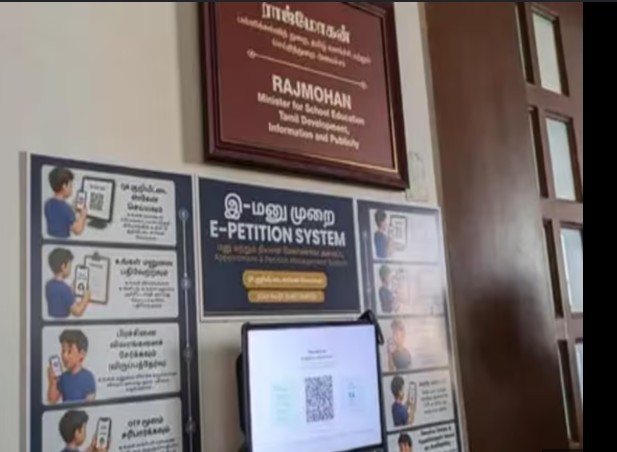
In a significant move to modernise public service delivery, the Tamil Nadu School Education Department has introduced a QR code-based electronic petition (e-petition) system, enabling citizens to submit grievances digitally instead of relying on traditional paper-based applications.
Launched by School Education Minister Anbil Mahesh Poyyamozhi at his office in the State Secretariat, the initiative is designed to make grievance redressal faster, more transparent, accessible and environmentally sustainable. By combining digital submissions with a token-based appointment system, the department aims to improve citizen experience while streamlining administrative processes.
The initiative reflects Tamil Nadu’s broader push towards e-governance, where technology is increasingly being used to simplify interactions between citizens and government departments.
What Is the New QR Code-Based E-Petition System?
The newly launched platform allows visitors seeking appointments with the School Education Minister to submit their grievances electronically by simply scanning a QR code displayed outside the minister’s office.
Once scanned, users are directed to an online portal where they can:
- Enter personal details.
- Upload digital copies of petitions.
- Scan and upload physical documents.
- Provide a brief description of their grievance.
- Upload an optional voice recording explaining the issue.
The digital workflow replaces conventional paper submissions with a unified online process, making grievance registration quicker and easier for both citizens and government officials.
How the System Works
The new mechanism has been designed to make the grievance submission process simple and user-friendly.
Step 1: Scan the QR Code
Visitors scan the QR code displayed outside the minister’s office using their smartphone.
Step 2: Register Online
Applicants enter their basic information and upload their petition along with supporting documents.
Step 3: Add Additional Details
Users may include a short written explanation or upload a voice note describing their grievance. These features are optional but intended to help officials better understand individual concerns.
Step 4: Receive a Digital Token
After successful registration, applicants receive a token number and an appointment slot based on the minister’s availability during grievance redressal sessions.
This integrated approach reduces waiting time while ensuring that petitions are systematically recorded and tracked.
Why the Initiative Matters
Public grievance systems often face challenges such as lengthy queues, paperwork, delayed processing and limited tracking mechanisms.
The QR code-based platform addresses these concerns by introducing:
Paperless Administration
Digital submission reduces dependence on physical documents, supporting environmentally sustainable governance.
Greater Transparency
Electronic registration creates a digital record of every petition, improving accountability and enabling easier tracking.
Faster Processing
Officials can access petitions immediately after submission, reducing delays in registration and forwarding.
Improved Citizen Experience
The token-based visitor management system minimises overcrowding and long waiting hours at government offices.
A Step Towards Smarter Governance
The launch reflects the growing adoption of digital governance solutions across Indian states.
QR codes have increasingly become part of public service delivery in sectors such as:
- Healthcare
- Revenue administration
- Transport services
- Education
- Public grievance management
By extending this technology to grievance redressal, the School Education Department aims to make government services more responsive and citizen-friendly.
Experts believe such initiatives can significantly improve administrative efficiency while reducing operational costs associated with manual record management.
Benefits for Parents, Teachers and Students
Although the e-petition system is introduced at the minister’s office, it is expected to benefit a wide range of education stakeholders.
Parents
Parents can submit concerns related to school infrastructure, admissions, student welfare or administrative issues through a structured digital process.
Teachers
Teachers visiting the Secretariat for official matters can avoid carrying extensive paperwork and receive organised appointment schedules.
Students
Student-related grievances can be documented more efficiently, helping authorities process issues systematically.
Education Administrators
Digital records improve coordination, monitoring and follow-up, making grievance handling more transparent.
Technology Meets Public Service
One of the notable features of the platform is its emphasis on accessibility.
Instead of requiring complex registration procedures, the system relies on a simple QR code that can be scanned using most smartphones.
Additional features such as:
- Document uploads
- Voice note submissions
- Digital acknowledgements
- Appointment scheduling
demonstrate how relatively simple technologies can significantly improve citizen-government interaction.
Could This Become a Model for Other Departments?
Government officials believe the initiative has the potential to serve as a model for other departments seeking to modernise public service delivery.
If successfully implemented, similar QR code-enabled grievance systems could eventually be adopted across sectors such as:
- Higher Education
- Municipal Administration
- Social Welfare
- Rural Development
- Public Health
- Revenue Services
Such expansion would further strengthen Tamil Nadu’s ongoing digital governance initiatives.
Challenges That Need Attention
While the initiative marks an important step towards digital transformation, its long-term success will depend on several factors.
Digital Accessibility
Citizens without smartphones or internet access may still require assisted or offline grievance submission options.
Timely Resolution
Technology can simplify registration, but effective grievance redressal ultimately depends on prompt administrative action.
Data Security
As petitions contain personal information, maintaining cybersecurity and protecting citizen data will remain essential.
Digital Awareness
Public awareness campaigns may be needed to ensure that citizens understand how to use the new platform effectively.
The Bigger Picture
The introduction of a QR code-based e-petition system demonstrates how digital technologies are gradually reshaping governance in India’s education sector.
Rather than viewing technology solely as a classroom tool, governments are increasingly integrating digital solutions into administrative processes that directly affect parents, teachers, students and citizens.
As education departments continue adopting technology-driven governance models, initiatives such as this have the potential to improve service delivery, reduce bureaucracy and strengthen public trust through greater transparency and accountability.