In a significant shift in India’s education landscape, the Central Board of Secondary Education is gradually integrating computational thinking (CT) and artificial intelligence (AI) into everyday classroom learning. Rather than treating AI as a standalone subject, the approach focuses on embedding these skills across disciplines, marking a move away from rote memorisation toward problem-solving, logical reasoning, and real-world application.
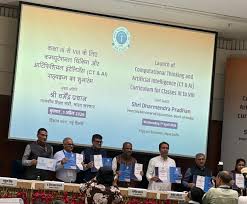
The curriculum on Computational Thinking & Artificial Intelligence was released on April 1, 2026, by Dharmendra Pradhan, Education Minister, Union Government, for CBSE students between Classes 3–8. The inclusion of this curriculum will equip students with skills such as logical reasoning, problem solving, and identification of patterns.
This step aligns closely with the vision of the National Education Policy 2020, which emphasises skill-based and multidisciplinary learning.
What Makes This Approach ‘Measured’ and Practical
CBSE’s strategy is being described as “measured” because it avoids overwhelming students with technical complexity at an early stage. Instead, it introduces AI and computational thinking in a gradual, age-appropriate, and activity-based manner.
- Focus on conceptual understanding rather than coding-heavy learning
- Integration into subjects like mathematics, science, and even language
- Emphasis on offline activities, projects, and experiential learning
- Reduced dependency on screens to ensure balanced development
This ensures that students understand how to think, not just how to use technology.
Understanding Computational Thinking in Education
At its core, computational thinking is a way of solving problems systematically. It includes skills such as:
- Breaking complex problems into smaller parts (decomposition)
- Identifying patterns and trends
- Designing step-by-step solutions (algorithms)
- Using logic and abstraction
These skills are not limited to computer science—they are life skills applicable across subjects and real-world situations.
AI Moves Beyond Computer Labs into Everyday Learning
Traditionally, AI and coding were restricted to computer labs or optional subjects. CBSE’s new framework changes this by embedding AI concepts into daily classroom activities and teaching methods.
Students from early classes will be introduced to:
- Basic data literacy and logical reasoning
- Ethical use of AI technologies
- Real-life applications of AI in daily life
- Critical thinking through AI-assisted learning
The aim is to make AI a tool for learning rather than just a topic to study.
Benefits for Students: Building Future-Ready Skills
This integration is expected to have far-reaching benefits for students:
- Development of critical thinking and analytical skills
- Early exposure to emerging technologies like AI and machine learning
- Better preparation for future careers in a tech-driven economy
- Improved ability to solve real-world problems
Experts believe that introducing these concepts early can significantly enhance creativity, collaboration, and decision-making abilities.
Challenges: Teacher Readiness and Digital Divide
While the initiative is forward-looking, it also presents challenges:
- Teachers need extensive training to effectively deliver AI-integrated lessons
- Schools in rural or under-resourced areas may face infrastructure limitations
- Risk of over-reliance on AI tools impacting independent thinking
Studies also caution that AI must be used carefully to ensure it enhances learning without reducing critical thinking abilities.
A Paradigm Shift in Indian Education
The integration of computational thinking and AI signals a broader transformation in India’s education system. It reflects a shift from:
- Memorisation → Conceptual understanding
- Theory → Practical application
- Subject-based learning → Interdisciplinary learning
By embedding these skills early, CBSE aims to prepare students not just for exams, but for lifelong learning and future challenges.