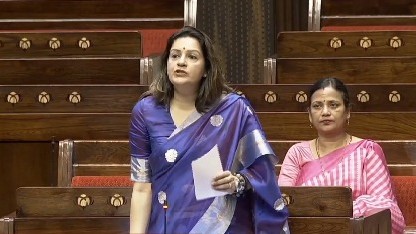
The ongoing controversy surrounding an NCERT Class 8 social science textbook chapter on “corruption in the judiciary” has sparked debate across political and academic circles. During a discussion in Parliament, Rajya Sabha MP Priyanka Chaturvedi stated that all three pillars of democracy—legislature, executive, and judiciary—must remain accountable and open to public scrutiny.
Her remarks came after the Supreme Court issued strong directions regarding the textbook and individuals involved in preparing the content, triggering discussions about judicial oversight and academic freedom.
What the Rajya Sabha MP Said
During Zero Hour in Parliament, Chaturvedi emphasised the importance of checks and balances among democratic institutions.
Key statements made in Parliament
- All three branches of governance should be equal before the law.
- Each branch must remain accountable and open to scrutiny.
- Any sense of supremacy by one institution could create governance challenges.
She argued that democracy functions best when institutional accountability and transparency are maintained.
Concerns Over ‘Judicial Overreach’
The MP also criticised certain court directions related to the textbook controversy, describing them as an example of judicial overreach.
According to her remarks:
- The Supreme Court’s order suggested that academics involved in writing the controversial chapter should not participate in academic or public-funded institutional work.
- She argued that such directions could potentially interfere with academic independence and intellectual debate.
The issue has therefore sparked wider discussions about the balance between judicial authority and academic freedom.
Background of the NCERT Textbook Controversy
The controversy began after a Class 8 social science textbook released by NCERT included references to corruption within the judiciary.
The Supreme Court took serious note of the content and issued several directions:
- The court ordered that copies of the controversial chapter be withdrawn.
- It directed a review of the school curriculum.
- Three individuals associated with the chapter were asked to step away from work related to government-funded institutions.
Following the backlash, NCERT issued an unconditional apology and withdrew the textbook.
Debate Over Academic Freedom and Institutional Accountability
The incident has sparked a broader national conversation involving:
- Judicial accountability
- Academic freedom in curriculum design
- Government oversight of educational institutions
Legal experts, educators, and policymakers have expressed differing opinions about whether the court’s intervention was necessary or excessive.
Many believe the episode reflects the sensitive balance between protecting institutional credibility and encouraging open academic discourse.
Government Response and Curriculum Review
Following the controversy, the government informed the court that NCERT would review school textbooks across classes to ensure accuracy and sensitivity in educational content.
Key steps include:
- Formation of an expert committee to review curriculum material
- Re-evaluation of textbook content across subjects
- Strengthening academic oversight in textbook development
The review process aims to maintain balanced, factual and responsible educational material in schools.