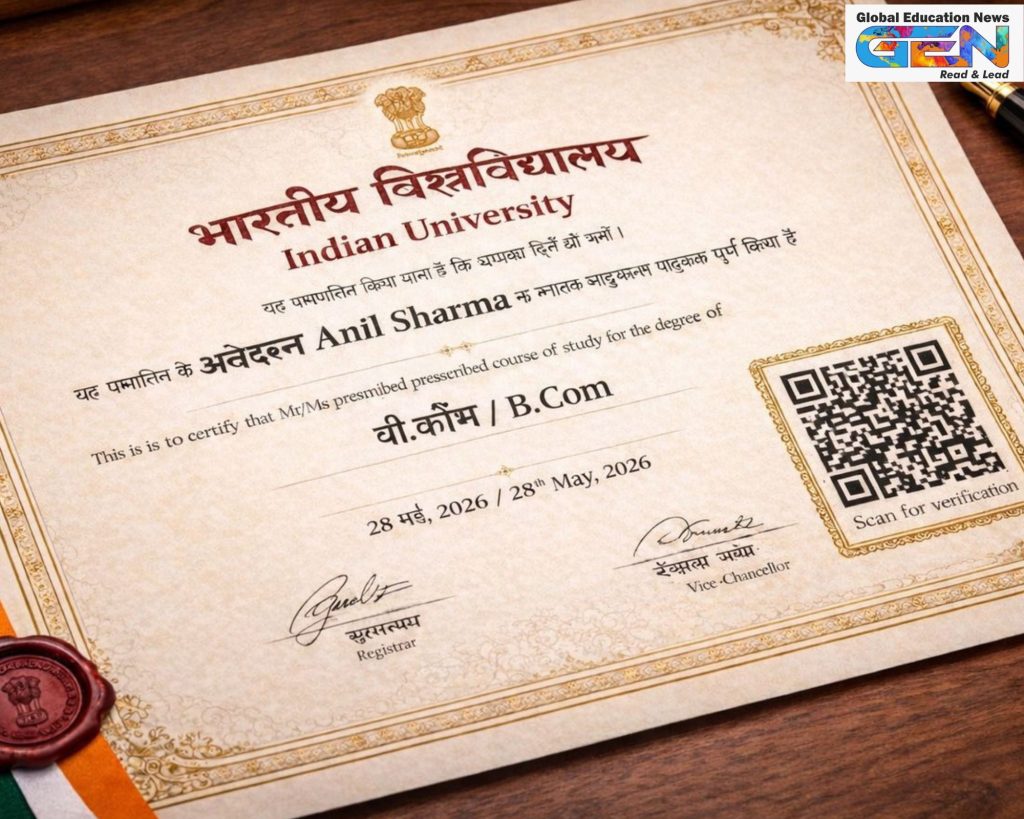
As of December 27, 2025, Rajasthan has taken a decisive step toward fortifying academic integrity with the Rajasthan Public Service Commission (RPSC)’s mandate for QR codes on all university-issued degrees, diplomas, mark sheets, and migration certificates. Announced on December 26 and approved by the state government in September, this policy targets the scourge of forged documents plaguing recruitments, where suspicious credentials often delay processes by weeks. In a state hosting over 80 universities and issuing 2 lakh+ degrees annually, the initiative promises one-click authentication against original records, aligning with the National Education Policy (NEP) 2020’s emphasis on credible credentials. By empowering agencies like RPSC and private recruiters to bypass manual checks, it could slash verification times by 80%, per official estimates. This analysis dissects the policy’s origins, mechanics, advantages, potential hurdles, and broader implications, highlighting its role in a national push against academic fraud amid rising job market scrutiny.
Background: Forged Degrees as a Recruitment Roadblock in Rajasthan
Rajasthan’s higher education sector, encompassing 40+ government universities and 50 private ones, faces chronic issues with credential tampering—fake degrees surfaced in 15-20% of 2025 RPSC exams, per internal audits. Manual verification, reliant on postal requests to universities, averages 15-30 days, stalling hires and eroding trust.
- Policy Catalyst: RPSC’s proposal, greenlit in September 2025, responds to a 25% uptick in fraud cases since 2023, fueled by online forgery rings and AI-altered marksheets.
- National Echoes: Mirrors UGC’s 2023 guidelines for digital degrees and Andhra Pradesh’s 2024 QR pilots, but Rajasthan’s scale—covering 1.5 million alumni—sets a precedent.
- Stakeholder Context: Affects students (90% govt/private uni enrollees), recruiters (RPSC processes 5 lakh applications/year), and universities (e.g., Rajasthan University, UNIPOD), amid NEP’s digital credentialing thrust.
This backdrop underscores the mandate as a proactive shield, not reactive fix, in an ecosystem where 10% of job rejections stem from unverified quals.
Core Provisions: From Mandate to Mechanics of QR Integration
The December 26 notification, issued by RPSC Chairman Bhanwar Lal Sharma, imposes uniform requirements on all state universities, with phased compliance to ease adoption.
Key elements include:
- Document Scope: Mandatory QR codes on degrees, diplomas, mark sheets, and migration certificates—issued post-September 2025; legacy docs encouraged for retrofitting.
- Tech Framework: QR links to a centralized university database (via NAD—National Academic Depository), enabling instant scans via apps like DigiLocker or RPSC’s portal.
- Implementation Timeline: Universities integrate by January 31, 2026; RPSC audits quarterly, with non-compliance risking affiliation penalties.
- Verification Process: Recruiters scan QR for real-time match against NAD records—name, roll number, grades—flagging discrepancies instantly.
| Aspect | Requirement | Enforcement | Tech Integration |
|---|---|---|---|
| QR Placement | Embedded on printed/digital certs | Universities self-certify | NAD API linkage; blockchain optional for tamper-proofing |
| Scan Functionality | One-click to original records | Free public app | Compatible with Android/iOS; offline cache for rural access |
| Retrofit Option | Voluntary for pre-2025 docs | Subsidized stickers (₹10-20/doc) | Pilot in 10 unis by Feb 2026 |
| Data Security | Encrypted, consent-based access | UGC-compliant privacy | Annual audits; breach fines up to ₹1 crore |
These provisions ensure robustness, with RPSC piloting in its own recruitments from Q1 2026.
Rationale and Benefits: Curbing Fraud, Accelerating Access
The policy’s intellectual core: Streamline a bottleneck where 30% of Rajasthan’s govt jobs (e.g., RAS, teachers) face verification delays, costing ₹500 crore annually in lost productivity.
- Anti-Fraud Arsenal: QR tech detects alterations in 95% cases vs. 60% manual; aligns with UAPA’s anti-forgery clauses for severe penalties.
- Efficiency Gains: Reduces processing from 20 days to seconds; RPSC projects 40% faster hires, aiding 1 lakh annual placements.
- Broader Wins: Boosts employability trust—foreign unis/employers favor verifiable creds; empowers marginalized students (70% from rural unis) against scams.
- Official Endorsement: A senior RPSC official noted: “This will expedite the recruitment process… verification with a single click.” Another affirmed: “Degrees… will mandatorily bear a QR code,” signaling zero tolerance.
Quantitatively, it could cut fraud losses (₹200 crore/year) by 50%, per state estimates.
Challenges and Mitigation: From Tech Gaps to Adoption Hurdles
While innovative, the rollout confronts Rajasthan’s digital divides—40% rural unis lack robust servers—and resistance from legacy systems.
- Infrastructure Barriers: Small private unis (50% of total) may struggle with QR embedding; mitigated by state grants (₹50 crore fund) and training for 5,000 admins.
- Privacy Risks: Data breaches; countered by NAD’s ISO 27001 standards and opt-out clauses.
- Equity Concerns: Urban bias in app access; addressed via SMS-based verification for non-smartphone users (30% rural youth).
- Scalability Test: Initial pilots in Jaipur/Mount Abu unis to refine, with UGC oversight for national scalability.
Stakeholders like the Rajasthan University Vice-Chancellor hail it as “future-proofing,” but call for phased subsidies.
Implications: A Blueprint for National Credential Credibility
Rajasthan’s QR mandate could cascade: UGC eyes similar for 1,000+ unis by 2027, syncing with ABC (Academic Bank of Credits) for seamless transcripts. Economically, it fortifies Rajasthan’s ₹10 lakh crore job market, reducing 5% mismatch losses. Socially, it levels the field for women (60% fraud victims) and SC/ST grads. Globally, it echoes Estonia’s e-degrees, positioning India as a digital education leader—potentially saving ₹1,000 crore in verification costs nationwide.
Yet, without interoperability (e.g., with AICTE), silos persist; 2026 pilots will gauge true traction.